Your Two-Shoe Workweek Needs Less Overlap, Not More Shoes
The useful second pair fixes the first pair’s failure. Score both for wet grip, drying, coverage and trouser compatibility before spending more.
November 24, 2026 · 8 min read
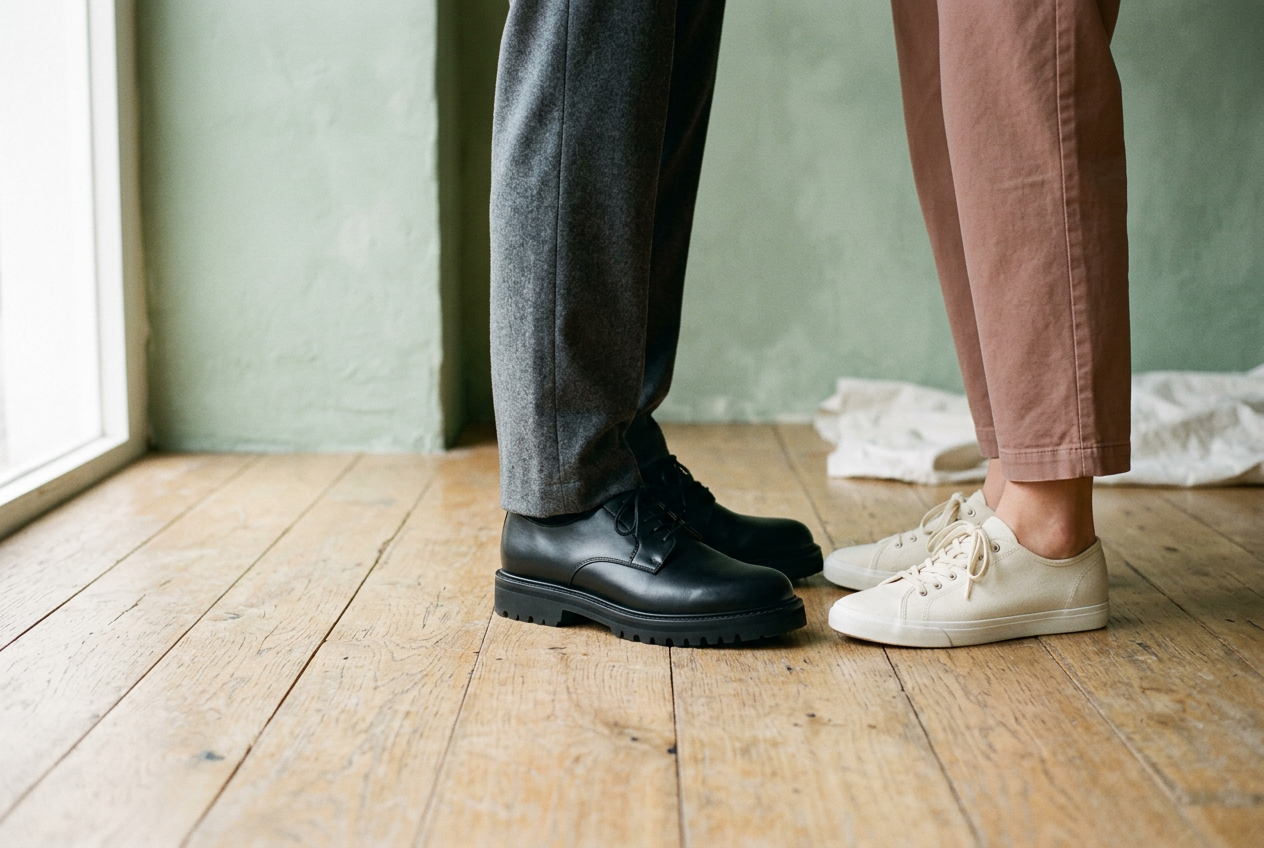
The concrete case here is a black leather derby with a round toe, a rubber lug outsole and enough room for a medium-weight sock. A derby is a dress shoe with open lacing, which gives the instep more room than a closed-lace Oxford. It is our reference pair for an illustrative workweek containing a wet commute, a long walk and one meeting that calls for something sharper than a running shoe.
This is unisex advice. The exact lasts and size labels vary across women’s and men’s departments, but wet pavement, pinched toes and trousers collapsing over a bulky sole do not care which side of the store supplied the shoe.
The point is not that everyone needs a black derby. It is that this particular one has legible strengths and failures: its covered leather upper handles splashes, the tread offers more wet-weather potential than a smooth leather sole, and its visual weight works under straight or full-length trousers. It may be too heavy for an extended walk, slow to dry after saturation and awkward beneath a narrow cropped hem. Those gaps tell us what the second pair must do.
Start with the harder job
Many two-shoe capsules begin with two versions of the dress code: a loafer and a ballet flat, or a derby and a sleeker lace-up. That can be useful if appearance is the only constraint. It becomes expensive redundancy when both pairs have smooth soles, exposed insteps or stiff uppers that make a long commute unpleasant.
Pick the first shoe for the condition that is hardest to negotiate during a normal week. For our reference derby, that condition is rain combined with an office where an overtly technical trail shoe would feel out of place. The upper is full-grain leather, meaning the hide’s outer surface remains intact rather than being sanded away, and it can tolerate routine splashes when maintained with an appropriate conditioner or polish. The lug outsole has raised rubber blocks for traction, although tread depth alone does not guarantee grip because the rubber compound also matters.
Your hardest job may be different. A person who walks an hour each day should start with the walking pair, while someone who changes buildings but rarely goes outside might put formal compatibility first. The mistake is beginning with the most appealing shoe and assigning it practical abilities it does not have.
Give each pair the same four tests
Use a zero-to-two score for each test. Zero means the shoe fails a condition you regularly face, one means it works with a precaution, and two means it can be worn without managing the shoe all day. Do not obsess over the total. A zero in a nonnegotiable category matters more than several easy points elsewhere.
1. Outsole grip
Look beneath the shoe before looking at its profile. A polished leather outsole can be elegant and repairable, but it offers little reassurance on wet paint, tile or smooth station flooring unless a cobbler adds a rubber sole guard. Hard plastic-like sections may wear slowly yet feel slick. Rubber with visible channels has somewhere to move surface water, though shallow fashion treads can fill with grit and still slide.
For shoes you own, try a short damp-pavement walk at a controlled pace rather than staging a hazardous test on a slick indoor floor. Notice whether the heel skates at contact and whether the forefoot holds during push-off. A new shoe that cannot be worn outside before return should be judged from material, tread pattern and flexibility, with the understanding that certainty comes only after use.
Our derby earns two points if its rubber remains secure on the actual commute. It drops to one if the heel slips on station tile, even when the front lugs feel dependable outdoors. That distinction may make a grippier walking shoe more useful than a second dress shoe.
2. Drying time
A shoe is not rain-capable merely because water stays out for ten minutes. It also needs to recover before its next turn in the capsule. After normal wet wear, remove the insole if it is designed to come out, loosen the laces and let the pair dry away from direct heat. Stuffing the toes loosely with plain paper can draw out moisture, but replace the paper once it becomes damp.
Dense leather and padded linings often dry more slowly than unlined shoes. Open mesh releases moisture faster but allows water through immediately, leaving the sock to manage the result. Membranes can block outside water while holding perspiration inside, especially in warm offices. Score the shoe on the condition it reaches by the following morning: dry throughout earns two, wearable with lingering dampness earns one, and still wet enough to require another pair earns zero.
The reference derby should never be forced dry on a radiator, which can harden leather and stress adhesives. If it repeatedly needs more than one night after ordinary rain, rotation is not a luxury. The second shoe must be ready while the first rests.
3. Toe coverage
Coverage includes more than whether the toes are visible. Check the vamp, the part of the upper over the forefoot, along with the tongue opening and the topline around the foot. A closed toe paired with a low-cut side can admit rain from puddle splash, while an open tongue can channel water toward the sock.
Coverage also carries dress-code information. A substantial closed upper usually reads more formal than a ventilated knit, but a blunt waterproof boot may exceed what the outfit needs indoors. Our derby scores well for office polish and routine spray. It does not replace a rain boot for deep standing water, and treating it as one would shorten the useful life of the upper.
4. Trouser compatibility
Try each candidate with the trousers you wear most, not the ideal outfit imagined around the shoe. Stand, sit and walk across a clean indoor floor. A wide outsole can catch a narrow hem; a high instep can push a cropped trouser outward; a long pointed toe may appear exaggerated beneath a short, straight leg. Full-length wide trousers can swallow a delicate flat and drag against the ground when its sole is thinner than the shoe used for hemming.
The round-toe derby works best here with straight or moderately wide trousers that reach near the top of the shoe. Under a sharply tapered ankle, its lugged edge becomes the loudest part of the outfit. That earns two points for one trouser group and perhaps zero for another, which is why trouser compatibility should be scored against actual work clothes rather than treated as a property the shoe possesses on its own.
Make the second pair change the week
Now apply the reference derby to a worked week. It covers the wet Monday commute and Tuesday meeting. On Wednesday, a long cross-town walk exposes its weight and firm forefoot. Thursday requires cropped tailored trousers that look clumsy against the lugged sole.
The derby can return on Friday after it has dried and aired.
A low-profile walking sneaker with a rubber outsole, covered toe and restrained upper would change Wednesday and Thursday, provided the office accepts it. Its lighter build addresses distance, while a slim sole sits more cleanly under the cropped trouser. That is functional contrast.
A second black derby with a marginally smoother sole would mostly duplicate Monday and Tuesday. Redundancy would help only if the first derby often remains wet overnight, or if wearing the same firm shape on consecutive days causes pressure at the same points. In that case, even two visually similar shoes should differ in last shape, which is the three-dimensional form that determines the shoe’s internal fit. Alternating toe shape and heel hold can spare a tender area.
For a more formal office, the second pair might instead be a refined loafer with a thin rubber outsole and a less bulky toe. It would improve trouser compatibility and dressiness, but it would not solve the long walk unless its fit and cushioning had already proved capable. The open instep also gives up rain protection. That trade is sensible only when formal range outranks mileage.
Spend on the failure you cannot work around
The reference derby deserves more of the budget when wet-weather construction, sole replacement and durable leather matter every week. Inspect where the upper meets the sole, whether the heel feels stable and whether a worn outsole can plausibly be repaired. A stitched sole may support repair, but construction varies and a visible stitch is not a promise that every cobbler can rebuild the shoe.
The second pair need not cost the same. A limited-duty office shoe can sit around the price of a decent sneaker if it fits well and passes its assigned tests. Paying an investment-level price for another attractive shoe with the same slippery sole and slow-drying lining does not strengthen the capsule.
Fit remains the veto. Try shoes later in the day with the sock thickness used for work, then check that the toes can spread without the heel lifting excessively. Leather may soften across a flex point; it will not reliably become longer, and a narrow toe box is not a sensible break-in project.
Run the capsule for one week
Before buying pair two, record which shoe you wore, the weather, the walking time and why you changed out of it. Keep the note practical. “Derby still damp Thursday morning” identifies a rotation problem. “Derby looked heavy with cropped gray trousers” identifies a silhouette problem.
“Forefoot sore after long walk” identifies a comfort problem that another formal shoe may repeat.
At the end of the week, buy for the repeated failure rather than the hypothetical occasion. The black derby stays our anchor: capable in rain, credible at a meeting and imperfect over distance. Its second pair earns a place only by changing one of those outcomes.
Questions people ask
Can two work shoes be enough for a rainy week?
Yes, if at least one pair handles wet surfaces and both can dry between wears. A saturated leather shoe may need longer than one night, so the second pair must be suitable for the next day’s commute rather than reserved for indoor use only. Persistent heavy rain may justify a separate weather boot.
Should both pairs have rubber outsoles?
Not necessarily, but rubber is useful when wet grip appears often in your week. A smooth leather sole can work for mostly indoor, formal use, especially with a professionally fitted rubber sole guard. Test the whole outsole, including the heel, because a secure forefoot does not compensate for a heel that skates on tile.
Is a sneaker always the best second work shoe?
No. It is useful when the first pair fails on walking comfort and the dress code permits a restrained athletic shape. If your first shoe already walks well but looks heavy with tailoring, a slimmer loafer or flat may add more range. The second pair should turn a repeated zero into a dependable score.
How should work shoes fit with trousers before hemming?
Choose the shoe height first when possible. A trouser hem set for a thin flat may drag when worn with a lower-cut shoe, while a hem set over a bulky sneaker can look too short with a sleek loafer. Bring the intended shoes to alterations and walk before approving the length.
One update a day
Today's fashion update, in your inbox
One fashion update each morning — no hype, no filler, just pieces worth wearing.