Unisex Sneaker Sizing Can Leave a Narrow Heel Behind
A length conversion gets you into the right neighborhood, but a unisex last may still be broad through the heel. Here is how to test the fit before the return window closes.
November 20, 2026 · 8 min read
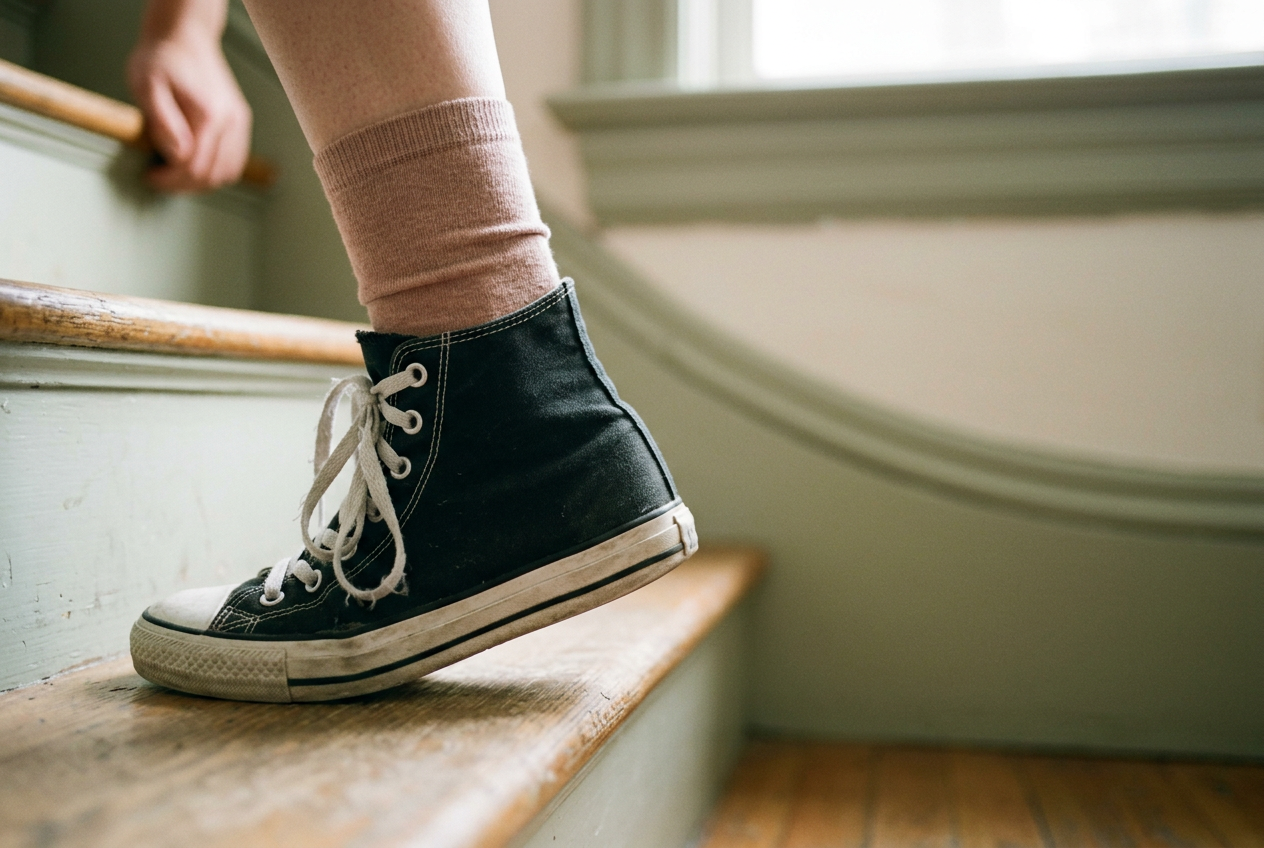
The useful line on a Converse Chuck 70 listing is not the color name. It is the sizing note: the unisex canvas high-top runs large, and Converse advises going down from your usual size. The label also shows separate men’s and women’s numbers, commonly two US sizes apart on Converse unisex shoes.
That looks like enough information to order. It is enough to estimate length. It says much less about whether a narrow heel will stay inside the shoe once the rubber sole stops looking pristine and starts meeting stairs.
This guide is unisex because narrow heels are not restricted to one department, and neither are the sneakers now sold across men’s, women’s and unisex categories. The conversion number may be gendered. The fit problem is geometry.
Conversion is only the first calculation
Start with the chart attached to the exact shoe, not a remembered rule from another brand. Converse commonly pairs its unisex men’s and women’s US sizes with a two-size difference, while Nike’s general footwear guidance commonly uses a one-and-a-half-size conversion between men’s and women’s sizing. That disagreement is not an error. It is the reason a universal conversion shortcut fails.
Match your usual size to the brand’s conversion, then check whether the product page gives model-specific advice. The Chuck 70 note about sizing down matters because converting a familiar women’s size into the corresponding men’s number does not account for that shoe running long. Brand chart first, model note second.
If the brand provides foot-length measurements, compare those too, preferably using the measurement method it specifies. Measure both feet while standing, wearing the socks intended for the sneakers, and use the longer foot. A traced foot can gain length if the pencil leans outward, which is a small administrative betrayal with consequences.
Do not convert through European sizing unless the brand requires it. Moving from a US women’s size to a remembered EU size and back into US men’s sizing adds another chart, and brands do not map every system identically.
The last decides where the room sits
A last, meaning the foot-shaped form used to build a shoe, sets more than overall length. It influences the heel pocket, waist, forefoot width, toe shape and internal volume, so two sneakers marked with equivalent lengths can hold the same foot quite differently.
Some unisex sneakers use geometry close to a traditional men’s standard width; others have a shared last developed for the model, and brands do not always publish which approach they took. New Balance’s public width guidance, for example, labels women’s standard width as B and men’s standard width as D. That is useful evidence that standard width conventions differ, but it does not prove every unisex sneaker is a D-width shoe.
Treat silence as silence. A product being called unisex does not tell you whether the heel was narrowed, whether the forefoot was widened, or whether the grade between sizes changed. Grading is the way a pattern’s dimensions increase or decrease across sizes. The chart can confirm intended length while leaving all those proportions undisclosed.
The Chuck 70 makes the distinction easy to see. Its canvas upper can draw inward under the laces, but the rubber foxing around the lower shoe fixes much of the base shape. Tightening the high-top may secure the ankle while the heel still moves lower down. A snug collar is not automatically a well-held heel.
Run the indoor try-on in the right order
Try the sneakers late enough in the day that your feet have done some ordinary swelling, using the sock thickness you expect to wear. Put on both shoes. Feet are frequently unequal, and the larger one does not volunteer this information on a size chart.
Seat the heel before lacing by tapping it gently back into the shoe. Lace from the bottom upward with even tension rather than hauling only on the top rows. Stand up, spread your toes and check that the forefoot lies flat rather than hanging over the edge of the sole or pressing hard against the upper.
Walk on a clean indoor floor, then use stairs if available. The heel should rise with the shoe rather than lifting first and dropping back on each step. Some movement can occur in a stiff new sneaker, but repeated sliding, sock drag or the need to curl the toes to keep the shoe aboard points to excess volume. Your toes have other work.
Next, watch the laces. If the two sides of the upper are already pulled almost together and the heel still slips, there is little adjustment left. On the Chuck 70, the tall canvas panels can make aggressive tightening look effective because they wrap the ankle; walk again while paying attention specifically to movement at the base of the heel, not pressure above it.
Finish with several direction changes and a slow heel raise. Stop if the little toe is pinched, the arch sits on the edge of the insole, or the heel rubs in one concentrated spot. A shoe that passes only while you stand admiring it has passed a different exam.
Know what lacing can fix
Lacing works best when the shoe is broadly the right shape but has modest extra volume over the instep, which is the raised area on top of the midfoot. It can pull a flexible upper closer to the foot and reduce forward sliding. It cannot redraw a heel pocket that is too broad.
A runner’s loop may help on low-top sneakers with an extra rear eyelet. The technique creates a small loop on each side, then crosses the lace ends through those loops before tightening, increasing hold near the ankle. Use firm tension, not a tourniquet. Numbness, top-of-foot pressure or a tongue that folds sharply means the adjustment has gone too far.
The Chuck 70 high-top is a less tidy candidate for that trick because its regular eyelet run already climbs the ankle. Adjusting the upper rows can improve collar hold, but if the heel still moves after the lower and middle rows are secure, adding more pressure at the top mostly relocates the discomfort.
Alternative lacing patterns can also create space over a high instep or reduce pressure on a sore point. They are fine adjustments. When the eyelet rows nearly meet, the forefoot is being squeezed and the heel remains loose, the last is wrong for the foot.
Inserts help with volume, with limits
A thin tongue pad placed beneath the tongue can take up volume over the instep and push the foot back toward the heel. A heel grip can reduce minor rubbing. Both are inexpensive compared with replacing sneakers, but neither should become structural engineering for a new pair that can still be returned.
Full-length insoles require more caution. A thicker insole raises the foot inside the shoe, which may improve contact at the heel but can also push the toes into the upper, crowd the forefoot and change where the collar hits. If the original insole is removable, compare thickness and shape before swapping it; never assume extra cushioning is free space.
Test any insert indoors with both shoes and the intended socks. If it fixes the heel by making the toes miserable, it has not fixed the fit. It has opened a second complaint.
Do not ask break-in to change the last
Canvas, leather and suede can soften with wear. Foam may compress. None of those changes reliably turns a broad heel pocket into a narrow one, and softer material can make an already loose fit feel looser after the initial stiffness disappears.
This matters with the Chuck 70 because a new canvas high-top may feel secure around the ankle before the upper relaxes. The rubber sole and lower structure will not narrow around the heel because the canvas has become more cooperative. Wear will settle the shoe around the last’s proportions, not revise them.
Ignore advice to keep a painful or unstable pair because it will “mold to the foot” unless the discomfort comes from a clearly identified, softenable pressure point and the retailer’s return terms allow a real trial. Most return policies do not welcome soles carrying evidence from the sidewalk, so perform the decision-making indoors.
Choose the alternative by locating the failure
If the length is correct, the forefoot is comfortable and only the heel is loose, look for the same style in a women’s-specific version, a narrow width, or another model known to have a lower-volume rear. Do not assume the women’s version will always be narrower. Confirm the published width and try it.
If sizing down secures the heel but pushes the longest toe into the front or compresses the ball of the foot, go back up. A smaller size is not a narrow width. It shortens the entire shoe, which is efficient only if the entire foot also became shorter while you were lacing.
For online orders, check the model-specific chart and return conditions before buying two adjacent sizes. Compare them during the same indoor session, with identical socks and lacing tension, because memory is generous to whichever pair has the better color.
The Chuck 70 conversion can get the length close, and its sizing note may move the order down again. The final decision still belongs to the stair test: heel rising with shoe, toes lying flat, and laces retaining enough adjustment to be useful next week.
Questions people ask
Can
I use my usual women’s-to-men’s size conversion for every unisex sneaker?
No. Converse commonly shows a two-size difference between its men’s and women’s US labels, while other brands commonly use one and a half sizes. Use the chart for the exact brand and read the model’s own sizing note, since a shoe that runs long may require another adjustment.
Will thick socks fix a narrow heel in unisex sneakers?
Thicker socks can take up a small amount of space, but they also reduce room around the toes and forefoot. Use them only if they are the socks you plan to wear normally. A winter sock used to rescue a summer sneaker is a seasonal payment plan for discomfort.
Can heel-lock lacing make a wide heel pocket fit?
It can reduce minor movement when the overall last suits your foot and the shoe has suitable eyelets. It cannot narrow the base of the heel pocket. If the upper is pulled nearly closed, the top of the foot feels pressure and the heel still lifts, choose another shape.
Should I size down when my heel slips?
Only if the smaller size preserves toe clearance and forefoot width. Walk, change direction and raise onto the balls of your feet indoors. If the heel improves but the longest toe reaches the front or the little toe presses into the side, restore the length and change width or model instead.
One update a day
Today's fashion update, in your inbox
One fashion update each morning — no hype, no filler, just pieces worth wearing.