Your Slingback Strap Slips. A Smaller Size May Make It Worse.
A slingback stays up when its strap meets the heel at the right height and tension. Downsizing cannot correct bad strap geometry, though it can make your toes miserable.
Women's · November 15, 2026 · 7 min read
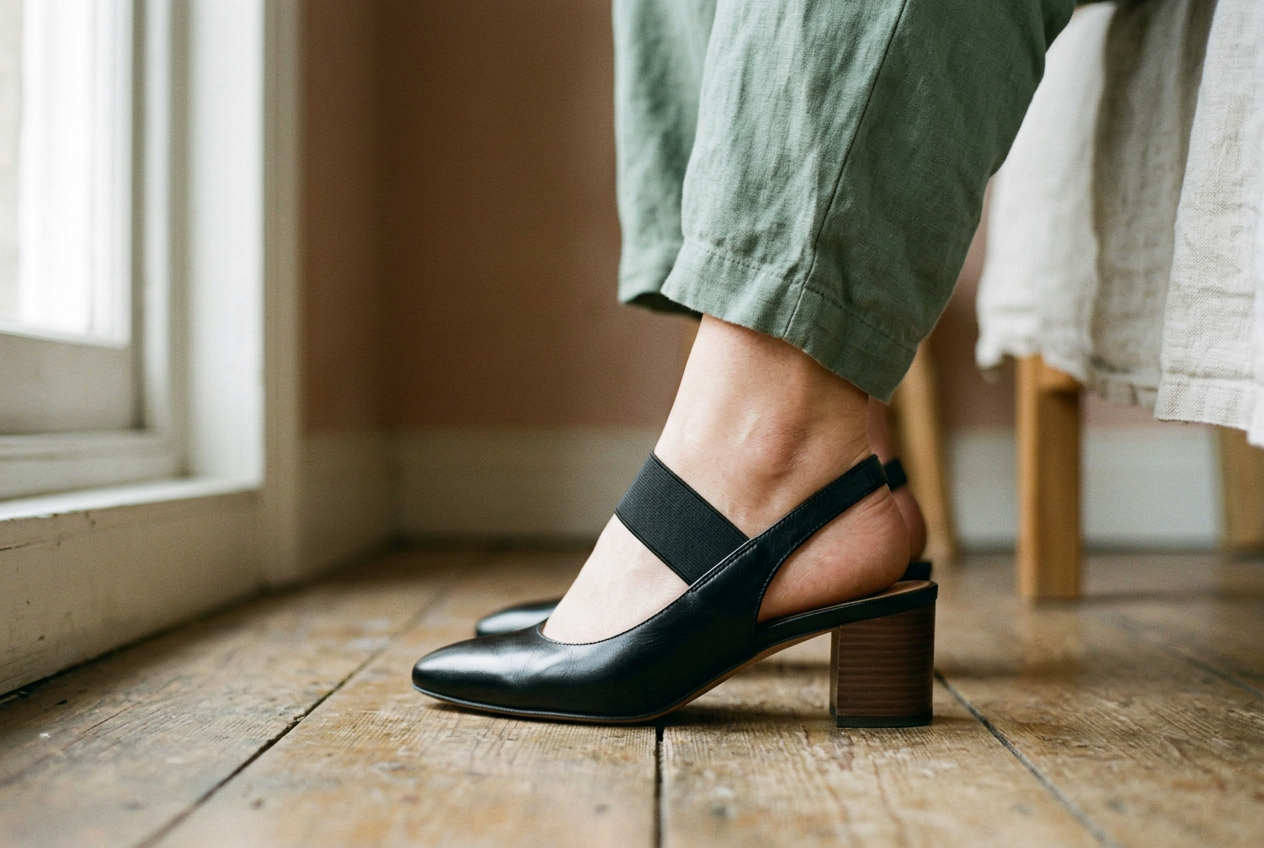
The fitting case here is a women’s black leather slingback pump with a pointed toe, a low block heel and a buckled strap interrupted by a short elastic insert. The forefoot fit was secure, the heel sat on the insole rather than hanging over it, and the strap still dropped during an ordinary indoor lap.
Going down a size tightened the toe box without fixing the rear geometry. After a week of wear in the original size, the right strap remained less reliable than the left, and the leather upper softened without performing the useful trick of making the elastic shorter. Shoes rarely break in toward greater restraint.
First check whether the shoe is too large
A smaller size helps only when the whole shoe is too long or roomy. With your weight on both feet, look for the ball of the foot, meaning the widest joint behind the toes, to sit at the widest part of the shoe. Your heel should rest on the insole rather than near its back edge, while the upper should hold the forefoot without forcing the toes together.
In the test pump, those points lined up in the original size. The smaller pair pushed the toes farther into the point and left the strap approaching the heel at nearly the same angle, so it delivered more pressure and no greater security. This is the standard slingback insult: sore toes at the front, loose strap at the back, full price in the middle.
Consider sizing down when the foot slides forward, the ball joint sits behind the shoe’s widest point or there is excess length at the heel. If only the strap is loose, treat it as a strap problem first.
Heel shape gives the strap its resting place
A slingback needs to sit against the curve where the heel narrows toward the Achilles tendon. A pronounced curve gives the strap a shallow ledge; a straighter rear heel gives it less to catch against, particularly when the strap is narrow, smooth or positioned high.
The useful test is visual. Stand naturally and view the shoe from the side, or use a mirror. The strap should settle into the heel’s curve without crossing the soft Achilles area near the ankle. If it rests above the curve, each step encourages it downward.
If it sits too low, it can rub the rounded part of the heel or slip under it.
Feet are not symmetrical, which explained part of the test pair’s one-sided failure. The same strap position met a clearer curve on the left heel than on the right. A smaller shoe could not change that anatomy; an adjustable strap could at least compensate for it.
Strap angle controls where the tension goes
Look at the line from the strap’s side attachment to the center of the heel. When that line rises steeply toward the back, tension pulls the center downward toward the lower attachment point. The heel curve must resist that pull every time the foot lifts.
A more level approach usually asks less of the heel. This does not mean every strap should run dead straight, but a fitting-room view from the side can reveal why one slingback stays put while another, in the same labeled size, migrates south before the elevator arrives.
Strap width matters less than placement. A broad strap spreads pressure and may feel steadier, yet it will still fall if its upper edge sits above the heel’s useful curve. On the black pump, tightening the buckle increased tension along the same downward angle. The strap felt firmer while standing, then slipped during walking anyway.
Elastic has a narrow useful range
The elastic insert, sometimes called elastic gore, is the stretch panel that lets the strap expand as the foot enters and moves. It should extend enough to prevent the strap from cutting in, then recover promptly so the leather section returns to the heel.
Too much elastic length leaves the strap slack before it stretches. Elastic that is overly soft can feel pleasant in the fitting room but fail as soon as the heel lifts, while a short, forceful insert may pull the strap downward along a poor angle and press a line into the skin. Neither result qualifies as comfort. One is merely quieter about its intentions.
Test recovery by pulling the strap gently away from the heel and releasing it. It should return without sagging or twisting. Then walk at a normal pace, take a few stairs if the store permits and sit before standing again. A strap that needs to be replaced after every transition is giving useful information, not requesting patience.
Elastic also tends to relax with wear rather than tighten. The test pump’s insert did not improve over the week, although the leather around the forefoot became more yielding. Buying a marginally loose slingback on the theory that it will settle into place reverses the usual direction of travel.
Use the fitting room as a walking test
Try both shoes with the hosiery or bare-foot setup you intend to wear. A slick stocking changes friction at the heel, while bare skin can grip briefly and then become less cooperative with heat or moisture. The correct test is the real combination, not the store’s disposable sock followed by optimism.
Fasten an adjustable strap at a comfortable hole, walk several laps and watch which event happens first: the strap falls, the foot slides forward or the toes begin to grip. A falling strap with a stable forefoot points to position or tension. Forward sliding suggests excess volume, insufficient upper hold or a sole shape that directs the foot toward the toe.
Next, move the buckle by one hole. If tighter tension makes the strap stay without pushing the foot forward or cutting into the heel, the shoe may work. If tightening only increases pressure, or if the strap still lands above the heel curve, another hole will not rewrite the design.
The better alternative is often a slingback with a higher side attachment, a less steep strap line or a longer adjustable leather section paired with a shorter elastic insert. An ankle strap is more secure, though it changes the look and adds hardware. Fashion does occasionally charge an aesthetic fee in skin.
Alteration is possible, but decide early
A cobbler may be able to shorten a leather strap, add a buckle hole or replace a tired elastic insert. The feasibility depends on where the seams, buckle and elastic sit, so request an assessment before the return window closes. Altering a new shoe makes sense when the rest of the fit is unusually good; it makes less sense when the forefoot also pinches or slides.
Adhesive heel grips are unreliable in an open-backed shoe because there is no full heel counter, meaning the firm rear wall of a closed shoe, to support the pad. A slim grip placed under the strap may change its position, but it also creates an edge that can rub. For the black pump, the cleaner decision was to reject the smaller size and judge the original pair on whether strap alteration was worth paying for.
Questions people ask
Should slingback straps feel tight when they are new?
They should feel secure, not punishing. A leather strap may soften slightly, while its elastic insert is more likely to relax than tighten, so do not buy a loose strap expecting improvement or tolerate deep pressure on the theory that discomfort proves a good fit.
Will a heel grip stop a slingback strap from falling?
Sometimes, but only when a thin grip moves the strap onto a better part of the heel without creating friction. Heel grips cannot correct a steep strap angle or weak elastic, and an open-backed shoe gives the adhesive pad less structure than a pump with a full rear wall.
Does a wider slingback strap stay up better?
A wider strap spreads pressure across more skin and can feel steadier, but position still decides whether it stays. If the strap crosses above the heel’s curve or pulls downward from low side attachments, extra width produces a broader slipping strap rather than a secure one.
Can a cobbler shorten a loose slingback strap?
Often, provided the strap has enough plain leather and the buckle or elastic can be moved without disturbing a decorative seam. Get a quote before wearing the soles outdoors, and bring both shoes because your heels may need slightly different adjustments.
One update a day
Today's fashion update, in your inbox
One fashion update each morning — no hype, no filler, just pieces worth wearing.