Toe Spring Helps a Stiff Walking Shoe Until It Presses Back
The upward curve at a shoe’s toe can move a stiff sole through a step, but the same shape may load the forefoot. One short comparison walk reveals which version you have.
November 21, 2026 · 7 min read
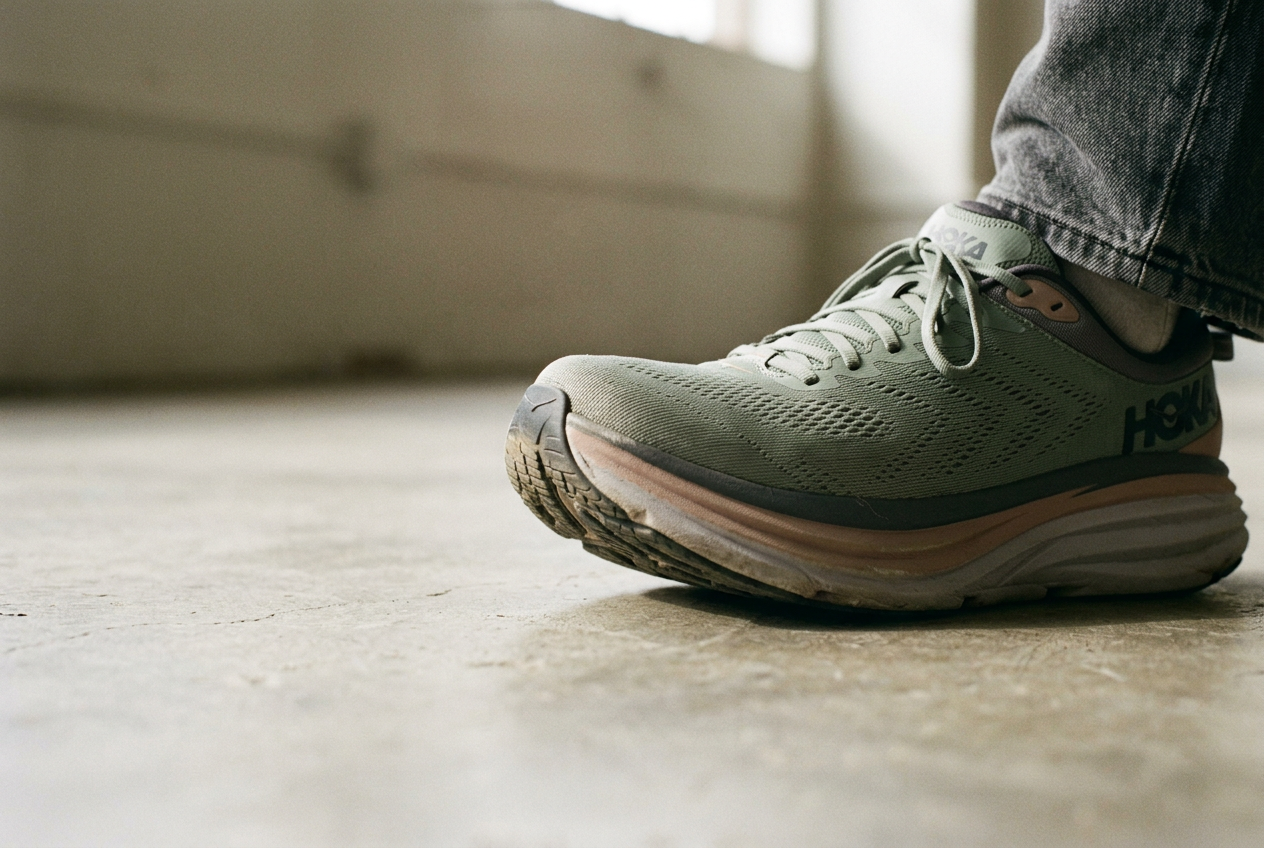
Set a Hoka Bondi on a table and the front of its thick sole sits visibly above the surface. That rise is toe spring, the upward curve at the front of a shoe, and in a shoe this cushioned and stiff it helps determine how the foot gets from heel contact to push-off.
The Bondi is a useful case because its sole does not fold through the forefoot like a thin canvas sneaker. The geometry has to do more of the work. Some walkers feel a smooth roll; others feel tipped toward the ball of the foot, with the toes waiting in the air for the rest of the shoe to catch up. Both reactions are plausible.
The curve cannot be judged apart from sole stiffness, fit and the amount of motion available at the toe joints.
This is unisex fit advice. The mechanics apply across men’s and women’s sizing, although the same model may be built on different lasts, meaning the foot-shaped forms used to give shoes their internal dimensions. Compare the fit on your foot rather than assuming equivalent labeled sizes create equivalent space.
The curve is part of a system
Toe spring is easy to spot from the side, which makes it easy to blame. Place the shoe on a flat floor and look at how much daylight appears below the toe. More daylight means a more obvious curve, but it does not tell you whether that curve will feel helpful.
A rocker sole, meaning a sole shaped to roll the body forward rather than bend sharply at one point, combines that curve with stiffness and a rounded transition underfoot. Toe spring is one visible piece of the rocker. A flexible ballet sneaker can have an upturned toe and still bend with the foot, while a thick walking shoe may barely flex by hand and depend on its profile to move.
Return to the Bondi. Its thick foam platform keeps the foot farther from the ground than a low-profile court sneaker would, while the curved forefoot lets the shoe rotate ahead without demanding as much bending from the sole. That can suit a stride that moves comfortably over the shoe’s rounded section. It can feel awkward when the foot wants to flex somewhere else.
Where the curve begins matters more than the height of the toe tip. If the sole starts rising beneath the toe joints, the shoe can roll from roughly the place the foot expects to push. If it begins farther back, the wearer may feel perched on the forefoot. If it begins too far forward, the foot still has to bend a stiff sole before the rocker contributes much.
Stiff soles make toe spring consequential
A thin, flexible shoe usually allows the toe joints to bend as the heel lifts. The foot supplies much of the motion, and the shoe follows. A stiff walking shoe changes that arrangement because its sole resists folding, so the wearer either rolls over its curve or works against a platform that would rather remain in one piece.
That resistance is not automatically a defect. People with limited comfortable movement at the big-toe joint may prefer a shoe that reduces how far the joint must bend during push-off. A well-positioned rocker can also make a heavily cushioned sole feel less blocky. The tradeoff is control: the manufacturer has chosen where the shoe wants to pivot, and your foot gets a vote only after purchase.
Try flexing the Bondi and a basic flexible sneaker in both hands. The thinner shoe usually bends closer to the ball of the foot, while the Bondi resists that fold and keeps its broader shape. This hand test describes construction, not comfort. The relevant result appears when body weight reaches the rocker and the heel begins to lift.
Foam softness can disguise the issue during a brief fitting. A plush step-in feel comes from compression underfoot, while an easy stride depends on the shoe moving at the right time and place. Five pleasant steps on carpet may prove that the lining is soft. They do not prove that the forefoot geometry works after several blocks.
The pressure point has recognizable causes
Toe spring holds the toes in some degree of extension, meaning they sit angled upward relative to the forefoot. A small amount may go unnoticed. A pronounced curve in a stiff shoe can become obvious when the toe box is shallow, the pair runs short or the rocker places the transition behind the natural bend of the foot.
Fit length deserves particular attention. The toes need space in front, but the useful check is whether the widest part of the forefoot aligns with the broadest part of the shoe. In a short Bondi, or any similarly rockered shoe, the foot may sit too far forward and miss the section designed to carry it through the step. Sizing up can restore alignment, though extra length is a poor fix if the heel then slips.
Width also changes the verdict. A forefoot squeezed from the sides cannot spread normally under load, and the rocker may then feel like a ridge beneath the ball of the foot rather than a continuous curve. Look for pressure beneath the big-toe joint, under the smaller toe joints or at the ends of the toes. Numbness, burning and persistent pain are reasons to stop the trial, not a break-in plan.
A secure midfoot can help keep the foot positioned over the intended pivot, but aggressive lacing should not be used to drag an incompatible foot backward. That bargain tends to collect payment on the instep.
Use one route to compare the stride
The most useful test needs two shoes: the rockered pair under consideration and a familiar walking shoe that does not cause forefoot trouble. Wear the same sock thickness and walk the same short route in each pair, preferably including level pavement and a gentle incline. A store corridor works if that is all the return policy permits, though several continuous minutes reveal more than pacing beside a mirror.
Start at your normal speed. Do not exaggerate the heel-to-toe motion to make the rocker perform. In the Bondi, notice whether the heel lifts and the shoe rolls forward without requiring an extra shove from the calf or a gripping motion from the toes. The useful sensation is uneventful: pressure travels forward and leaves the toes without lingering under one joint.
Next, shorten the stride slightly. Some strongly curved shoes feel smooth only when the wearer takes a longer step and lands farther back on the sole; at slower speeds, the same shoe can feel like a platform with a turned-up end. A walking shoe should cope with your ordinary pace, including the small steps used in stores, stations and kitchens. Nobody maintains test-track form while carrying groceries.
Use the comparison shoe immediately afterward. Pay attention to location rather than softness. If the flexible pair asks the big-toe joint to bend more but spreads pressure evenly, while the rockered shoe creates one hot spot beneath the forefoot, toe spring is fighting the stride. If the flexible pair makes push-off feel restricted and the Bondi carries the step forward with less joint bending, the rocker is contributing useful motion.
Repeat the test on a slight incline if possible. Uphill walking asks more from forefoot flexion and can expose a stiff sole that felt fine on level ground. Downhill, check whether the foot slides forward into the raised toe. The comparison does not need to become an endurance event.
The aim is to identify which shoe produces a cleaner transition before fatigue and enthusiasm start rewriting the evidence.
Buy the motion, not the side profile
A dramatic toe spring can look technical, particularly when paired with a deep foam midsole, but visible engineering is not proof of compatible engineering. Choose the rockered shoe when its pivot aligns with the forefoot, the toes have vertical room and the walking comparison feels smoother at your usual pace. Leave it when the curve produces a fixed pressure point or demands a stride you do not naturally use.
The alternative does not have to be a barefoot-style shoe. A moderately cushioned walking sneaker with more forefoot flex may suit someone whose toe joints move comfortably and whose foot prefers to control push-off. Another rockered model may work if its curve begins in a different place. Brand loyalty cannot correct pivot placement.
For the Bondi, the table test explains why the shoe looks the way it does; the walking comparison decides whether that shape earns space in the closet. If the roll helps only while marching briskly across a store, it is unlikely to become more diplomatic during a slow afternoon.
Questions people ask
Is more toe spring better for walking?
No. A larger curve can help a very stiff sole roll forward, but its position matters as much as its height. Too much lift, a poorly aligned pivot or a shallow toe box may hold the toes upward and concentrate pressure beneath the forefoot.
Can toe spring help a stiff big-toe joint?
It may reduce how far the big-toe joint has to bend during push-off because the shoe rolls over its curved sole. Comfort still depends on fit and pivot placement. Anyone with persistent joint pain or a diagnosed foot condition should discuss footwear choices with an appropriate clinician.
Should toes touch the raised front of a walking shoe?
The toes should not be jammed into the end or pressed firmly against the upper by the curve. Check that the forefoot sits at the shoe’s widest point and that the toes have enough length and vertical space when standing, then confirm the foot does not slide forward downhill.
Can toe spring be tested without wearing shoes outdoors?
Yes. Walk continuously indoors at normal and slower speeds, then compare the pair with a familiar flexible shoe using the same socks. An incline is useful if available. Focus on whether pressure moves through the forefoot or remains beneath one joint, and preserve the retailer’s return condition.
One update a day
Today's fashion update, in your inbox
One fashion update each morning — no hype, no filler, just pieces worth wearing.