Try Lock Lacing Before You Size Down Your Sneakers
A runner’s loop can stop heel lift when the front of a sneaker already fits. If the collar shape is wrong, however, tighter laces only make the shoe more argumentative.
November 18, 2026 · 7 min read
Heel slippage often gets treated as proof that a sneaker is too big. Sometimes it is. Quite often, the length is right and the lacing has failed to hold the rear of the foot against a shallow, generously padded or badly matched collar.
The useful first move costs nothing and takes about two minutes: re-lace the top eyelets into a runner’s loop, also called heel-lock lacing, which creates extra tension around the ankle without tightening every crossing over the foot. The less useful reflex is buying the next size down while hoping one’s toes will negotiate among themselves.
This is unisex fit advice. Men’s and women’s size labels change the numbers and sometimes the width offered, but the test is the same: preserve usable toe space, secure the heel and pay attention to the shape of the collar.
The test shoe slipped only at the back
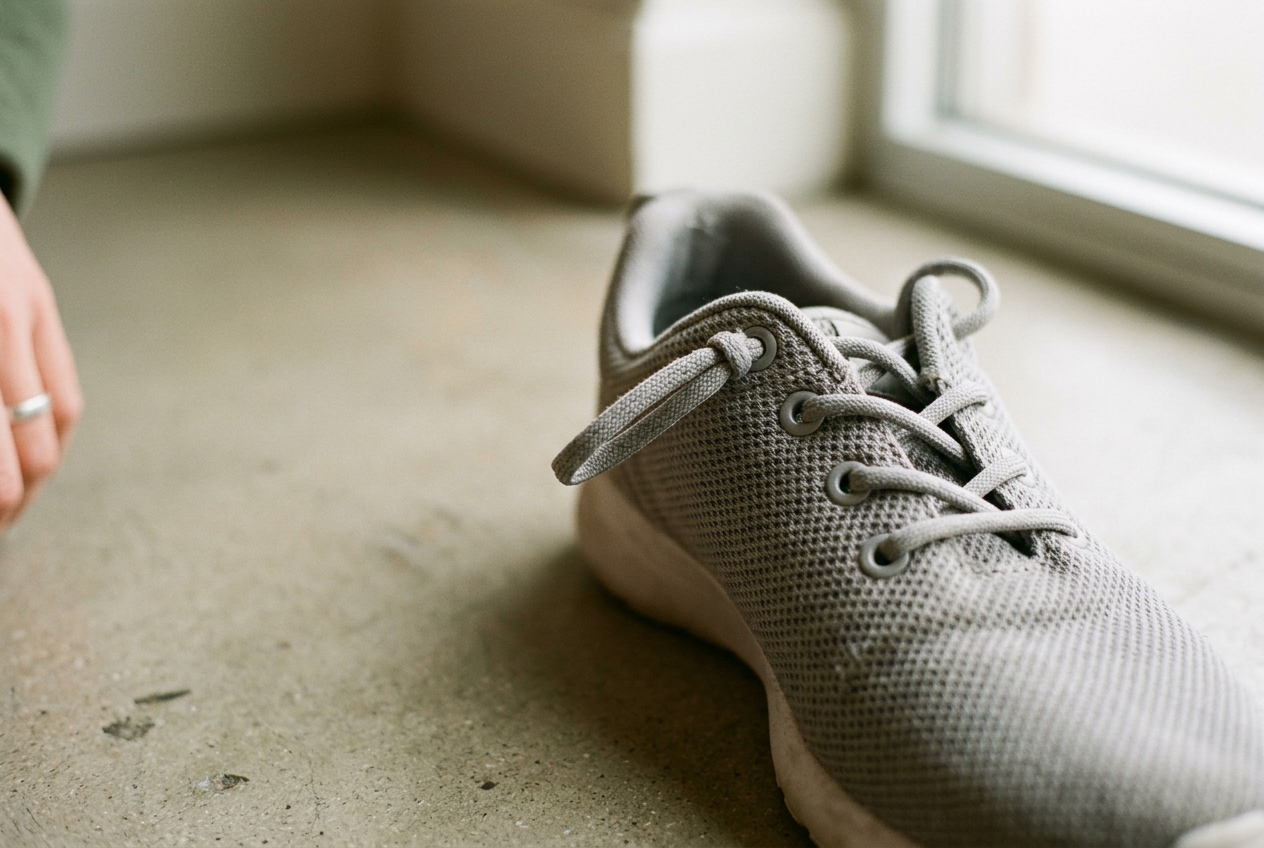
I used a gray low-top sneaker from my own rotation as the working case. It has an engineered-mesh upper, thin synthetic overlays, a removable foam sockliner and a padded polyester collar built around a firm heel counter, meaning the internal structure that cups and stabilizes the back of the foot.
Its length was unremarkable in the best way. My longest toe had standing clearance, the forefoot flexed at the shoe’s flex point, and the mesh did not press across the widest part of the foot. Yet the heel rose with each brisk step. After a week of ordinary walking, the collar lining had a visibly flattened patch where the heel had been traveling up and down.
That combination matters. Toe fit good, midfoot fit good, heel loose: try lacing before changing size.
The original lacing used every eyelet in an ordinary crisscross pattern. Tightening the bow reduced some movement, but it also pulled hard across the instep, the raised top surface of the midfoot, while the heel continued to lift. This is the classic bad bargain: numbness in front, rubbing behind.
How to tie a runner’s loop
A runner’s loop works best on sneakers with an extra top eyelet set slightly behind the main row. It separates the tension at the collar from the tension lower down, so the forefoot can remain comfortably laced while the final section holds the heel.
- Lace the sneaker normally in a crisscross pattern, stopping at the second-highest eyelet on each side. Put the shoe on before adjusting tension; a beautifully laced empty shoe knows nothing about your foot.
- Feed each lace end straight up through the top eyelet on the same side, entering from the outside. Do not pull it through completely. Leave a small loop between the final two eyelets.
- Cross the lace ends. Pass the right lace through the loop on the left, then pass the left lace through the loop on the right.
- Pull both ends outward and slightly downward rather than hauling them straight upward. This closes the loops and draws the collar around the heel. The pressure should feel localized near the top of the shoe, not like a strap cutting across the ankle.
- Tie the usual bow. Walk indoors, then climb stairs or use a sloped surface if one is available, since flat standing can conceal movement that appears as soon as the foot rolls forward.
On the gray mesh pair, the change was immediate but not miraculous. The heel still moved a little, as heels do inside most low-top sneakers, but it stopped lifting far enough to rub the collar on every stride. More importantly, the toe box, meaning the space surrounding the toes, felt exactly as it had before.
The adjustment took less time than repacking a return. I retied it once after the laces settled during the first walk, then left the lower crossings alone for the rest of the week.
The loop should hold, not punish
A useful runner’s loop limits vertical travel without forcing the foot forward. Check the result with the sneaker tied while standing: the heel should feel seated, the tongue should lie flat, and the lace throat, meaning the opening between the two eyelet rows, should still show some space rather than being pulled shut.
Walk for several minutes. Tingling, pressure over the instep or a hard bite at the front of the ankle means the top section is too tight. Loosen only the lock first. If the foot still feels compressed, ease the lower crossings as well.
Socks affect the result. A thicker athletic sock can fill a small amount of collar volume, but using winter-weight socks to rescue a warm-weather mesh sneaker creates a separate comfort problem. Test the lacing with the sock thickness you intend to wear most often.
Lock lacing also cannot correct excessive length. If the foot slides forward before the heel rises, or the forefoot swims from side to side even with moderate lace tension, the shoe has more volume than the loop can manage. It is a lace pattern, not structural renovation.
Size down only when the whole shoe is roomy
Trying the next size down makes sense when the current pair is too long through the foot, the widest part of the shoe sits ahead of the widest part of your foot, and the laces must be cinched until the eyelet rows nearly meet. The smaller size still needs to pass a walking test, preferably later in the day when feet may be fuller.
Do not size down solely because the heel lifts. In the gray test sneaker, the next smaller size would have shortened a toe box that already fit, while the basic collar shape would have remained the same. That trade replaces friction at the heel with pressure at the toes, which is not progress despite being located farther from view.
Check the smaller shoe while standing and walking. Toes should not touch the front on level ground or strike it when descending stairs, and the forefoot should spread without meeting a hard sidewall. A thumb-width rule can offer a rough visual cue, but toe lengths and shoe shapes vary too much for it to settle the decision by itself.
If one foot is larger, fit the larger foot. Lock lacing can then fine-tune the smaller side independently, which is far more sensible than making the larger foot spend the day folded for symmetry.
Some heels and collars do not belong together
The strongest sign of a shape mismatch is persistent gaping at the sides of the collar even when the shoe’s length and forefoot width are correct. A rounded, deeply cupped heel counter may fail to hold a narrow or straighter heel; a broad, heavily padded collar may feel plush under a finger yet leave too much room once the padding compresses.
Watch the top edge while walking. If the back center stays close but both sides flare open, more lace tension may pull the shoe inward without creating proper contact around the heel. If the counter presses one precise spot near the Achilles tendon while the rest of the collar remains loose, the contour is wrong rather than uniformly oversized.
Another clue is how far the laces must travel. On the test pair, the runner’s loop closed the collar while leaving visible space between the eyelet rows. Had those rows touched and the heel still slipped, I would have stopped tightening. Once the upper has nowhere left to move, extra force goes into the foot.
Repeated rubbing in the same place, especially after different socks and a sensible lacing adjustment, also points toward shape. Adhesive heel grips may reduce spare volume, but they alter the collar’s geometry, can push the foot forward and may peel as heat and moisture build. A thin tongue pad can help when the entire shoe is slightly high-volume, though it is less useful when only the rear profile is wrong.
An added insole is not a neutral fix. It raises the foot inside the shoe, which can place the heel above the counter’s intended cup and make slippage worse. If the original sockliner is already thick, stacking another insert is particularly likely to trade looseness for crowding.
At that point, return the shoe if possible and try a model with a narrower or more sculpted heel. Brand loyalty is expensive when the heel counter disagrees with your anatomy.
Questions people ask
Does a runner’s loop work on every low-top sneaker?
No. It works best when the sneaker has two usable eyelets near the ankle and already fits through the forefoot. Shoes with very low collars, short laces or widely spaced top eyelets may gain little control, while a stiff collar can become uncomfortable when pulled tighter.
How much heel movement is normal in sneakers?
A small amount of movement can be normal, particularly in flexible low-tops. The problem begins when the heel lifts repeatedly enough to rub, pulls the sock downward or makes the foot slide forward. The runner’s loop should reduce that travel without creating pressure over the instep.
Can
I use the runner’s loop if the sneaker has no extra eyelet?
You can form the loops using the top two regular eyelets, but doing so shortens the crisscross section and may change tension across the midfoot. Test it indoors. If the forefoot becomes loose or the top edge bites, the eyelet layout is not suited to this method.
Should
I size down if lock lacing does not stop the slipping?
Only if the current shoe is also too long or roomy through the forefoot. When toe clearance and width already feel right, failed lock lacing points more strongly toward an incompatible heel shape. Keep the correct length and try a sneaker with a closer, better-contoured collar.
One update a day
Today's fashion update, in your inbox
One fashion update each morning — no hype, no filler, just pieces worth wearing.