Why Sandal Ankle Straps Loosen After Ten Minutes
A sandal can feel secure in the mirror and sloppy by the end of the block. The cause is usually strap settling, heel movement or a shape mismatch that another buckle hole will not fix.
November 10, 2026 · 8 min read
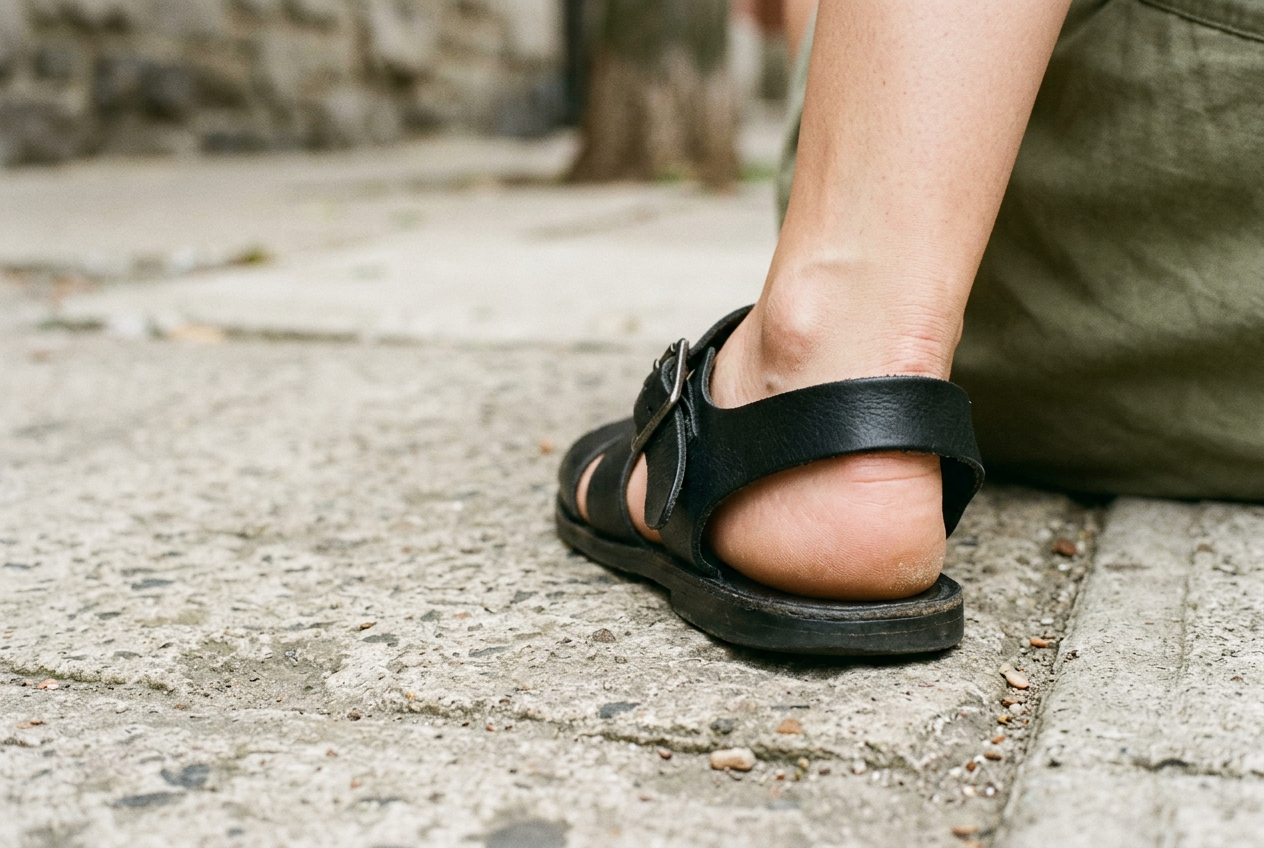
The black leather sandal looked secure while I stood in it. Its narrow ankle strap sat flat, the buckle tongue was centered in an existing hole, and the low block heel kept everything sensible enough for a full day rather than a ceremonial walk from cab to chair.
Ten minutes outside changed the fit. The rear section of the strap dropped toward the heel, my foot moved forward on the footbed, and the buckle began tipping instead of lying flat. The tongue had not slipped into another hole. The sandal had loosened around it.
This is unisex fit advice: strap mechanics do not change with department labels, although brands may grade widths and ankle-strap lengths differently across men’s and women’s sizing. The useful distinction is between a strap that needs one measured adjustment and a sandal that does not hold your foot in the right place.
A standing fit misses the moving part
A sandal fitting usually happens under unusually flattering conditions. You stand on level flooring, take several short steps, look down, and decide whether anything pinches. The sole has not warmed, the upper has not absorbed moisture, and your stride has not forced the sandal to flex repeatedly.
Walking loads the shoe differently. Your heel rises as you push off, the sole resists bending, and the ankle strap takes some of the force needed to keep the foot and shoe traveling together. If the sole is stiff, the strap does more work. If the footbed is slick or too long, the foot also slides forward, which changes where the strap meets the ankle.
The secure standing fit of the black sandal depended on my heel remaining at the back of the footbed. Once the heel lifted and shifted slightly forward, the strap no longer followed the same path around the ankle. Its rear section settled lower, onto a narrower part of the body, leaving room that had not existed at the fitting.
This is why the familiar one-finger rule is unreliable. A fingertip under the strap may indicate reasonable room while standing, but it says little about whether the strap will migrate, whether the sole flexes with the foot, or whether the heel will stay centered after several blocks.
Buckle placement can turn movement into slack
Buckle position controls the direction of the pull. On the test sandal, the buckle sat slightly forward of the ankle bone, while the strap attachment on the opposite side also began ahead of the joint. That placement looked neat from the side, but both fixed points encouraged the rear loop to angle downward as the ankle moved.
A buckle positioned closer to the side of the ankle, with strap attachments that let the band travel horizontally around the body, is less likely to twist. It is not automatically more comfortable. A buckle placed directly over a prominent ankle bone can press and rub, particularly when its metal frame is wider than the strap beneath it.
Watch the buckle after walking. If it remains flat while an even amount of slack develops around the strap, the material has probably settled or stretched. If the buckle rotates toward the front and the rear strap drops, placement is contributing to the failure. Tightening may reduce the visible gap, but it also pulls the angled buckle harder against the ankle.
Strap height matters too. A very low band can slip toward the heel; a high band is less likely to travel but may restrict ankle movement. There is no perfect height detached from the rest of the sandal, which is inconvenient but preferable to pretending every ankle can be secured by moving one small piece of metal.
Leather stretches, but not all stretch is break-in
The black sandal used a smooth leather outer strap with a separate lining. After repeated flexing, the layers softened and conformed more closely to the ankle. That small change was enough to create noticeable slack because the strap was narrow and already operating near the limit of its adjustment.
Leather usually gives where it bends and where the buckle tongue concentrates pressure. Suede and soft, minimally structured leather tend to settle sooner than firm leather. A stitched lining can limit distortion, although thin lining material may compress even when the outer layer still looks unchanged.
Synthetic straps behave less predictably. Some soften with warmth, while coated materials may resist stretching until the surface creases or the layers begin separating. An elastic insert, often called elastic gore, can make fastening easier but may also allow the heel to rise farther with every step. Tightening the buckle does not remove movement from a tired elastic section.
Moisture complicates the judgment. Warm skin and perspiration can make a foot slide, even while normal swelling makes the overall fit feel tighter later in the day. A sandal that loosens during the first ten minutes and pinches after several hours has not found a clever equilibrium. It has produced two fit problems on the same outing.
Test the foot position before altering the strap
Fasten the sandal on the hole that feels secure without pressing while standing. Check that the heel sits within the heel seat, meaning the shaped rear area of the footbed, and that the widest part of the forefoot aligns with the widest part of the sole. Then walk indoors long enough for your normal stride to appear, including a turn and a flight of stairs if the return conditions permit it.
After walking, ignore the strap for a moment. Look at the foot. If the heel remains centered and the toes have not moved toward the front edge, the sandal may need a modest strap adjustment. If the heel shifts sideways, the arch lands on the wrong contour, or the toes advance as the heel rises, the strap is being asked to correct the shape underneath.
The last, meaning the foot-shaped form used to build the shoe, determines that underlying shape. A last can be too straight for a curved foot, too wide through the heel, or proportioned with more length behind the arch than your foot needs. Sandal straps can restrain some movement, but they cannot relocate the heel seat or move the arch support.
On the black sandal, tightening the strap held my ankle more firmly while my heel still crept forward. The buckle then pressed harder, and the sole continued to lag behind my foot at push-off. That result ruled out a useful alteration. More restraint would have made the sandal busier, not better.
One extra hole is sometimes reasonable
Add a hole only after an indoor walking test confirms that the foot remains centered and the existing tightest setting leaves even slack. Altering the strap may end the option to return the shoe, so do not punch first and conduct the diagnosis later.
A robust leather strap without edge stitching in the proposed area is the safest candidate. Place the new hole toward the strap tip, following the same center line and spacing used by the existing holes. Use a leather punch that matches their diameter and shape, with the strap supported on a suitable work surface. A nail, knife tip or household drill can split fibers and leave an untidy opening that grows under tension.
The new hole needs enough material around it to resist tearing. Do not place it in a tapered tip, through decorative perforation, beside a seam, or so close to the edge that the leather forms a thin bridge around the buckle tongue. A shoe repair shop is the better option for narrow straps, layered patent finishes, stitched construction and expensive sandals. The job is usually small; replacing a torn strap is not.
Do not punch elastic, braided material or a thin synthetic strap at home. Those constructions may fray, split or lose reinforcement around the new opening. A cobbler may be able to shorten the strap at its attachment point or add a reinforced hole, but the cost only makes sense if the sandal already walks well.
Needing one additional hole can reflect ordinary variation in ankle circumference. Needing several suggests that the supplied strap is too long, the buckle sits in the wrong place, or the foot is sliding enough to create artificial slack. Stop before the adjustment reaches the curved end of the strap.
The last is wrong when tightening changes the pain, not the movement
A useful tighter setting keeps the heel in place without forcing the buckle frame into skin. You should not need to shorten your stride, curl the toes to hold the footbed, or refasten the sandal after each short walk.
Return or skip the pair when the heel still lifts markedly on the tightest comfortable hole, when the foot repeatedly slides beyond the footbed’s intended contours, or when the ankle strap must become painful before the sandal follows the foot. A more flexible sole may help if stiffness is driving heel lift. A sandal with a better-shaped heel cup or a broader rear strap may help if the foot moves sideways.
The alternative to the black sandal was not another hole. It was a pair whose sole flexed closer to the forefoot and whose ankle strap ran more level around the body. That construction allowed some heel movement, as sandals do, without making the buckle responsible for hauling the sole through every step.
Questions people ask
Why does my sandal strap loosen even though the buckle stays in the same hole?
The material may stretch or compress, and the strap may settle lower on the ankle as the heel moves. The buckle can remain fastened while the effective circumference changes. Check whether the rear strap has dropped and whether your foot has moved forward on the footbed.
Can
I add another hole to a leather sandal strap?
Yes, if the foot remains centered and a single extra hole will create an even, comfortable fit. Match the existing spacing and hole size, and avoid seams, tapered ends or very thin leather. For narrow, lined or expensive straps, a shoe repair shop is safer than an improvised punch.
How tight should an ankle strap be?
It should lie flat and keep the sandal traveling with the foot without digging in or forcing the buckle to tilt. Fit it while standing, then judge it after walking. A strap that only controls movement when painfully tight is compensating for the sandal’s shape or stiffness.
Will ankle straps stop stretching after break-in?
Leather often settles most noticeably early in wear, but it can continue changing at bend points and buckle holes. Elastic and thin synthetic straps may keep relaxing. If repeated tightening is needed while the heel also slides, further break-in is unlikely to produce a stable fit.
One update a day
Today's fashion update, in your inbox
One fashion update each morning — no hype, no filler, just pieces worth wearing.