Square Toe Flip-Flops Catch Stairs Earlier Than You Think
A squared sole can extend well beyond the toes, putting its front edge in contact with stairs before your foot expects it. Here is how to test the fit before wearing the shape outside.
November 9, 2026 · 7 min read
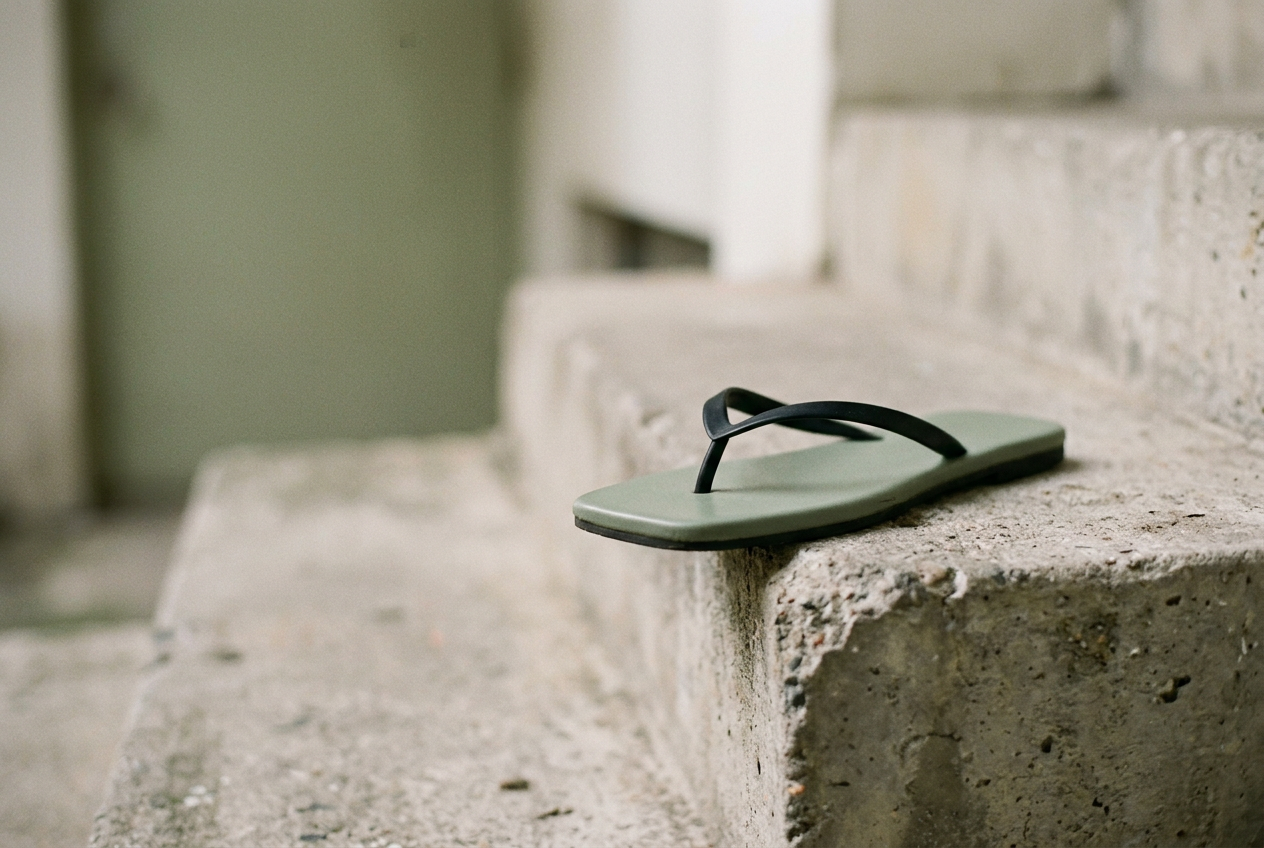
The pair under test looked sensible on level ground: synthetic thong straps, a molded EVA footbed and a separate rubber outsole, with a clean square front that extended visibly past the longest toe. After a week of ordinary wear, that extension had become the important part of the shoe. It reached stair nosings before the foot did, clipped curbs during lazy steps and required more deliberate placement on an escalator.
This is unisex advice. The mechanics apply across wardrobes and size charts, although the square-toe shape appears more often in women’s sandal ranges, where a longer front platform may be used to make the foot look narrower or the shoe more graphic.
The tested pair did not fail dramatically. There was no theatrical tumble, ruined lunch or emergency involving a handrail. Instead, the front edge made occasional contact with whatever came next, delivering the small, ugly interruption of a sole folding upward while the rest of the body continued forward. Fashion has produced worse discomfort, but few types are this petty.
The square is not the whole problem
A square toe describes the outline of the front edge, not the amount of empty sole in front of the foot. The more useful measurement is toe projection, meaning the distance between the longest toe and the leading edge of the sandal.
On the test pair, the longest toe sat behind a broad shelf of foam. That shelf looked polished from above because it preserved the full geometric shape rather than letting toes interrupt the line, but the extra length changed when the sole met an obstacle. A rounded flip-flop with similar projection could still catch; its curved edge, however, was more likely to meet a stair at one point and slide away. The square edge arrived across a wider section.
Sole stiffness altered the result. The EVA footbed bent under pressure, while the rubber outsole resisted just enough to make the front lip hesitate against a hard edge before flexing upward. A firmer leather footbed would not necessarily be safer. It might resist folding, yet transmit more of the impact into the toe post and the foot, which is a brisk way to discover how securely a thong sandal is attached.
The issue became less noticeable once I shortened my stride and lifted the forefoot more. That is an adaptation, not comfort. A shoe that makes its wearer supervise every step has assigned homework.
What happened on stairs
Descending exposed the fit first. The test pair’s front edge reached the stair nosing, the projecting edge where one tread ends, before the ball of the foot had fully cleared it. If I placed the middle of the foot firmly on each tread, nothing caught. If I let the front of the sandal skim forward in the loose way flip-flops encourage, the squared lip tapped or dragged.
Ascending produced a different mistake. A low step taken quickly allowed the empty front section to meet the vertical face of the next stair. The flexible sole folded, the thong strap held the foot back, and the step became shorter than planned. That sequence lasted a fraction of a second, but it was enough to show why the fit matters more than the trend photograph.
Open stairs with shallow treads demanded the most attention because there was less room to place the whole sandal. The square shape itself did not make those stairs unusable; the combination of long projection, a flexible front and a loose flip-flop gait did. Holding the rail and putting more of the sole on each tread solved the immediate problem, though it did not make the shoe a persuasive choice for a day built around staircases.
After a week, the front corners showed light abrasion before the center of the toe edge did. That wear pattern matched the moments when one corner arrived at a step or curb while the foot approached at a slight angle. Square toes photograph symmetrically. Feet rarely travel that way.
Curbs favor a shorter sole
A curb is easier to see than a stair edge, but it encourages a larger step and less precise landing. Stepping up was mostly uneventful when I lifted the foot cleanly. The trouble came from approaching at an angle or pushing off late, which let one squared corner brush the curb face.
Stepping down made excess length more obvious. Flip-flops tend to separate from the heel during the swing phase, the portion of a step when the foot is off the ground, then slap back into place. On the test pair, that movement let the sole shift slightly forward relative to the toes, so the visual gap at the front became functional extra length at exactly the wrong moment.
A more secure thong fit reduced the shift. The toe post needs to sit close enough to prevent the foot from retreating toward the heel, without pulling hard into the webbing between the toes. If the foot slides backward during a few brisk indoor steps, the sandal is effectively longer in motion than it looked while standing still.
Wide straps can help control side-to-side movement, although they do not fix an overlong front. A contoured footbed, meaning a molded surface shaped around the heel and arch, may also hold the foot more consistently than a flat slab of foam. Neither feature earns much credit if the wearer’s toes finish far behind the edge.
Escalators require a cleaner margin
The test pair felt least appealing on an escalator. A moving step combines a grooved metal surface, changing geometry at the top and bottom, and little tolerance for a flexible shoe wandering near an edge. Posted safety guidance and handrail use matter more than any styling analysis here.
Standing well within the step kept the squared front away from the boundaries. At the exit, lifting the foot rather than shuffling let the sole clear the transition plate. The pair managed it without incident, but the long front edge demanded attention, particularly because the rubber outsole gripped the ridged surface instead of sliding freely over it.
Grip is useful until the part gripping is an empty section of sole. This is the square-toe tradeoff in miniature: a defined front looks intentional, but a projecting, flexible edge can contact the ground independently of the toes controlling the shoe.
I would not choose the tested pair for a commute involving repeated escalators, crowded stairs and quick transfers. That judgment is about this construction and fit, not a ban on the silhouette. A square-toe sandal with little empty space in front, a secure upper and a less flexible forepart can behave far more predictably.
Test the projection before buying
Start with the heel. It should sit on the footbed rather than hanging over the back or floating far ahead of it. Then look at the longest toe while standing with full weight on the foot, since feet spread and lengthen under load. A small protective margin is useful; a visible platform large enough to preserve the square at the expense of foot control is not.
Walk briskly on a hard store floor if permitted. Listen for more than the ordinary flip-flop slap. A front edge that scuffs during level walking will not become more discreet around stairs, even if the upper softens with wear.
Next, take several exaggerated high steps without using an actual staircase. The exercise looks foolish for less time than catching a curb does. Watch whether the front corners dip, fold or swing across the path of the other foot. If the sandal rotates around the toe post, try a better-fitting upper rather than sizing down automatically, because a shorter size may push the toes over the edge while leaving the instability intact.
Online shoppers can compare the stated insole length with a flip-flop that already works, provided both measurements cover the full heel-to-edge distance. A paper tracing also helps. Put the reliable sandal on paper, mark its front edge and heel, then compare those dimensions with the new pair after delivery, before wearing it outdoors and complicating the return.
Where spending more helps, and where it does not
The mass-market molded pair used for this test sits below the price territory of full-leather designer flip-flops, yet price alone does not settle the stair problem. More expensive leather can improve strap finish, edge work and appearance after repeated wear. It cannot make excessive toe projection disappear.
Construction deserves the money when it holds the foot in one position. Look for a toe post that does not stretch immediately, straps that meet the sole without obvious gaps, and an outsole that bends near the ball of the foot rather than collapsing through the empty front. A very soft foam platform may feel forgiving in the fitting area, then flex around every stair edge outside.
The practical alternative is a softly squared or almond-shaped flip-flop whose front follows the toe line more closely. It keeps much of the current silhouette without leaving a broad landing pad ahead of the foot. For regular stairs, travel or public transit, that compromise is easier to justify than paying more for a severe square that still needs supervising.
Questions people ask
Are all square toe flip-flops awkward on stairs?
No. The risk rises when a square front projects well beyond the toes, the sole flexes through that empty section and the upper lets the foot slide backward. A close-fitting square toe with a secure thong and controlled flex can feel as predictable as a rounded sandal.
How much space should sit in front of the toes?
There should be enough sole to keep the toes from hanging over, but not a broad shelf included only to preserve the shape. Judge the gap while standing, then walk briskly to check whether the foot retreats and creates more projection in motion.
Should I size down if the front looks too long?
Only if the heel, toe post and footbed also fit in the smaller size. Sizing down can trade a catching front edge for toes or heel hanging over the sole. If the upper fits but the projection remains excessive, choose another last, meaning the form that determines the shoe’s shape and proportions.
Are rigid square toe sandals safer than soft ones?
Not automatically. A rigid sole may resist folding over a stair edge, but it can transfer the impact to the straps and foot. The better test is whether the sole clears obstacles cleanly, bends near the ball of the foot and stays aligned beneath you.
One update a day
Today's fashion update, in your inbox
One fashion update each morning — no hype, no filler, just pieces worth wearing.