Half an Inch of Empty Sole Makes Square-Toe Flip-Flops Risky
A squared sole can extend well past the foot, leaving its corners to meet stairs first. Here is the practical toe-space limit and a cautious test to run before keeping a pair.
October 25, 2026 · 7 min read
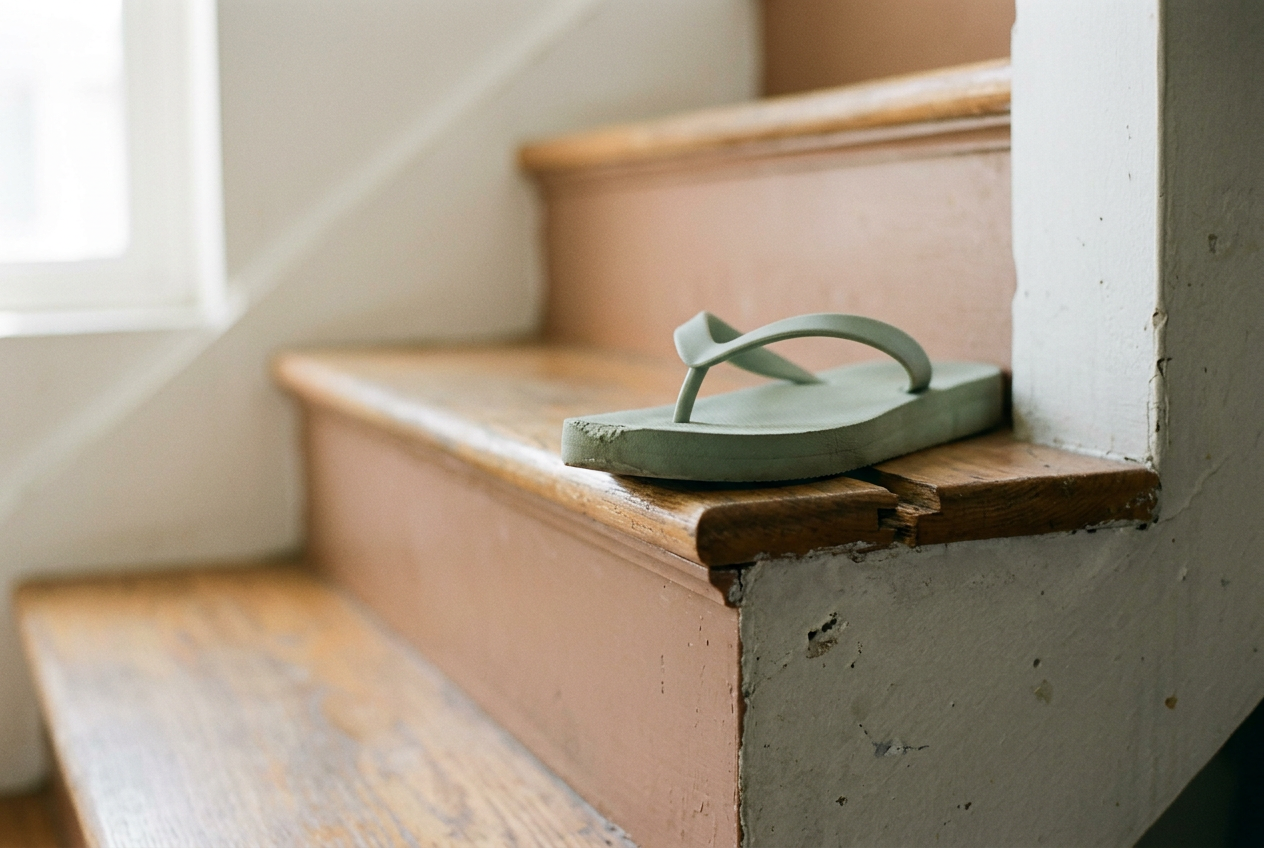
Square-toe flip-flops have acquired broader, more emphatic fronts, and some now put enough sole ahead of the foot to behave less like decoration and more like a small landing platform. On level pavement, that extra length may only produce a slap. At the front edge of a stair, it can arrive before your toes do.
This is unisex guidance because sole geometry does not care which department supplied the shoe. Foot shape, gait and stair design vary, so the measurements below are shopping limits rather than a universal safety standard. Anyone with balance or mobility concerns should skip the live stair test and compare the sandal with a securely fitting pair on level ground instead.
The test pair met the stair first
The pair used for this evaluation was a flat square-toe thong sandal with a dense EVA footbed, meaning a light closed-cell foam, synthetic straps and a thin rubber outsole. The sole flexed at the ball of the foot but stayed fairly firm across its squared front. With the heel seated and the strap holding the foot naturally, there was about half an inch between the longest toe and the front edge.
That half inch looked intentional in the mirror. It was less convincing on stairs.
During a week of ordinary wear, the test pair was walked on level sidewalks, taken over standard curbs and worn slowly on a closed indoor staircase while using the handrail. Ascending exposed the problem most clearly: the inside front corner brushed the stair nosing, which is the leading edge of a tread, before the forefoot had fully cleared it. The sandal did not cause a fall, but one firm catch was enough to stop treating the contact as harmless noise.
The same corner collected the first visible scuff. That matters because square soles disguise excess length when viewed from above; the foot appears centered, the shape looks crisp, and the unused material seems evenly distributed. Wear marks underneath tell a less diplomatic story. If the front corner is being abraded while the area beneath the toes remains relatively clean, the sole is leading the step.
Measure the sole in the direction you walk
Do not measure diagonally from the little toe to the outer corner. A squared sandal will always show a large diagonal gap there because the smaller toes curve backward while the sole does not, and using that distance would reject almost every strong square shape.
Measure projected overhang instead, meaning the empty sole directly ahead of a toe in the direction of travel. Stand naturally in both sandals with your heel settled against the intended rear position. Place a ruler along the centerline from the tip of the longest toe to the front edge, then repeat in front of the big toe and near each front corner. A phone photo taken from directly above helps if the ruler makes you curl your toes.
A quarter inch, roughly 6 millimeters, leaves enough visual space for the toe not to crowd the edge while keeping the front close to the foot. Between a quarter and three-eighths of an inch can work when the sole bends easily and the straps prevent the foot from sliding backward. At about half an inch, the test sandal began putting its front edge into the path of stairs and curbs, so that is my practical rejection point for a thin, flexible flip-flop rather than a promise that every smaller gap is safe.
Check both feet. Keep the measurement that belongs to the smaller foot, since it will have more empty sole, and do not push that foot forward to make the numbers prettier. If your heel then hangs off the back, the pair has traded one fit problem for another.
This test does not revisit width sizing. A foot can fit the platform perfectly from side to side and still sit too far behind an extended toe. The relevant issue is where the front edge lands relative to the foot during a step, not whether the widest part of the forefoot fills the sandal.
Run the stair test without staging a stunt
Start on level flooring. Walk at your normal indoor pace, turn in both directions and listen for a sharper slap from one front corner. A flexible flip-flop will make some noise by design, but repeated corner contact suggests that the sole is twisting or landing ahead of the toes.
Next, approach a low curb or a single broad step while holding a rail or another fixed support. Step up slowly with each foot. Watch whether the sandal clears as one piece or whether a front corner folds under, drags or strikes the edge. Stop after contact; repeating a catch adds no useful information and gives the sandal another opportunity to make its point physically.
Use a familiar, well-lit staircase only after the single-step check passes. On ascent, lift the foot normally rather than exaggerating your knee height, since the aim is to observe the shoe you will wear, not the shoe under laboratory choreography. On descent, notice whether the squared front extends over the tread before the ball of the foot feels planted. A long sole can make a shallow step feel shorter, particularly when the outsole is stiff.
Finally, walk up a curb at a slight angle. This was the least flattering move for the test pair because the corner, rather than the center of the front edge, became the leading point. People rarely approach every curb squarely, especially in a crowd or while carrying a bag, so a sandal that works only under straight, deliberate foot placement is asking for attention it has not earned.
Return the pair if the corner catches once during this cautious sequence, if you start lifting your feet higher to compensate, or if your toes grip the footbed to keep the sandal aligned. Toe gripping can feel like control for several minutes; over a longer walk, it is unpaid muscular administration.
Material changes the consequence, not the geometry
Soft foam corners are more likely to fold or skid when they meet an edge. A rigid leather or molded synthetic platform may not fold, but its unused front can act as a longer lever against the strap when it strikes. Neither material cancels excess space. They fail differently.
The EVA test sandal sat between those extremes. Its front was flexible enough to deform slightly, yet firm enough that the corner did not disappear under pressure. After a week, the scuff at that corner confirmed where contact occurred, while the synthetic thong straps had not stretched enough to move the foot forward and reduce the gap.
Strap placement deserves equal attention. A loose thong or high forefoot strap allows the foot to slide backward, increasing the overhang while you walk even if the sandal looked acceptable when you first stood in it. Smooth footbeds can do the same once damp. Press the heel into position, take several steps and measure again; the walking measurement is the one that matters.
A thick platform needs more caution, not a larger allowance. Added height reduces feedback from the ground and makes a caught edge harder to correct quickly. If the front is both thick and extended, a rounded or softly squared alternative is the better purchase, even when the severe square photographs better.
Keep the square, trim the empty space
The useful compromise is a square outline that begins close to the toes, with its drama coming from the corners rather than a long center extension. Look for roughly a quarter inch ahead of the longest toe, secure straps and a sole that flexes where the foot bends without collapsing at the front edge.
If a preferred pair reaches the half-inch mark, sizing down is only reasonable when the heel stays fully supported and no toe reaches or crosses the front. Cutting or sanding the sole is not a sensible correction: it can expose foam, separate outsole layers and leave two corners that are less even than the original problem.
The test pair remained wearable on uninterrupted level ground, but stairs changed the decision. A flip-flop should not require a special ascent technique to preserve a decorative rectangle of foam.
Questions people ask
How much space should be in front of the toes in flip-flops?
About a quarter inch ahead of the longest toe is a useful shopping target for a square-toe flip-flop. Space approaching half an inch deserves a stair and curb check, especially when the sole is stiff, thick or able to twist independently of the foot.
Are square-toe sandals more dangerous than rounded ones?
Not by definition. The problem is unsupported sole length and a leading corner that can meet an edge before the foot clears it. A close-fitting square front may behave better than an oversized rounded sandal, while a sharply extended square shape gives catching more opportunity.
Can I size down to reduce empty toe space?
Only if the smaller size keeps every toe on the footbed and fully supports the heel. Do not exchange front overhang for a hanging heel or cramped straps. If neither size places the foot securely within the sole, that model has the wrong proportions for your foot.
Why does only one corner of my flip-flop get scuffed?
One foot may rotate slightly during a step, or the sandal may twist because its straps hold unevenly. A scuffed front corner indicates repeated contact, especially when the rest of the toe edge remains cleaner. Use that mark as a reason to repeat the low-step check, not as routine break-in.
One update a day
Today's fashion update, in your inbox
One fashion update each morning — no hype, no filler, just pieces worth wearing.