Square Toe Flip-Flops Get Awkward When the Sole Runs Long
A squared footbed can look polished while adding a ledge your stride must clear. Here is how to measure it and test the pair on stairs and curbs.
Women's · October 17, 2026 · 7 min read
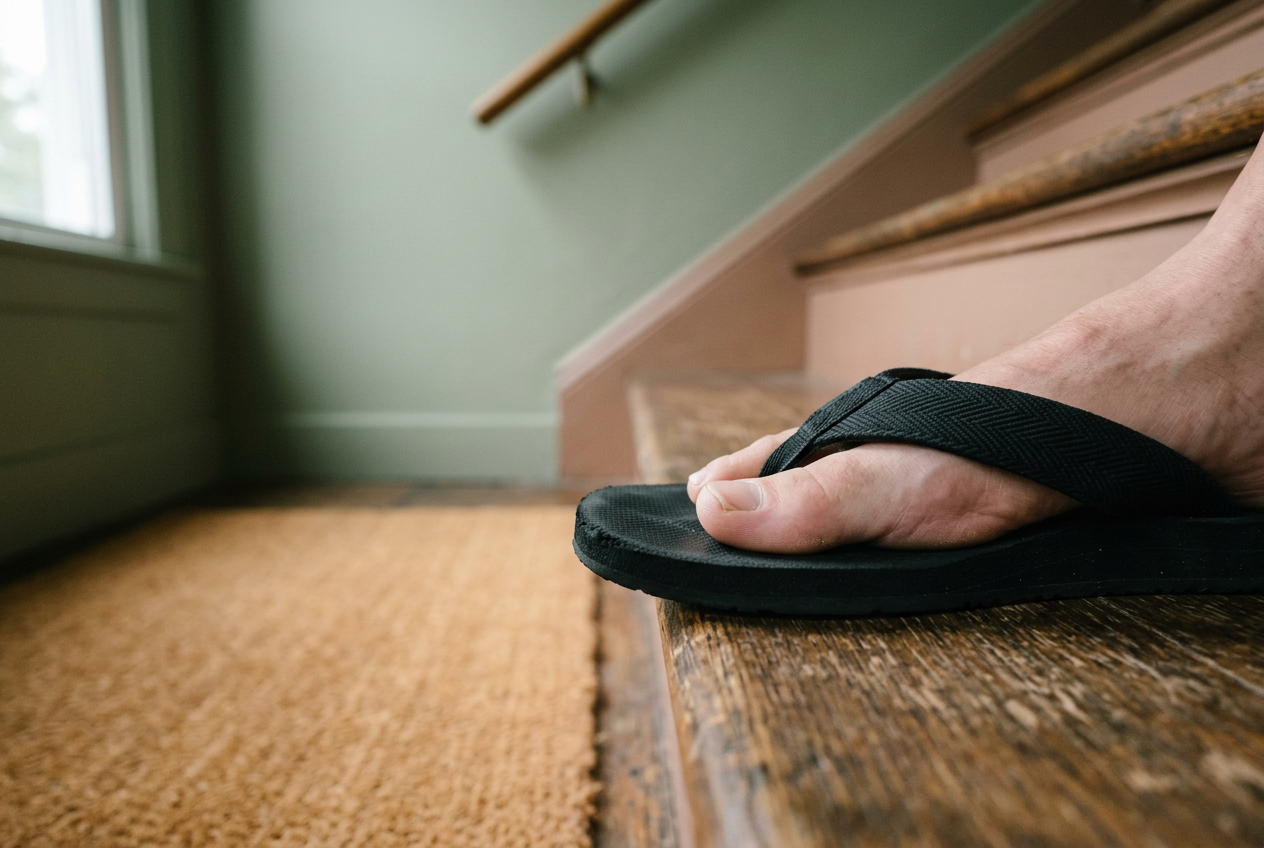
The black test pair looked correctly sized from above. My heel sat inside the footbed, the synthetic thong strap held without pinching, and the widest part of my foot matched the molded EVA sole. At the squared front, though, the footbed continued three-eighths of an inch beyond my longest toe.
That modest shelf became the useful detail. During a week of wearing the pair on the same indoor staircase and along a route with several curbs, its front edge brushed stair risers often enough to alter my foot lift. A comparison pair with roughly one-eighth of an inch beyond the toes cleared cleanly; a roomier pair with about five-eighths required an obvious shorter step. The toes were comfortable.
The architecture had reservations.
This is women’s footwear coverage, based on women’s sizing and the proportions of the tested pairs. The same measurement method can be used elsewhere, but a size label alone will not predict the result.
Measure the ledge while standing
Excess sole means the distance from the end of the longest toe to the forward edge of the footbed, measured in the direction the foot travels. Ignore the projecting square corners. They contribute visual width, but the center front is the section most likely to meet a stair riser, meaning the vertical face between two steps.
Stand normally in both flip-flops before measuring. Weight changes foot length, and a measurement taken while sitting can make a close fit look roomier than it is. Place a small strip of removable tape on the footbed immediately ahead of the longest toe, step out without shifting it, then measure from that mark to the front edge. Check both feet and use the larger result.
On the black EVA pair, the three-eighths-inch gap was easy to miss because the sole and insole were one continuous color. A high-contrast welt, piping, or stacked leather edge makes the projection more obvious, although visibility does not make the ledge shorter.
As a working fit check, up to about one-quarter inch behaved like ordinary toe room in the tested flip-flops. Between one-quarter and one-half inch called for a stair trial, particularly with a stiff or thick sole. Beyond one-half inch changed foot placement enough that I would return the pair unless the wearer has a naturally high foot lift and rarely deals with stairs. These are practical test ranges, not universal sizing rules.
Stairs expose the problem first
Going up was the clearest test. A flip-flop has no back strap, so the sole hangs from the thong and follows a fraction behind the foot as the leg swings. If the squared front also extends well past the toes, that lagging edge has more opportunity to brush the next riser before the foot lands.
The black pair did not produce a dramatic trip. It produced something more common and less cinematic: a light tap, followed by a slightly higher knee lift on later steps. That adjustment kept the sole clear, but it also made the shoe feel more demanding than its flat construction suggested. A flip-flop should not require choreography before coffee.
Descending raised a different issue. The projected front edge reached over the stair nosing, the outer corner where the tread meets the riser, before my toes appeared to be close to it. The foot still had enough support, but the visual relationship between toe position and step edge became less reliable. Looking down at the toes no longer showed exactly where the shoe ended.
Sole construction changed the severity. The molded EVA on the test pair was light and yielded when it grazed a riser, while the denser rubber comparison sole carried more momentum. A thin, flexible foam sole bent more easily, but that flexibility let its front lip fold when it met an edge. Soft does not automatically mean forgiving; sometimes it means the obstacle gets a better grip.
Toe spring also matters. Toe spring is the upward curve built into the front of a sole. A slight curve lifts the leading edge away from a riser, while a flat squared slab keeps more material in the collision path. Many polished square-toe flip-flops are intentionally flat, which gives them their clean profile and gives stairs additional administrative work.
Curbs reward a square approach
The three-eighths-inch test pair behaved better at curbs when I approached straight on and placed the forefoot fully on top before transferring weight. At a diagonal, one squared corner arrived first, and the shoe rotated slightly around the thong strap. The movement was small, though repeated corrections made the pair feel less secure than it did on level pavement.
Stepping down from a curb required a shorter lead than I use in rounded flip-flops. With a long sole, reaching forward heel-first leaves the projecting toe section hovering near the curb face as the foot drops. Bringing the landing foot closer to the curb reduced that contact. It also shortened the stride, which is useful information during a store test: if a shoe makes a normal curb feel unusually deep, the sole may be setting the pace.
Grip cannot cancel excess length. A textured rubber outsole can improve contact after the shoe lands, but it does not prevent the front edge from striking first. Smooth leather soles deserve extra caution because they add less traction once weight transfers, particularly on painted or wet steps. A cobbler may add a thin rubber sole protector to leather, though that addresses grip rather than the dimensions of the footbed.
Notice the stride change before buying
A long square front usually announces itself through compensation. On the test route, I began lifting the knee higher on stairs, taking a shorter step off curbs, and tightening the toes around the thong during quick direction changes. None caused immediate pain. Together, they made a basic flip-flop more tiring than the same flat silhouette with less sole ahead.
Toe gripping deserves attention because buyers often interpret it as loose straps. A thong that sits too far forward can certainly make the foot work harder, but extra sole can produce the same response when the wearer tries to control a platform that extends beyond the foot. Tightening the strap may pin the toes in place without fixing the leading edge.
Sizing down is not a dependable answer. On the black pair, a smaller size reduced the front gap but pushed the heel close to the rear edge and moved the widest part of the foot beyond the shaped section of the sole. The cleaner alternative was the comparison pair with the shorter front projection, even though both carried the same nominal size. Shape beat label.
This distinction matters across price bands. Budget molded synthetics can run long because one footbed shape must accommodate many feet, while pricier leather pairs may deliberately exaggerate the square toe as a design feature. Better materials can improve finish and durability. They cannot negotiate with a stair.
Use a five-minute store test
First, stand in the pair and mark the end of the longest toe with your fingertip or a removable scrap of tape. Measure forward rather than toward either corner. If the gap approaches half an inch, treat the pair as a deliberate long-sole design rather than harmless toe room.
Next, walk at your usual pace and listen. Repeated front-edge scuffs or a louder slap can indicate that the sole is lagging behind the foot. Turn tightly in both directions, since a square corner that drags during a turn will be more irritating outside, where pavement is less level and strangers are less invested in your experiment.
Finally, use the store staircase if staff permit, or test on one safe step at home without removing labels or marking the sole. Go up and down while holding the rail. Add a straight curb-style step and a diagonal one using a low, stable platform. Return the pair if you must raise the knee, shorten the stride, or watch every landing to keep the front clear.
The black EVA pair passed the visual fit check and failed this movement check. Three-eighths of an inch was enough to make me manage the shoe, and the smaller size created a new problem at the heel. The pair with roughly one-eighth of an inch beyond the longest toe kept the squared look without putting extra sole in charge.
Questions people ask
How much space should square toe flip-flops have beyond the toes?
About one-quarter inch or less behaved like ordinary toe room in this evaluation. Between one-quarter and one-half inch deserves a stair and curb test, especially with a flat, stiff sole. A longer gap may still fit the footbed visually, but it can change clearance and stride.
Should my toes reach the edge of square toe flip-flops?
They do not need to touch the edge. A small margin protects the toes and keeps them inside the footbed, but the longest toe should sit close enough that the shoe ends where your stride expects it to end. Check the heel and widest part of the foot before sizing down.
Are thick square toe soles harder to walk in?
Thickness alone is not the deciding factor. Weight, flexibility, toe spring, and excess length work together. A light EVA sole with a slight upward curve may clear steps better than a thinner flat sole whose front lip folds, while a heavy rubber slab can make an extended toe feel more noticeable.
Can a cobbler shorten an overly long square toe sole?
Usually this is not a sensible alteration for molded EVA or rubber flip-flops because trimming can expose the structure, disturb the finish, or change the sole’s balance. Leather construction varies, but reshaping still costs time and money. Returning the pair for a shorter footbed is the cleaner option.
One update a day
Today's fashion update, in your inbox
One fashion update each morning — no hype, no filler, just pieces worth wearing.