Fisherman Sandals Should Cage Your Toes, Not Crush Them
The right cage fit protects toes while letting the shoe bend with your foot. Sizing up may add room, but it can put the sole’s flex point in the wrong place.
October 8, 2026 · 7 min read
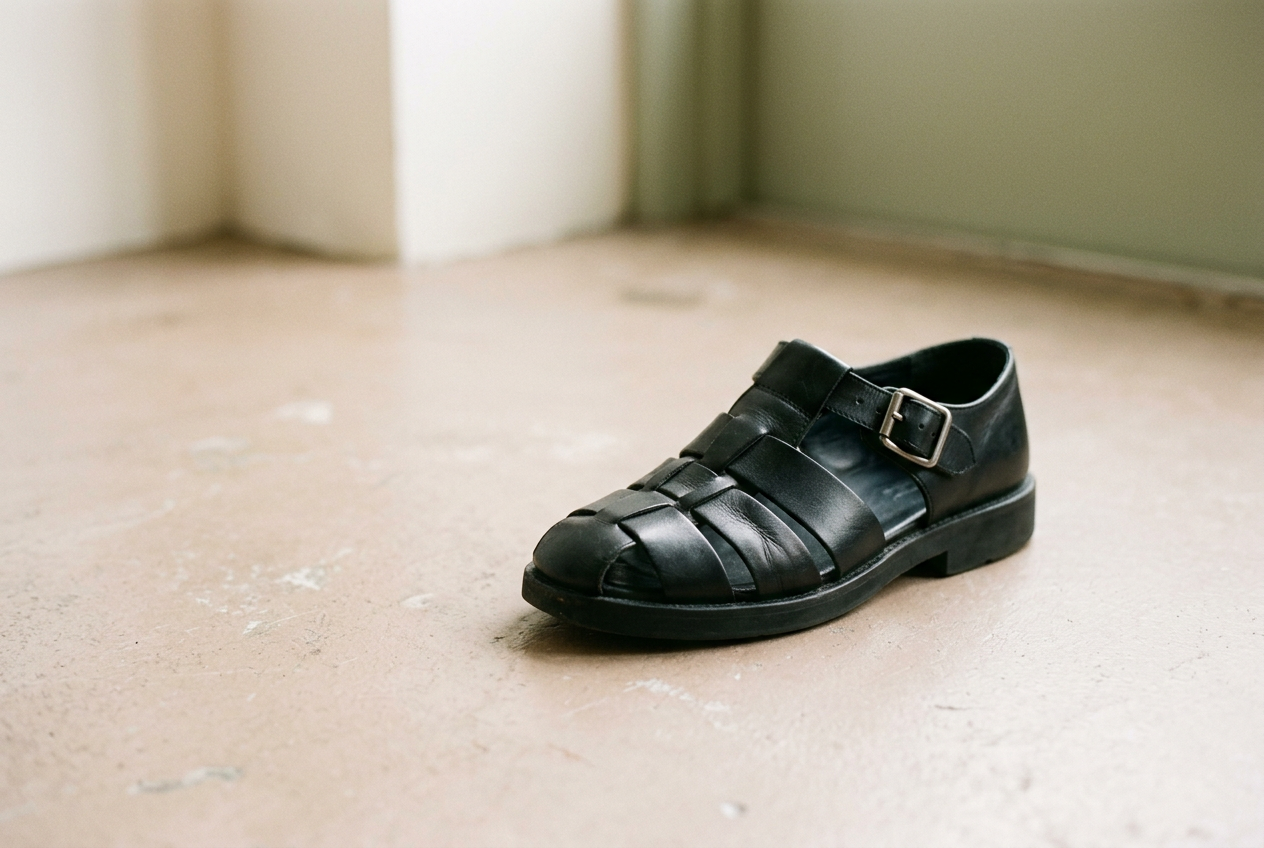
The working example here is a black leather fisherman sandal I wore for a week: stitched leather cage straps, a leather lining, an adjustable buckle strap and a thin rubber outsole. I also tried the same style one size larger indoors. The usual size looked close around the little-toe side at first; the larger one offered more empty space, yet bent behind my foot’s natural hinge and slipped at the heel.
That comparison explains the central nuisance of fisherman sandals. Their closed cage looks protective, and it is, but the same structure that keeps toes away from curbs gives the forefoot fewer places to spread. An open sandal can let a wide foot escape over the edge. A fisherman sandal contains the evidence.
This is unisex fit advice. The numbers printed inside men’s and women’s versions may differ, but the checks below concern where a human foot widens, bends and rises under a strap. Use the brand’s measurements as a starting point, particularly if it publishes actual foot length, then treat the size label as administrative paperwork.
Start with the widest part of the cage
The useful width is not the opening near the ankle. It is the space across the ball of the foot, meaning the broad area beneath the big-toe and little-toe joints, where the foot spreads under body weight.
Put both sandals on and stand before deciding. In the black leather test pair, the cage looked generous while I was seated, but the outside forefoot strap became noticeably closer once weight moved through the foot. Close is acceptable. A hard strap edge sitting directly on the little-toe joint is not, especially if the foot already pushes the leather outward and changes the line of the shoe.
Walk across a hard floor and watch the forefoot during push-off. The toes should widen inside the cage without bulging sharply between straps, and the sandal’s edge should remain visible around most of the foot. A soft impression from a broad leather strap can settle as the upper warms. A narrow red line, pinching at one joint or numbness is not a charming break-in ritual.
It is the shoe filing a complaint against your anatomy.
Leather matters here. Unlined leather may soften and shape to the foot, although raw or stiff edges can rub while that happens; lined leather feels neater but often gives less quickly because two layers must flex. Woven synthetic straps may relax very little, while soft textile webbing can yield without gaining meaningful width in the sole beneath it. No upper can make a narrow footbed wider.
My usual-size pair gave slightly at the outside strap over the week, enough to remove the initial pressure without letting the foot drift. That is the useful version of break-in. If the cage had distorted from the start, I would have rejected it rather than waiting for leather to perform minor orthopedic construction.
Check where the instep strap lands
The instep is the raised top of the foot between the toes and ankle. On a fisherman sandal, the adjustable strap may cross this area or sit farther back near the ankle, depending on the pattern; its placement determines whether the foot stays seated or gets pressed downward.
In the test pair, the strap crossed just behind the highest part of my instep. That position held the heel without cutting into the top of the foot when I bent my ankle. On a higher-volume foot, the same strap could land on the peak and feel tight even when the front cage fits. On a low-volume foot, it might buckle securely yet leave enough vertical space for the foot to slide forward.
Fasten the buckle while standing, then take several full steps and go up on the toes. You should be able to place a fingertip under the strap with mild resistance, though finger tests are only a rough check because fingers, unlike feet, are not standardized equipment. More important, the strap should not pull the heel forward when tightened or lift away from the foot when loosened one hole.
Look at the hardware position as well. A buckle sitting directly over a bony prominence can become irritating once the foot swells in warm weather, while a strap tail that barely reaches the keeper may pop free throughout the day. Neither problem improves the visual austerity of a black cage sandal. It merely gives you a small metal object to resent.
The middle buckle hole is useful, not mandatory
Many fit guides insist the buckle should close on the middle hole. That is a sensible preference because it leaves adjustment in both directions, but feet and strap patterns refuse to obey tidy rules.
The test pair closed one hole tighter than the center while leaving enough strap through the keeper. I still had room to loosen it after walking, and the buckle frame stayed away from the ankle bone. That range mattered more than achieving perfect symmetry on a strip of punched leather.
Reject the fit when you must use the final hole and the strap still feels loose, or when the first hole closes only under tension and pulls the sandal’s quarters, the side sections around the heel, out of shape. An extra hole can sometimes solve a long strap, but it cannot move a badly placed buckle or lengthen a short strap. Altering it may also affect returns, so perform the indoor walk before reaching for a punch.
Swelling deserves room, not speculation. Try sandals later in the day if your feet tend to expand in heat, using the conditions in which you expect to wear them. A secure morning fit that becomes a tourniquet by dinner is technically adjustable, just not in the pleasant sense.
Closed toes need length without a front cave
A fisherman sandal’s toe box, the enclosed space around the toes, hides the front gap that would be obvious in a slide. Press lightly over the upper or inspect through the cage openings to locate the longest toe. It should not touch the closed end while standing or on a slight downhill slope.
The exact visible allowance varies with toe shape and the curve of the sandal, so a ruler alone will not settle this. What matters is that the toes stay clear of the front during a purposeful stride, while the broadest part of the foot still aligns with the broadest part of the shoe. Too little length produces contact. Too much allows forward travel, especially if the instep strap cannot hold the heel.
In my usual size, the longest toe remained behind the front wall and the cage creased across the toe joints. In the larger comparison pair, the extra closed-toe space looked harmless from above, but my foot slid farther before the strap caught it. The sole also bent behind the joints rather than beneath them.
That bending location is the flex point, meaning the part of the shoe designed to fold as the foot pushes off. Check it by walking, not by folding an empty sandal in your hands. If the flex point sits too far forward, the foot fights a stiff section with every step. If it sits too far back, the upper can crease into the toes while the heel lifts.
Why sizing up can make width worse
Going up a size increases length reliably. It does not reliably add useful width, because the last, the foot-shaped form around which a shoe is built, usually scales in several directions at once. The cage may become a little broader, but its widest point and flex point also move forward.
That was the failure in the larger black sandal. It relieved the outside forefoot strap while standing still, yet the relief came from placing my foot farther back in a longer shoe; during walking, the heel moved and the sole folded late. Tightening the buckle reduced the slip but pressed the instep down. One problem had recruited two assistants.
If the normal length pinches across the forefoot, look for a wide fitting or a different pattern with fewer, broader cage straps. A more open woven sandal can offer lateral give, while a huarache-style upper may distribute pressure differently, though either alternative provides less protection at the front. A wide footbed in the correct length beats surplus toe space disguised as generosity.
Price does not cancel geometry. Fisherman sandals run from high-street synthetic versions to leather pairs priced like substantial shoes, and the more expensive construction may bring cleaner lining, firmer hardware or a sole worth repairing. None of that makes a narrow last accommodate a wide forefoot. Pay for materials after the fit works.
Use the return window before the pavement
Do the first check on a clean hard floor with the socks, if any, you intend to wear. Stand long enough for the foot to spread, walk at normal speed, turn tightly and test a stair. Carpet can hide heel movement and a rigid sole; outdoor wear can end the return option before you have learned anything useful.
I kept the usual-size black pair because its pressure eased without the cage deforming, the buckle retained adjustment and the sole flexed beneath the toe joints. The larger pair failed indoors. That was fortunate. There are more entertaining ways to discover a sizing mistake than several blocks from home with a buckle already tightened to its limit.
Questions people ask
Should fisherman sandals feel tight when new?
They may feel close across broad leather straps, but they should not cause sharp pressure, numbness or deep strap marks. The test pair softened slightly at the outer forefoot during a week of wear; it did not gain a new width. Synthetic cages and heavily lined leather generally offer even less reason to gamble on stretching.
How much room should fisherman sandals have at the toe?
The longest toe should remain clear of the closed front while standing, walking and moving down a slight slope. Avoid buying so much extra length that the foot slides forward or the shoe bends behind the toe joints. The hidden gap matters less than correct alignment through the widest part of the foot.
Should
I size up in fisherman sandals for wide feet?
Only if the larger size keeps the flex point beneath your toe joints and the heel secure without overtightening the instep strap. In the pair tested here, sizing up reduced static pressure but created heel movement and a misplaced bend. A wide fitting or roomier cage pattern is the better fix.
Can a buckle hole be added to improve the fit?
A shoe repair shop can often add a clean hole to a leather strap, but that only helps when the strap is too long and the buckle already sits correctly. It cannot repair a short strap, misplaced hardware or an oversized shoe. Check the return policy before altering anything, then make sure the strap tail still reaches its keeper.
One update a day
Today's fashion update, in your inbox
One fashion update each morning — no hype, no filler, just pieces worth wearing.