Your Sneakers Can Be the Right Length and Still Bend Wrong
A sneaker can leave enough room at the toes yet pinch at every step. Check whether the ball of your foot meets the shoe’s intended flex point before changing sizes.
September 26, 2026 · 7 min read
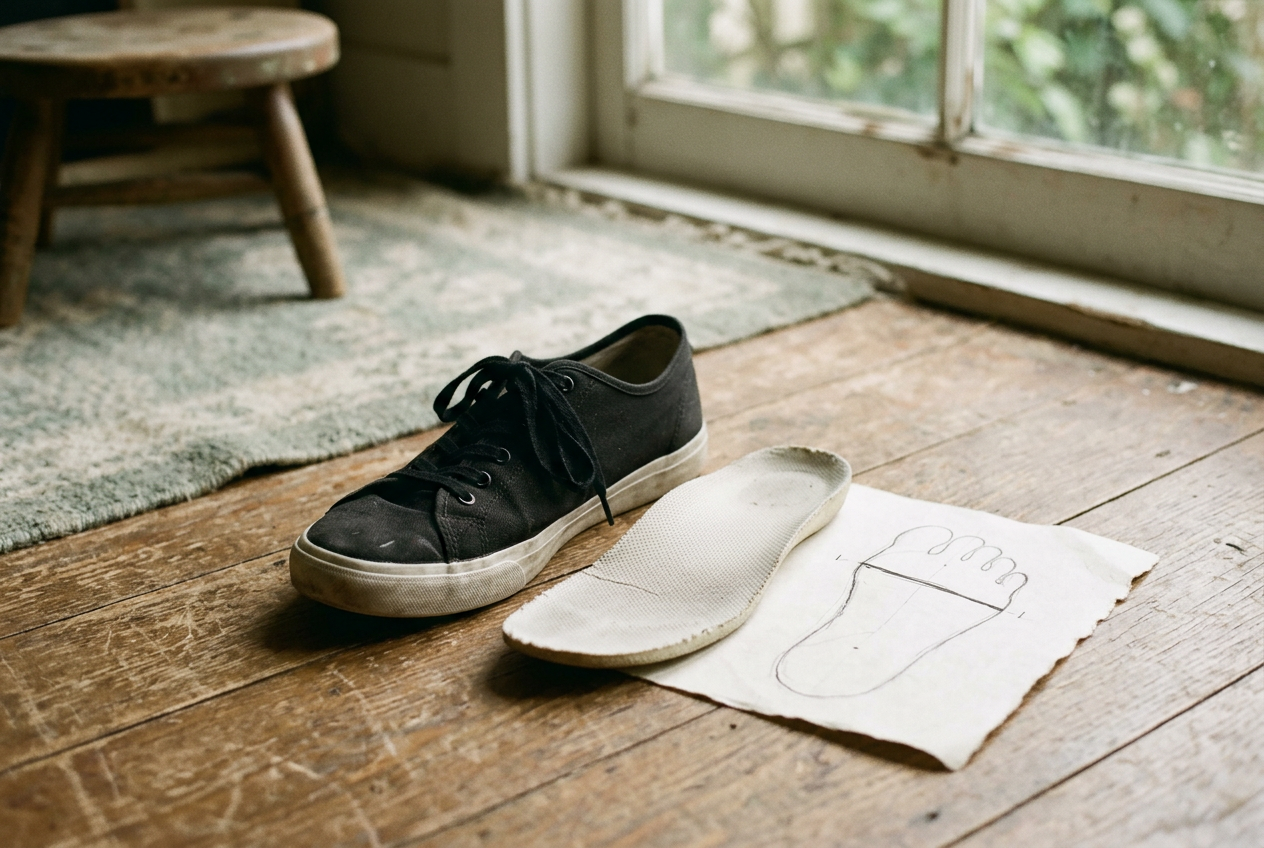
The useful clue in my black low-top canvas sneaker was not at the toes. There was roughly a thumb’s width of empty space ahead of them, the heel stayed put, and the laces did not need winching. On paper, the length worked. Walking still pressed the inside edge of the upper against the big-toe joint, while the rubber sole felt reluctant to follow the foot.
That combination points to heel-to-ball fit, meaning the distance from the back of the heel to the main forefoot joint. The measurement receives less attention than overall length because it rarely appears on a shoe box, yet it determines whether a conventional sneaker bends where your foot bends.
This is unisex fit advice. Men’s and women’s size labels may use different scales, but the mechanical check is the same.
Start with the foot, not the size label
The ball of the foot is the padded area behind the toes where the long foot bones meet the toe bones. Its inner edge is easy to locate: stand barefoot and feel for the prominent joint immediately behind the big toe. On the outside, find the corresponding bump behind the little toe. The line between them may angle rather than run straight across.
Check while standing because the foot spreads under body weight. A seated outline can make the forefoot look tidier than it behaves once it has been assigned a pavement.
Place each bare foot on paper, distribute your weight normally, and mark the big-toe and little-toe joints with the pencil held upright. Trace the heel as well. Draw a line between the two joint marks, then note where that line sits in relation to the back of the heel. You do not need to turn this into a home surveying project.
The goal is to identify the flex line and compare its position with the shoe.
A second method is quicker in a store. Put on the sneaker, stand, and press along both sides of the upper until you feel those joints. Mark their position mentally against a seam, eyelet or change in the sole pattern. The widest part of the foot may not match the visually widest part of the sneaker, especially when rubber sidewalls disguise the usable interior shape.
On the black canvas pair, my big-toe joint sat behind the broadest-looking section of the rubber sole. That explained why the shoe looked roomy from above but still folded fabric into the joint when I stepped.
Find where the sneaker wants to flex
The flex point is the section of the sole designed to bend during the push-off part of a step. Put on both shoes, lace them as you would outside, and walk at your normal pace rather than taking exaggerated fitting-room strides. Watch where the upper first creases across the forefoot. A phone video taken from the side can help, although a mirror and several slow steps are enough.
Next, remove the shoe and bend it gently with your hands. Hold the heel in one hand and press upward beneath the forefoot with the other. Do not fold a new shoe in half to prove a point. A conventional flexible sneaker should give most readily around the same area where your toe joints sat when you were standing.
Hand flexing is supporting evidence, not the verdict. A foot loads the sole differently from a hand, and thick rubber can soften after wear. The walking crease matters more because it shows the foot and shoe negotiating in real time, without either party behaving especially generously.
The canvas pair creased in front of my big-toe joint. My foot tried to bend behind the sole’s preferred hinge, so the upper tightened across the joint before the shoe rolled forward. More break-in could soften the canvas, but it would not move the sole’s geometry backward.
If the sockliner, meaning the removable layer directly beneath the foot, comes out, use it as another check. Stand on it with the heel aligned against the back edge. The joint marks should sit near the sockliner’s broad forefoot area rather than spilling over its sides or landing far behind it. Do not treat the sockliner outline as the whole interior, since some sit above tapered sidewalls, but obvious overhang is useful evidence.
Read the mismatch before changing size
When the foot’s flex line sits behind the shoe’s, the sneaker can feel too long mechanically even if toe clearance looks sensible. Common signs include upper creasing ahead of the joints, pressure at the big-toe joint and a step that feels delayed as the sole resists bending. Going down half a size may move the shoe’s flex point backward, but it also removes toe room. If the toes then meet the front, the smaller size has fixed one problem by hiring another.
When the foot’s flex line sits ahead of the shoe’s, the toes may feel crowded and the upper may cut across the joints as the shoe bends behind them. Sizing up can move the flex zone forward, though excess heel movement or too much empty toe space may follow.
Width complicates both cases. A wide version usually adds room around the forefoot, but it does not always change heel-to-ball length. If the joints align with the shoe’s flex point and merely press against the sides, extra width is a reasonable next test. If the joints sit clearly behind or ahead of that point, another model built on a different last, the foot-shaped form used to construct a shoe, is often the cleaner answer.
This was the decision with the black canvas sneaker. A smaller size compromised toe clearance, while loosening the laces changed pressure across the top without changing the bend. The useful alternative was not more patience. It was a low-top with a shorter heel-to-ball position and a rounder usable forefoot.
Run the check in the store
Allow about five minutes once both shoes are on. First, stand and locate the two forefoot joints through the upper. Then walk long enough for the shoe to flex repeatedly, checking whether the main crease crosses those joints. Remove one shoe, flex it gently by hand, and compare that bend with the position you noted.
Repeat the test on both feet because one may be longer or have a differently placed forefoot. Fit the harder foot, provided the other can still be secured without crushing it through the laces. Use the socks you expect to wear; a thick sock changes volume and pressure, although it does not relocate your bones.
Stay on a clean indoor surface until the decision is made, and check the return policy before attempting an outdoor trial. A shoe that only feels acceptable after you shorten your stride is not passing. Neither is one that needs the laces left loose enough for the heel to lift.
Know when flex alignment is not the issue
Some running and walking shoes use a rocker sole, meaning the curved sole rolls forward while remaining relatively stiff. Hiking shoes with plates and certain performance sneakers may also resist bending under the ball by design. For those, judge whether the roll begins smoothly beneath your foot rather than demanding a visible hinge at the joint line.
Aligned flex will not correct every source of pain. Toe-box shape, arch placement, heel hold and upper seams can each spoil an otherwise sensible match. Persistent pain, numbness or swelling deserves attention beyond another round of sneaker shopping.
Questions people ask
How much room should be left in front of the toes?
Enough that the toes do not strike the front during walking or downhill movement, often around a thumb’s width as a rough fitting clue. Hand sizes and shoe shapes vary, so combine that check with secure heel hold and correct ball alignment rather than treating one gap as a universal measurement.
Can sneakers with the wrong flex point break in?
Canvas, leather and foam may soften, which can reduce surface pressure. Break-in does not substantially relocate the sole’s intended bend, so a shoe that consistently hinges ahead of or behind the toe joints may become softer without becoming mechanically better matched.
Does a wide sneaker fix heel-to-ball fit?
It can fix side pressure when the foot’s widest point already lines up with the shoe’s flex area. If that point sits too far forward or backward, added width supplies space around the mismatch but usually does not correct its position.
What if the sneaker has a stiff rocker sole?
Do not expect a rocker shoe to fold beneath the ball like a canvas sneaker. Walk in it and check that the curved sole carries you forward without pinching the toe joints, forcing heel lift or making you alter your normal stride.
One update a day
Today's fashion update, in your inbox
One fashion update each morning — no hype, no filler, just pieces worth wearing.