Your Sandal Buckle Fits Sitting Down. Test It on Stairs.
An ankle strap can seem perfectly adjusted in a chair, then press after a few blocks. A five-minute standing and stair check exposes the problem before the soles meet pavement.
September 19, 2026 · 7 min read
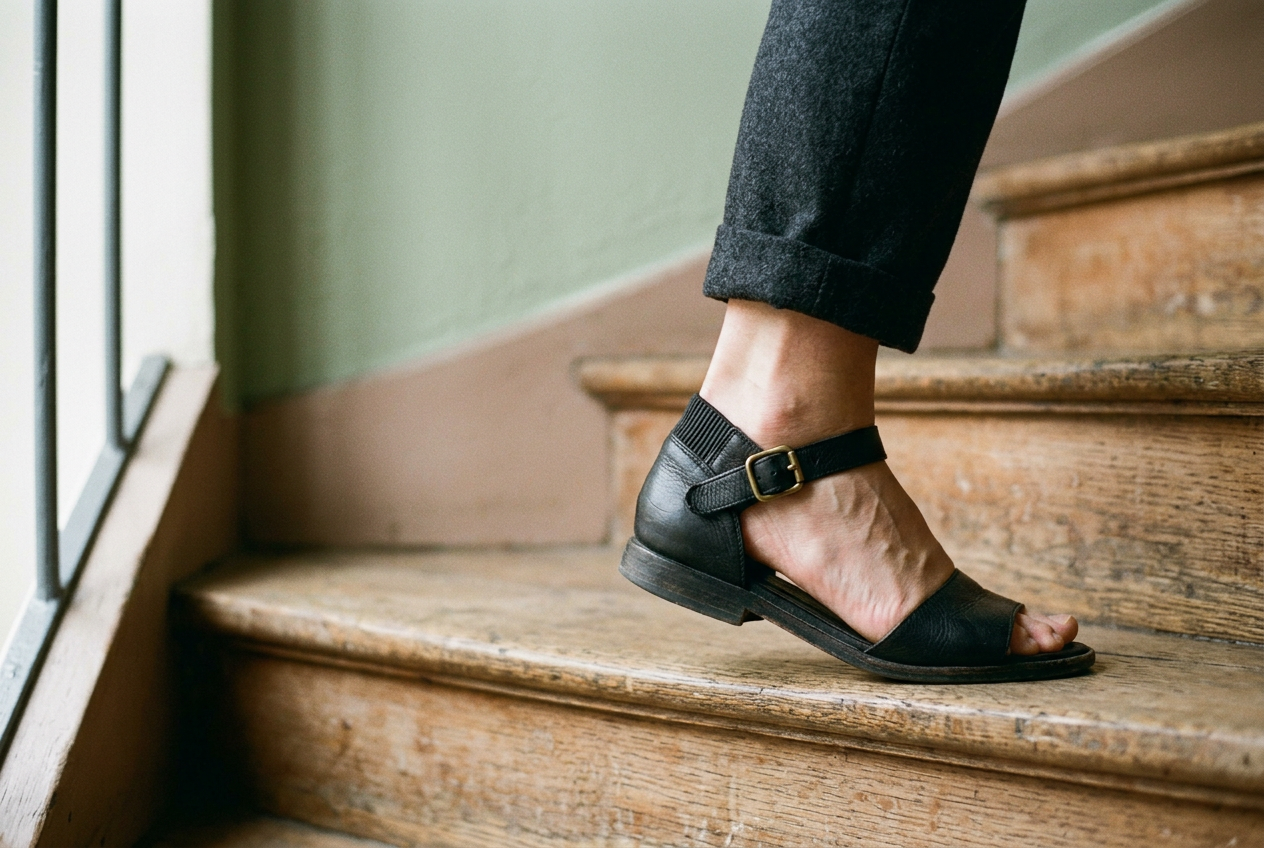
The problem pair was a black leather sandal with a low block heel, a five-hole ankle strap, and a small elastic insert hidden behind the buckle. Seated, the third hole gave the expected fit: close enough to hold the heel, with room for a fingertip. Standing made it firmer. A flight of stairs turned the buckle into a small metal objection.
That progression matters more than the chair test most of us perform in a store. Your ankle is not fixed at the circumference and angle it holds while your knee is bent, your foot is resting flat, and you are thinking mainly about whether the shoe looks good in the mirror.
This is unisex fit advice. Women’s and men’s sizing labels can change the available widths and proportions, but ankles, straps, and buckles still have to negotiate the same basic movement.
The ankle changes shape even when the bones do not
An ankle strap does not sit around a rigid cylinder. When you stand, weight moves into the foot, soft tissue shifts, and the tendons at the front and sides of the ankle become more prominent. The measured change may be modest, but a short leather strap has very little spare length, so modest is enough.
Walking adds repeated changes in angle. As the shin moves forward over the foot, the ankle enters dorsiflexion, meaning the top of the foot moves closer to the shin. The skin and tissue beneath a high ankle strap become fuller in one part of the stride, then relax again. A strap adjusted to be exact while seated may therefore press at every step rather than feeling uniformly snug.
Stairs exaggerate the issue because the ankle bends farther while the heel lifts and the shin travels forward. On the black sandal, the third buckle hole remained wearable while standing still, yet climbing pushed the strap into the front-outside section of the ankle. The pressure was not spread evenly. It landed beneath the buckle and at the lower edge of the leather, which made the shoe feel tighter than the strap’s overall length suggested.
Heat and time add another complication. Feet and ankles can become fuller after walking or standing, particularly on warm days, so a pair tried early in the day may have less margin later. This does not mean every sandal needs a visibly loose ankle strap. It means the final hole choice should come from movement, not upholstery.
Buckle position decides where the pressure lands
A buckle is thicker and less flexible than the strap around it. If it sits directly over the outer ankle bone, or close enough to catch that area as the strap shifts, extra length elsewhere will not necessarily rescue the fit. The hardware can still press during side-to-side movement.
Look at the buckle while standing rather than assuming it stays where the shoemaker placed it. A strap often rotates slightly once it carries the backward pull of the heel, especially when its anchor points sit at different heights on the sandal. On the black pair, the buckle began beside the ankle bone while seated and crept forward under load, bringing the leather keeper, the small loop that holds the strap tail, into contact with the skin.
The buckle tongue can create its own lump if the punched hole is stretched, poorly centered, or backed by several layers of folded material. Check the inside with a finger. A smooth lining may conceal the hardware well; an exposed fold or rivet can make an otherwise acceptable strap feel punitive after ten minutes.
Moving to a looser hole helps only when the heel remains controlled. If the sandal begins lifting heavily, the strap slides onto a new pressure point, or the forefoot claws to keep the shoe attached, the fit has not been fixed. The discomfort has been reassigned.
A small elastic insert has limits
Many ankle straps include elastic gore, a short stretch panel sewn into the strap so it can expand during movement. It is useful when the panel is soft enough to respond and long enough to offer meaningful give. It is decorative optimism when it stretches only after the leather has already pressed into the ankle.
Pull the strap gently while the shoe is off. The gore should extend without requiring a hard tug, then recover without staying rippled. Next, buckle the sandal and watch the insert while standing. If it is already stretched close to its limit before you take a step, it has no reserve for stairs, swelling, or the longer stride you use outside.
The insert on the black sandal looked promising but was too short to absorb much change. It softened the first moment of pressure, then reached its limit, leaving the buckle and leather to take the remaining load. This is why the mere presence of elastic should not be treated as evidence of comfort. Construction matters more than the product description.
A longer gore may feel easier but can reduce stability, especially in a heeled sandal where the ankle strap helps prevent the foot from sliding forward. There is a tradeoff. The useful version stretches during the deepest part of the step without allowing the heel to wander for the rest of it.
Strap angle can turn snug into sharp
A level-looking strap is not always level once worn. The angle comes from where the strap attaches to each side of the upper, how high it sits behind the ankle, and where the buckle adds weight. If the front edge bears most of the tension, that edge can cut while the rest of the strap appears loose.
Run a fingertip under the full width after standing for a minute. Equal resistance is the aim. If the fingertip passes easily beneath the upper edge but stops at the lower one, the strap is tilted into the ankle. Loosening may reduce pressure, though it will not correct an attachment point that forces the same angle at every setting.
Width changes the sensation too. A narrow strap concentrates force into a smaller area, while a broad strap distributes it but may restrict bending if it sits high. Soft leather can conform with wear; coated synthetic material may remain stiffer, and a raw or heavily sealed edge can continue rubbing even after the main strap relaxes. “It will break in” is not a useful plan for metal hardware, a badly placed rivet, or an edge that meets the same spot on every stair.
Use the standing and stair test before keeping the pair
Do this indoors on a clean floor while the return option remains intact. Wear the pair with the same bare foot, stocking, or sock planned for normal use, since even a thin layer changes friction and available strap length.
- Buckle both sandals while seated, using the loosest hole that still prevents obvious heel escape. Do not pull the strap tight before inserting the buckle tongue.
- Stand normally for one minute. Shift weight between feet, then check whether the buckle has moved toward either ankle bone and whether one edge of the strap feels more loaded.
- Walk for several minutes at a normal pace, including turns. Listen for heavy heel slapping and notice whether your toes grip the sole; both suggest that loosening the ankle strap has compromised hold.
- Climb and descend a flight of stairs at an ordinary pace while using the railing. Pressure that appears only on the ascent usually points to limited room during deeper ankle flexion, while rubbing on the descent can reflect the foot sliding forward and pulling against the strap.
- Sit again, but do not unbuckle immediately. Look for a sharply defined mark beneath the buckle, keeper, rivet, or strap edge. A temporary broad impression is different from a narrow red line, pinching, burning, or numbness.
The whole check takes about five minutes. On the black leather pair, loosening from the third hole to the fourth stopped the stair pressure but introduced too much heel lift, and the elastic panel could not cover the difference. That pair was not a break-in project. It was the wrong strap geometry for that ankle.
A better alternative would place the buckle away from the ankle bone, use a longer responsive gore, or set the strap slightly lower so it crosses an area that changes less during flexion. Sandals with hook-and-loop fastening offer finer adjustment than punched holes, although the fastening can look more casual and may collect lint. Extra holes are useful only when their placement preserves enough strap beyond the buckle to sit securely in the keeper.
Questions people ask
How tight should a sandal ankle strap be?
It should hold the heel without forcing the toes to grip, yet leave enough room for the ankle to flex on stairs. A fingertip check is only a starting point. The better standard is whether pressure stays broadly distributed while walking rather than collecting under the buckle or one strap edge.
Will a leather ankle strap loosen with wear?
Leather may soften and gain a little flexibility, particularly where it bends around the ankle. Do not expect wear to relocate a buckle, flatten exposed hardware, or correct a strap attached at the wrong angle. If the stair test produces sharp pressure, keeping the pair on faith is an expensive way to test leather’s patience.
Does elastic make an ankle strap more comfortable?
It can, provided the elastic stretches easily and still has reserve when you are standing. A short or stiff insert may reach its limit before the ankle reaches full flexion, at which point the leather and buckle take over. Watch the insert during a stair step rather than judging it while the shoe is off.
Can another buckle hole fix the pressure?
Sometimes. Use the looser hole, repeat the walking and stair test, and check whether the heel remains controlled. If pressure disappears but heel lift, sliding, or toe gripping begins, the adjustment has traded one fit failure for another. Return the sandal rather than adding a hole that leaves too little strap secured beyond the buckle.
One update a day
Today's fashion update, in your inbox
One fashion update each morning — no hype, no filler, just pieces worth wearing.