Your Cork Footbed Sandals Got Soaked. Skip the Hair Dryer
A soaked cork-latex footbed may recover, but heat can turn a wet sandal into a warped one. Here is how to dry it and tell a suede stain from structural damage.
November 3, 2026 · 7 min read
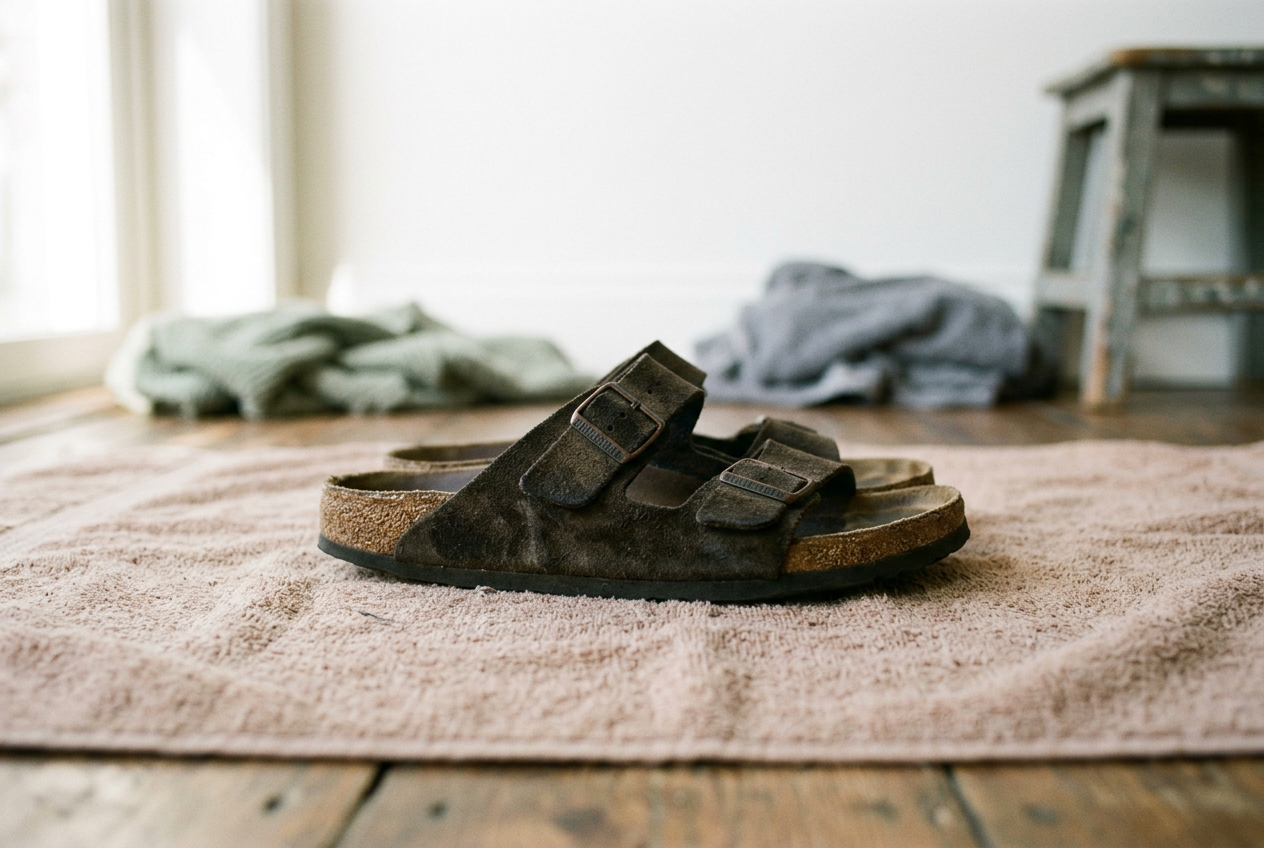
The concrete case here is a Birkenstock Arizona Suede Leather sandal worn barefoot through an unexpected soaking. Birkenstock identifies this model as having a suede upper, a suede footbed lining, a contoured cork-latex footbed and an EVA outsole, which makes it a useful example because every wet-weather weak point is visible rather than hidden inside a sneaker.
This is unisex care advice. The same drying logic applies across sizes and wardrobes, although a larger or thicker footbed may take longer to dry through than its surface suggests.
Birkenstock’s public care guidance says cork footwear should not be immersed and should dry slowly away from direct heat. That second instruction matters. A hair dryer may make the suede feel dry sooner while the cork underneath remains damp, and concentrated heat can shrink or distort parts of the footbed before moisture has escaped from its center. The result is a sandal that looks rescued until one arch feels oddly ambitious.
What the water reaches
The Arizona’s sidewall has a cork sealant, a protective coating applied to exposed cork to slow moisture loss and water entry. After a soaking, that coating may look dull, pale or patchy. Water can also find worn areas where the sealant has thinned, particularly around the flex point near the ball of the foot and along edges that have been scuffed against pavement.
A change in sheen does not prove the cork underneath has failed. Once the sandal is dry, intact cork should still feel firm and hold the same molded outline as the other shoe. Cork that remains unusually soft, sheds granules under light finger pressure or has opened into a deep crack deserves more suspicion than a chalky-looking surface.
Above the cork sits the suede lining. Suede has a nap, meaning the short raised fibers that give it a soft, changeable surface, and water can flatten those fibers while moving sweat, skin oils or dye toward the edge of the wet area. When that moisture evaporates, it may leave a tide mark. The color can look alarming because the boundary dries darker or lighter, but discoloration alone does not change arch support.
Then there are the joined layers. Birkenstock’s product documentation identifies the materials but does not publish the exact adhesive formula or promise that a saturated bond can be restored at home. Treat any new lifting between the cork-latex footbed and EVA outsole as possible delamination, meaning bonded layers have begun to separate. Do not push household glue into a wet seam.
It can trap moisture, leave a hard ridge and make a later repair less straightforward.
Footbed shape is the final concern. Cork-latex is resilient, but wearing it while saturated loads the heel cup and arch while the materials are in an abnormal state, so a wet walk continued for convenience can do more harm than the original splash. Take the Arizona off once practical. Bare feet drying at home are an inconvenience; a footbed dried around a distorted contour is a longer appointment with discomfort.
The drying sequence
First, undo both straps and remove loose grit with a soft, dry cloth. Blot standing water from the suede lining, upper and cork edge with an absorbent colorfast towel, using light pressure rather than rubbing. Scrubbing wet suede can roughen one area while flattening another, creating a second cosmetic problem before the first has been assessed.
Put the Arizona in its normal shape on a dry towel in a room with ordinary air circulation. Keep the straps open so air reaches the lining, and make sure neither sandal is leaning at an angle that presses the wet cork edge out of line. Change the towel when it becomes damp. Later, shift the sandals enough for air to reach the outsole and lower edge without balancing them in a bent position.
Leave heat out of it. Birkenstock specifically warns against direct heat and prolonged exposure to strong sunlight, including hot cars, because excessive heat can damage or shrink cork footwear. That rules out the radiator, heated floor, clothes dryer and hair dryer, even on the setting that sounds tactful. A fan across the room is gentler than a concentrated blast placed inches away.
Wait until the footbed is dry beneath the surface, not merely dry to the touch. The suede lining may lose its cool, damp feel before the cork edge has returned to an even color, particularly where the sealant was already worn. There is no honest universal drying time because saturation, room humidity and footbed thickness vary; rushing the Arizona back onto a warm foot is the expensive option disguised as the efficient one.
Once everything is dry, use a suede brush gently on the lining and upper to lift flattened nap. Brush in a consistent direction and stop if the surface begins shedding more than loose fibers. A tide mark may soften without disappearing. Avoid saturating the footbed with cleaner to chase perfect color, since another wet treatment repeats the condition you have just spent time reversing.
Inspect the exposed cork sidewall last. If it looks dry or has lost its sealed finish, Birkenstock sells Cork Sealer for exposed cork edges; follow the product directions and keep it off the suede footbed lining. Sealant is maintenance, not structural filler. It will not pull separated layers together, restore a crushed arch or turn crumbling cork back into a sound footbed.
Cosmetic mark or support problem
Set the dry pair side by side on a flat surface. The soaked Arizona does not need to match its mate in color, but it should sit with a comparable heel position, arch contour and toe angle. A slightly altered suede tone, flattened nap or visible water boundary is cosmetic if the platform remains stable and the cork feels firm.
Next, press around the cork edge with moderate fingertip pressure and look along the join above the EVA outsole. The edge should not feel mushy, release crumbs or reveal a gap that opens when the sandal flexes. A narrow surface line in the sealant is less concerning than a crack that travels into the cork or changes width under light movement.
Try the sandal indoors only after it is dry. Stand briefly on a clean, level floor, then compare the pair rather than relying on memory. Stop if the soaked side rocks, places the arch in a new position, lets the heel tilt or produces a hard pressure point that was absent before. Those are support changes, even if the suede has dried beautifully enough to distract from them.
Visible separation, persistent softness or a changed contour calls for assessment by a shoe repair shop or the brand’s customer service rather than another coating of care product. Repair may make sense when the upper and footbed remain sound and only an edge bond has lifted. A broadly distorted or crumbling cork-latex platform is a poor candidate for cosmetic optimism.
The material tradeoff
The classic Arizona earns its familiar underfoot shape from the cork-latex footbed, but that construction is not intended to behave like pool footwear. If regular soaking is part of the plan, a one-piece molded EVA sandal is the practical alternative because it has no suede lining or exposed cork sidewall to dry and reseal. It will feel different, may trap more sweat against bare skin and still should not be baked in a hot car.
For occasional city wear, the cork version remains reasonable if rain is an accident rather than the itinerary. The care cost is time: blotting, slow drying, brushing and checking the bond before the next outing. Anyone unwilling to grant a sandal that much convalescence should assign the Arizona to dry forecasts. Shoes are allowed boundaries, even when those boundaries are inconveniently meteorological.
Questions people ask
Can
I wear cork footbed sandals while they are still damp?
Wait until the lining and footbed are dry through. Walking in them while damp adds body weight and repeated flexing before the cork-latex and bonded layers have stabilized, which can encourage a changed contour or expose a weakened seam. The suede may also rub differently when wet.
Will a water stain ruin the suede footbed?
A tide mark or patch of flattened nap is usually cosmetic if the dry footbed remains firm, stable and unchanged in shape. Brush the suede gently only after drying. Repeatedly wetting the lining with cleaner to remove a stubborn mark may create more staining without improving support.
Should
I put cork sealer on immediately after the sandals get wet?
No. Let the sandals dry fully, then inspect the exposed cork edge. Cork sealer belongs on clean, dry cork that has lost its protective finish, following the product label; it should not be used to fill deep cracks, bond the outsole or coat the suede lining.
When is a soaked cork sandal beyond home care?
Seek repair guidance when the dry sandal rocks, the arch or heel cup has changed, cork stays soft or crumbly, or a gap opens between the footbed and outsole. A remaining suede tide mark does not meet that threshold by itself. Compare both shoes on a flat floor before deciding.
One update a day
Today's fashion update, in your inbox
One fashion update each morning — no hype, no filler, just pieces worth wearing.