Soaked Cork Sandals Can Dry. The Curling May Stay.
A saturated cork-latex footbed needs slow airflow, not heat. Suede usually recovers better than cracked cork or lifted edges, and resealing cannot flatten structural damage.
October 24, 2026 · 8 min read
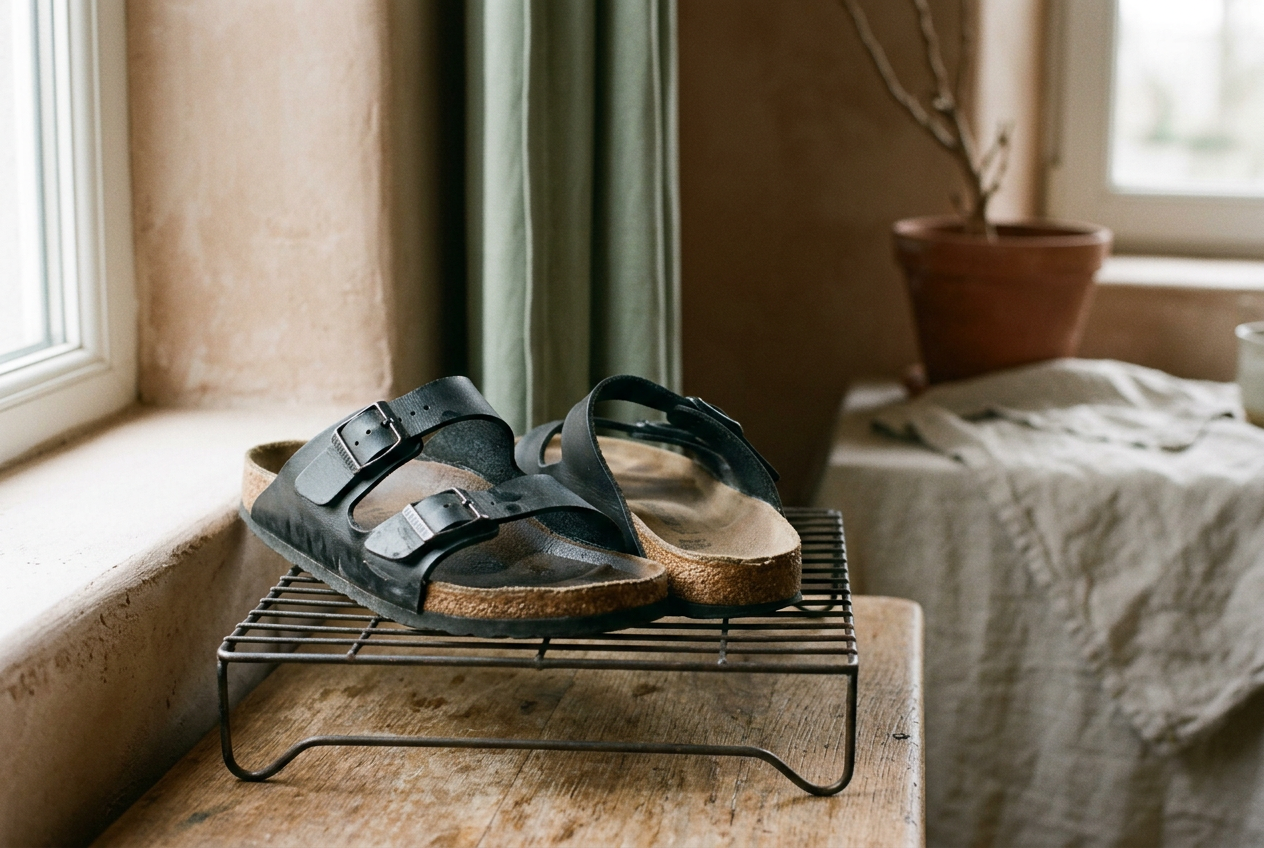
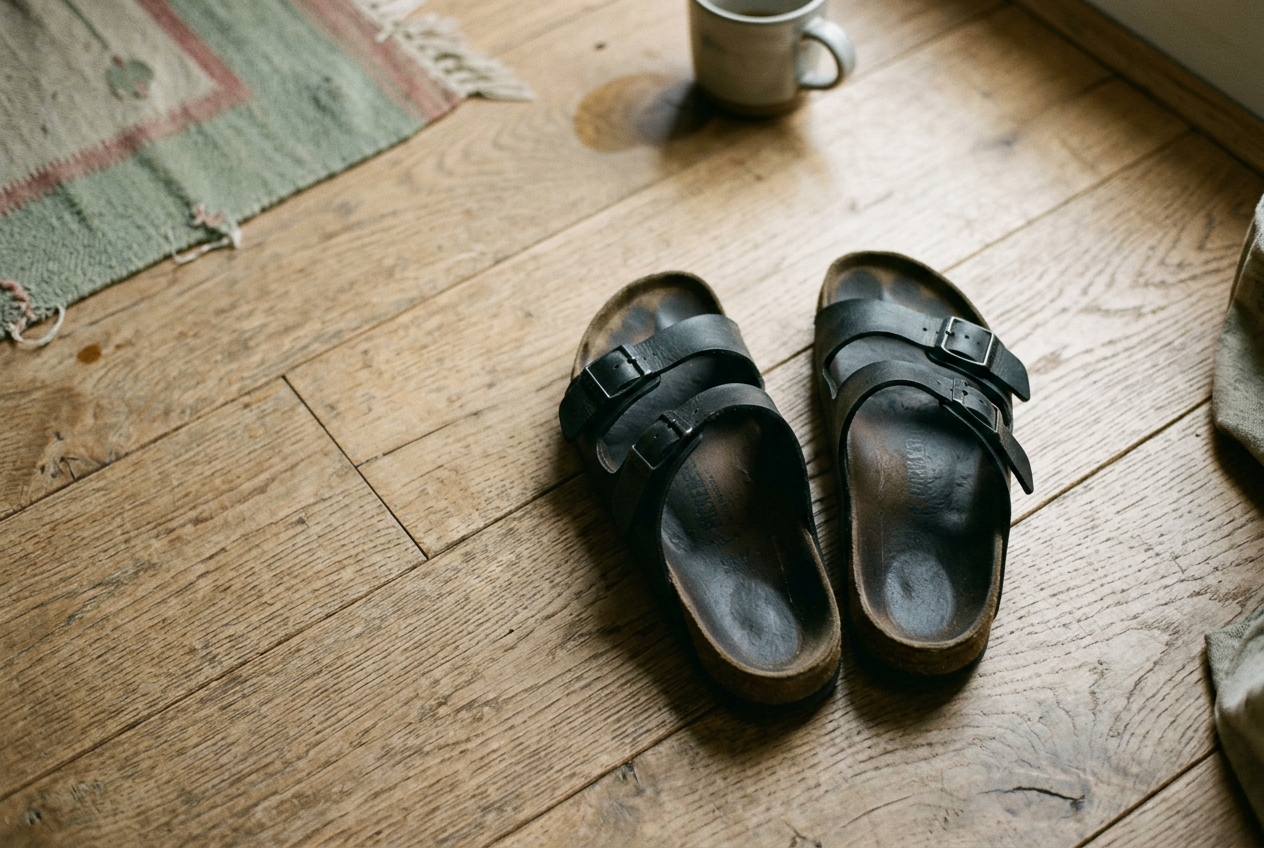
The test pair was a well-worn black two-strap sandal with a cork-latex footbed, a suede lining and a dark edge coating. A cork-latex footbed is granulated cork bound with latex, which gives the platform enough resilience to take a footprint without behaving like loose bulletin-board material.
I saturated one sandal across the lining and exposed footbed edge, then kept its mate dry as a control. This was an ordinary accident rendered repeatable: enough water to darken the suede throughout and wet the cork perimeter, rather than a quick splash wiped off at the door. The soaked sandal was not worn during drying, and it received no hair dryer, radiator or direct sun, because speed is where a recoverable soaking becomes a warped little argument with gravity.
This advice applies to unisex cork-footbed sandals across wardrobes. Strap placement and size grading vary, but water does not care which side of a shoe department supplied the pair.
What saturation changes first
The suede looked worse before the cork did. Its surface darkened unevenly, the nap collapsed and the lining felt slick under a finger, all of which can suggest permanent ruin while the material is still wet. Suede nap means the raised fibers that give the leather its soft surface; those fibers tend to lie down when saturated and can be lifted later if the lining dries without hardening.
The footbed edge needed closer attention. Its edge sealant, the flexible coating painted around exposed cork to slow moisture loss and abrasion, turned dull in places and felt less firm than the dry sandal’s coating. Existing hairline gaps became easier to see. That does not mean the sealant dissolved, but saturation reveals weak coverage because water darkens any cork exposed beneath it.
The sandal also became easier to distort by hand. I did not test that generosity. Wet cork-latex can tolerate ordinary handling, yet bending the shoe while its binder and adhesives are damp adds stress exactly where the platform meets the outsole. Carry a soaked pair flat.
Do not fold the sandals sole-to-sole or wedge them into a packed tote, however appealing that arrangement looks when everything else in the bag is also wet.
The drying sequence that did the least harm
First, I removed loose grit with a damp cloth around the outsole and straps, taking care not to scrub mud farther into the suede. Salt water, dirty street runoff and chlorinated pool water leave residues, so a light wipe with clean water is more useful than allowing the contaminants to dry in place. Do not rinse the whole sandal again unless its maker specifically recommends that treatment.
Next came blotting. I pressed an absorbent towel onto the suede and around the cork edge without rubbing, changed to a dry part of the towel and repeated until it stopped picking up much water. Rubbing wet suede can roughen one patch while flattening another, producing a footbed that looks scrubbed rather than rescued.
I opened both straps to expose as much lining as possible, set the sandal level and raised it on a small rack so room air could reach the outsole as well as the upper surface. A fan placed across the room kept air moving without blasting one edge. The dry mate sat beside it, which made new curling, color differences and changes in sole alignment much easier to judge than memory would have done.
Then I left it alone. Drying time changes with humidity, footbed thickness and how deeply water entered the cork, so the useful test is not a fixed number of hours. Press a clean paper towel against the lining and inspect the cork edge in good light; if either still feels cool, looks dark or transfers moisture, the sandal is not ready for brushing, sealing or walking.
Heat would have shortened the wait and raised the risk. A hair dryer can harden leather, soften adhesive unevenly and dry the exposed face of the cork before moisture deeper in the footbed has escaped. A radiator or hot windowsill can also encourage curling because one surface contracts faster than another. Slow drying is dull.
Dull is excellent shoe care.
What recovered on the test sandal
The suede recovered most convincingly. Once it felt dry rather than cool, I used a clean suede brush with light strokes in one direction, then changed direction over the areas where the nap remained flat. The lining did not return to unworn uniformity, which was never available on a well-used footbed, but it lost the slick wet appearance and no longer felt pasted down.
The cork-latex platform remained level against the dry mate. Its edge lightened as moisture left, and the sandal sat flat without rocking when placed on a hard surface. That matters more than small color variation. A dry footbed that keeps its shape, stays bonded to the outsole and does not flex at a new fault line has survived the soaking, even if the suede now carries a tide mark.
The edge coating was less obliging. Thin areas looked chalkier after drying, while preexisting cracks remained visible and slightly more open than they had appeared on the control sandal. Sealant is sacrificial. It protects the cork edge, but repeated flexing and abrasion eventually break the coating, especially near the ball of the foot where the sandal bends.
Curling and cracks mean different things
A slight upward movement in a thin suede lip is mostly cosmetic. The lining can contract as it dries, particularly where it extends beyond the supporting cork, and careful brushing may make that edge less noticeable. Do not trim it while damp. Leather that looks oversized during drying can settle once its moisture level evens out.
Curling of the whole footbed is structural. Place both sandals on a flat counter and view them from the heel and toe. If the wet shoe now lifts at one side, rocks under light pressure or has developed a new twist through the arch, the layers have dried out of alignment. Wearing it may force the sandal flatter for a few minutes, but body weight is not a repair method and the distorted platform can change where the arch support meets the foot.
Cracks require the same distinction. A split limited to the dark edge coating can often be cleaned and resealed after the footbed is dry. A crack that continues into the cork, opens when the sandal bends or releases crumbs under light pressure signals damage below the coating. Painting over it may improve the color while hiding the line, but it cannot rebond broken cork-latex.
Separation is clearer. If a gap has opened between the cork platform and rubber outsole, or between the suede lining and the footbed, stop wearing the sandal until it is assessed. Adhesive failure between layers is called delamination, and every flexing step can lengthen the gap. A shoe repair shop may be able to reglue a clean, accessible separation, although a footbed that is warped, soft or fractured may not justify the labor.
Resealing has one narrow job
Home resealing makes sense when the sandal is fully dry, the footbed remains flat and the only problem is worn or cracked edge coating over sound cork. Use a product intended for cork footwear, follow its instructions and keep it off the suede, straps and outsole. A thin coat is easier to control than a heavy one, which can dry as a conspicuous ridge and still fail to penetrate a structural split.
Before applying anything, brush away loose material and compare the damaged sandal with its mate. Press the cork lightly beside the crack. Sound cork should feel cohesive rather than spongy or granular; if the edge sheds, compresses or moves independently from the sole, adding sealant is cosmetic concealment.
The black two-strap test sandal qualified for a light reseal only after its shape and bond had been checked. The coating needed maintenance, not reconstruction. Had the platform rocked on the counter or shown a crack traveling under the heel cup, I would have skipped the bottle and taken the pair to a repair shop. Edge sealer costs less than professional work, but buying it to lacquer a failed footbed is still wasted money.
The point at which replacement wins
Retire or professionally assess the pair if the arch support has shifted, the heel cup has twisted, a crack crosses the load-bearing footbed or the outsole has separated across a broad area. Persistent musty odor after thorough drying also deserves caution because moisture may remain trapped inside the layered construction, where surface brushing cannot reach it.
Fit supplies another test. Put on the dry sandals indoors for a brief check, without committing to a long walk, and notice whether one arch now presses differently or one heel rolls toward the edge. Cork-footbed sandals are bought for a shaped platform. Once that geometry changes, saving the upper while tolerating a misplaced ridge is a poor bargain in comfort.
For future wet days, the practical alternative is a molded EVA sandal, with EVA meaning a lightweight closed-cell foam that does not absorb water like suede-lined cork construction. It will feel and look different, and it may offer less individualized molding, but it is the pair to take near a pool or into persistent rain. Cork-latex sandals are walking shoes with some resilience, not amphibious equipment.
Questions people ask
Can
I wear cork sandals while they are still damp?
No. Walking flexes the damp footbed, presses moisture deeper into the suede and loads any weakened adhesive joint. Wait until the lining no longer feels cool, the cork edge has returned to its normal color and the sandal sits flat beside its dry mate.
Can a hair dryer stop cork sandals from smelling?
A hair dryer may dry the surface quickly while leaving moisture inside, and concentrated heat can harden suede or distort bonded layers. Use room-temperature airflow above and below the sandal; if a musty smell remains after thorough drying, surface deodorizing will not resolve moisture trapped in the footbed.
Will cork sealer fix a crack in the footbed?
It can cover small failures in the edge coating and protect sound cork from further exposure. It will not reconnect a crack that enters the cork-latex, flatten a curled platform or close a gap between the footbed and outsole.
How do
I know if soaked sandals are safe to keep wearing?
Compare both shoes on a flat surface, then check for rocking, twisting, crumbling cork and separation between layers. If the dried sandal stays level and feels unchanged during a short indoor fit check, routine edge maintenance may be enough; altered arch pressure or a spreading gap calls for repair or replacement.
One update a day
Today's fashion update, in your inbox
One fashion update each morning — no hype, no filler, just pieces worth wearing.