Platform Sandals Can Feel Soft and Still Tip Sideways
A thick foam sole may cushion impact while bending badly across a slope. Test sideways flex, heel compression and your heel-to-toe roll before buying.
Women's · November 1, 2026 · 8 min read
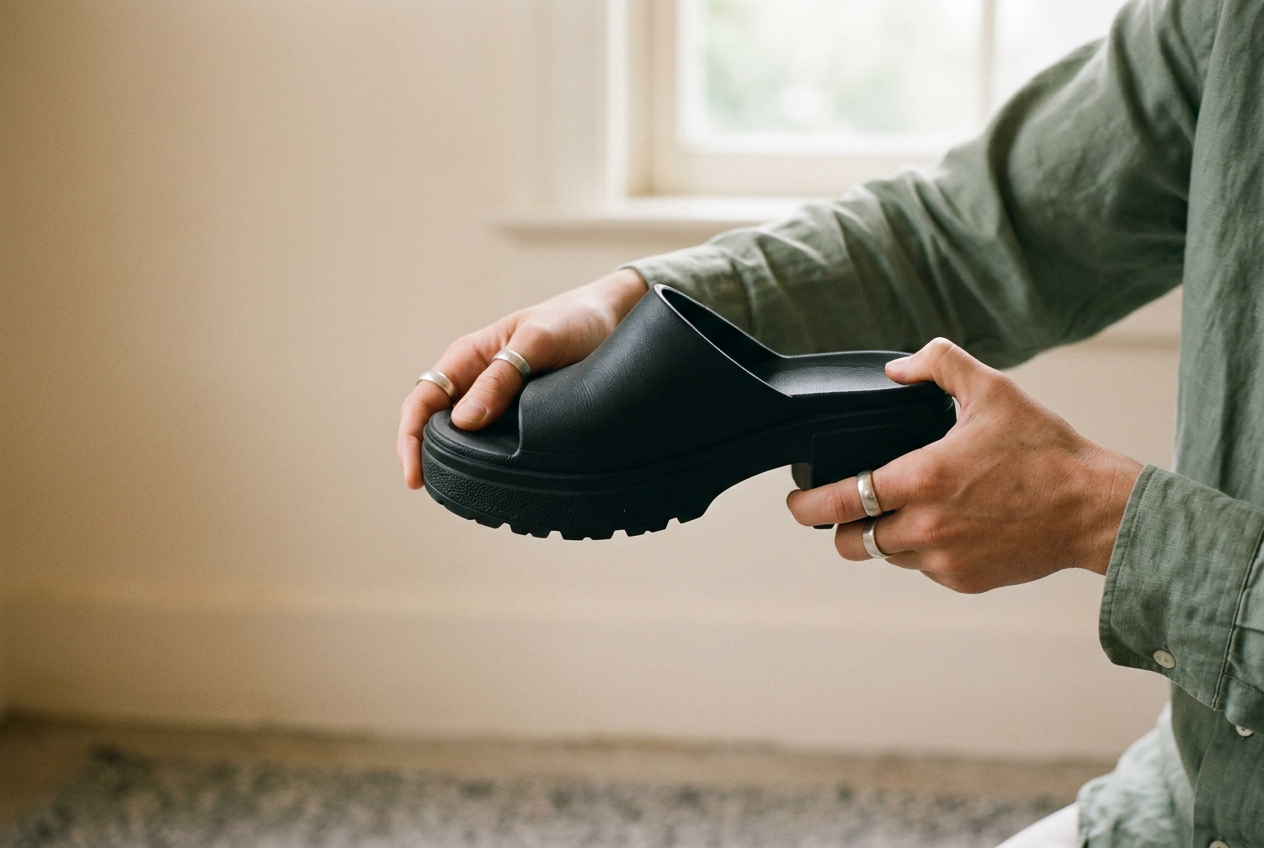
The useful test case is a black women’s platform sandal with wide synthetic straps and a one-piece molded EVA sole, meaning the entire platform is formed from lightweight foam rather than separate heel, midsole and outsole layers. It looks sensible. The upper holds most of the foot, the sole has plenty of surface area, and pressing a thumb into the heel produces a reassuring dent.
That last detail is persuasive in a store and incomplete on a sidewalk.
During a hands-on evaluation, the sample felt pleasantly soft while standing on level tile. At the edge of a floor mat, where one side of the sole sat slightly higher than the other, the platform leaned before the foot could correct it. The wide straps kept the sandal attached, but they could not make the base behave. A shoe can fit securely and still supply a small, mobile floor under each foot.
This advice applies to women’s platform sandals, particularly fashion styles with thick foam soles and minimal internal structure. The same mechanics can appear in other sizing categories, but women’s styles often combine more height with a narrower waist through the midfoot, so this fitting-room test focuses on that construction.
Start by ignoring the thumb test
Pressing the footbed tells you whether the material compresses under one small point. It does not tell you how the full sole moves when your weight shifts toward an outside edge, which is what happens on a sloped sidewalk, a driveway or the rounded lip of a curb cut.
Put on both sandals and fasten them as you would wear them. Do not pull an ankle strap tighter than is comfortable just to make the shoe pass. Walk several lengths of the store at your normal pace, then stop with your feet hip-width apart. A platform that feels calm only when you shorten your stride and concentrate on landing centrally has already assigned you unpaid work.
The black EVA sample passed the first few steps because the foam muted the contact with the tile. That softness disguised how much the heel moved laterally, meaning from side to side, once weight landed a little off-center. Cushioning softened the landing; it did not guide it.
Look at the upper while walking. Broad straps should keep the ball of the foot from sliding over the edge, while the heel should land near the center rather than drifting inward or outward. If the upper stretches as the sole tilts, the apparent security comes from your toes gripping the footbed. Toes are not structural components, despite their willingness to take on extra shifts.
Check lateral flex with the sandal off
Hold the sandal at the heel with one hand and the forefoot with the other. Apply gentle opposing pressure as if wringing a towel, but stop well before forcing the material. This checks torsional stiffness, which is the sole’s resistance to twisting along its length.
Some twist is normal, especially in lightweight foam. The concern is a thick platform that rotates easily through the middle while the upper stays fixed to the turning surface. On the test pair, the front and rear sections moved in opposite directions with modest pressure, and the narrowest part of the sole took most of the twist. That matched the movement felt at the mat edge.
Compare the twisting movement with a lower sandal or sneaker from the same store. This is not a contest to find the stiffest object available. A completely rigid platform can slap the ground and make the transition through each step awkward, while a very flexible one can fold around uneven pavement. The useful middle ground resists an easy sideways twist but still bends near the ball of the foot.
Next, place the sandal on a flat bench or low fitting platform, with staff permission, and press down around the outside edge of the heel. Watch the whole base rather than the dent under your finger. If one side collapses readily and the upper tilts with it, body weight will exaggerate that movement.
Do not balance on furniture or manufacture an obstacle course between the mirrors. The store would prefer to sell one pair of shoes, not host an incident report.
Test heel compression under body weight
Foam density matters more than visual thickness. A deep platform made from low-density EVA can compress farther than a slimmer, firmer sole, particularly under the heel where impact arrives first. Heel compression is the amount the sole sinks under load; uneven compression is the part that can make a slope feel steeper than it is.
Stand normally, then transfer most of your weight to one foot without lifting the other completely. Notice whether the loaded heel settles straight down or drifts toward an edge. Repeat on the other side. Shoes and bodies are not perfectly symmetrical, so a problem that appears on only one foot still counts.
The sample platform sank comfortably when pressure stayed centered. When the heel moved slightly outward, the outside wall compressed more and the upper followed the lean, creating a delayed correction rather than a firm boundary. On a smooth store floor, that movement was manageable. On a sidewalk that already angles toward the street, the sole would begin the step partly tilted and then compress farther on the low side.
Inspect the shape from behind. A heel that flares outward at the bottom generally creates a broader base than one with vertical or undercut sidewalls, though shape alone cannot guarantee stability. Press the rear corners and compare their resistance. Visible air pockets, decorative cutouts or deeply scooped sidewalls can remove material exactly where an off-center landing needs support.
A molded heel cup, the raised rim that cradles the back of the foot, can reduce sliding inside the sandal. It cannot rescue a platform that folds underneath it. The black sample had a shallow rim, useful for locating the heel but too slight to counter the base’s lateral compression.
Walk through the heel-to-toe transition
A thick one-piece sole has to decide where it bends. Your foot would usually flex near the ball, but a platform may rely on a rocker, meaning a curved sole profile that rolls the body forward without much forefoot bending.
Walk slowly enough to notice the sequence, without turning it into theater. The heel should contact the floor, the body should travel forward, and the toe should leave without the platform catching or forcing the foot to pivot over one abrupt point. Then return to your usual pace. A shoe that works only during a slow inspection may become clumsy once you are trying to cross a street before the light changes.
The test pair flexed little at the forefoot and used a mild rocker instead. On level tile, that produced a smooth enough roll. At the mat edge, the rocker shortened the portion of the sole touching the ground just as the foam was leaning sideways, so the sandal felt less planted during push-off than its broad outline suggested.
Listen as well as feel. A loud slap may indicate that the sole is landing as one block rather than moving with the stride, although sound varies with flooring and material. More important is any repeated need to lift the knee higher, shorten the step or grip with the toes to clear the front edge. Those adjustments become tiring before the sandals become technically painful, a distinction familiar to anyone who has carried attractive shoes home in a tote.
Use the store’s ordinary uneven surfaces
A polished aisle is the easiest possible assignment for a platform. Before paying, walk over the store’s normal floor transitions: tile to carpet, a thin entrance mat or an accessibility ramp if one is present and open to customers. Keep the test modest and use a handrail where available.
Approach a slight incline straight on, then take a few natural diagonal steps. Sloped sidewalks rarely meet the foot at a tidy right angle, and diagonal loading exposes lateral flex faster than walking directly uphill. The sandal should remain predictable rather than forcing the ankle to chase the sole.
This was where the black platform failed the buying decision. Its softness remained pleasant, the straps still fit, and the silhouette worked with wide-leg pants and a midi skirt. The base tipped enough on the diagonal that wearing it would require choosing routes and monitoring pavement. That is too much administration for a mass-market foam sandal, regardless of how agreeable it feels beside the cash register.
Know which compromise you are buying
One-piece EVA platforms have real advantages. They are light for their volume, easy to wipe clean and often less expensive than sandals built with leather uppers, a structured midsole and a separate rubber outsole. The tradeoff is that one foam compound may have to provide cushioning, shape and ground contact, jobs that benefit from different material properties.
A better alternative need not look orthopedic or abandon the platform. Look for a lower platform with a wider heel, firmer foam around the perimeter or a layered construction that pairs a cushioned footbed with a denser carrier underneath. A rubber outsole can improve grip, though traction and stability are separate: a grippy sole may still tilt, while a stable sole may slide if its tread and compound are poor.
Paying more does not settle the issue. Construction does. A costly platform can remain unstable if height, narrow sidewalls and soft foam work against one another, while a plain molded sandal may pass if its base is broad and its compound rebounds evenly. Spend the fitting time instead: several minutes walking, twisting the unworn shoe gently, checking heel compression and using one ordinary floor transition.
If the store lacks any safe uneven surface, buy only with a return policy that allows indoor try-on. Test the sandals at home on hard flooring and a thin rug without marking the soles. Once the platform asks your ankle to correct every imperfect landing, repack it. Softness has made its case; the rest of the shoe has not.
Questions people ask
How much should a platform sandal twist?
A lightweight platform may twist slightly, but the middle should resist easy rotation when you gently turn the heel and forefoot in opposite directions. If the sole twists readily through its narrowest point, test it on a normal floor transition and watch for sideways movement under the heel.
Does a wider platform always make a sandal more stable?
No. A broad outline helps only if the material supports weight near its edges. Soft foam can collapse unevenly, and an undercut heel can leave less ground contact than the platform appears to have when viewed from above.
Can an ankle strap fix an unstable platform sole?
An ankle strap can stop the foot from sliding or lifting out of the shoe, but it cannot prevent the sole from compressing or twisting underneath. Tightening the strap until the platform feels controlled may create rubbing while leaving the original stability problem in place.
Are firm platform sandals automatically better?
No. Excessively rigid soles may slap, catch at the toe or force an abrupt heel-to-toe roll. Look for resistance to sideways twisting and uneven heel compression, paired with forefoot flex or a smooth rocker that lets you walk at your normal pace.
One update a day
Today's fashion update, in your inbox
One fashion update each morning — no hype, no filler, just pieces worth wearing.