A Hot Car Can Shrink EVA Sandals Past a Wearable Fit
EVA foam can contract, twist, or lose its molded shape under trapped car heat. Check footbed alignment and sole contact before deciding a warped sandal is merely ugly.
October 20, 2026 · 7 min read
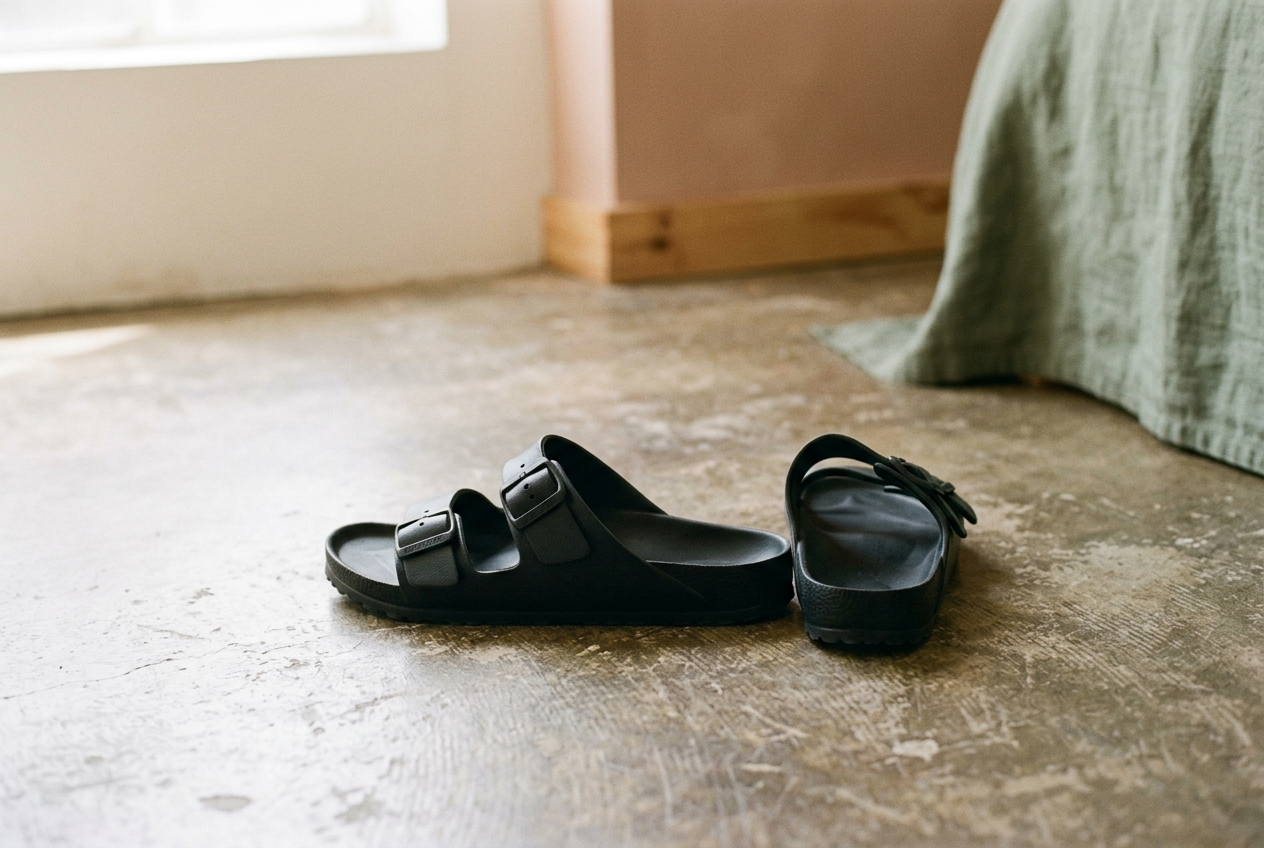
Use the Birkenstock Arizona EVA as the reference pair: a molded sandal with two adjustable straps, a shaped footbed, and an outsole made as one continuous EVA structure. Leave that structure in a closed car under strong sun, and heat can change several parts at once. The result may be shorter overall length, a tightened strap position, a twisted sole, or a footbed that no longer puts its raised contours where your foot expects them.
This is unisex care advice. The relevant fit issue is not whether the sandal came from a women’s or men’s size range, but whether its length, width, footbed contours, and outsole still line up with the foot that wore it before the heat exposure.
Why EVA changes shape in a hot car
EVA, meaning ethylene-vinyl acetate, is a flexible plastic copolymer commonly expanded into lightweight foam. Molded sandal foam contains tiny gas-filled cells that reduce weight and add cushioning, but the finished material can lose dimensional stability under enough heat, especially when the temperature stays elevated or one part receives more radiant heat than another.
A closed vehicle creates an awkward combination. The air becomes hot, sun through the glass heats exposed surfaces more intensely, and a sandal may rest against a seat, floor mat, or another shoe that holds one section in place while the rest warms. EVA does not need to turn liquid for the shape to change. It can soften, contract as manufacturing stresses relax, or deform under its own weight and whatever is pressing against it.
That explains why two sandals from the same pair may come out differently. One Arizona EVA might lie flat in the shaded footwell, while its mate sits near a window with a strap folded underneath. The second sandal receives a less even heat load and is constrained in a different position, which makes asymmetrical twisting more plausible than neat, uniform shrinkage.
Birkenstock’s public care information warns that EVA footwear can shrink when exposed to high heat and specifically advises against leaving it in a closed car. Crocs gives similar heat precautions for its molded foam footwear, including avoiding hot cars and direct sun during drying. Those warnings matter more than internet demonstrations in which somebody reheats a shoe and declares victory before walking around the block.
The distortions that change fit
Start with length. Put the Arizona EVA beside its mate with the heels aligned, provided only one appears damaged. A shortened sandal may leave less space behind the heel or ahead of the toes, and the change does not have to look dramatic on the floor to feel rude after half an hour of walking. Toes hanging over the front edge and heels sitting on the rear rim are fit failures, not a new silhouette.
Width changes can be less obvious. The footbed may narrow while the straps draw inward, making a previously comfortable buckle setting press across the forefoot. Adjusting the buckle can create more strap room, but it cannot restore lost platform width; if the side of the foot now spills over the edge, the sandal has changed beyond what hardware can solve.
Then inspect the molded landmarks. The Arizona EVA has a heel cup, a raised arch area, and a toe bar, meaning the ridge that sits behind the toes. Heat-related shrinkage can shift those features relative to the foot even when the sandal still appears wearable from above. An arch mound that presses too far back or a toe bar that lands under the toe joints can turn familiar support into a concentrated lump.
That is not a break-in problem.
A curled strap end or a slightly wavy upper surface may be cosmetic if the sandal still fits normally and the buckle works without strain. Discoloration alone also says little about fit. The practical dividing line is whether the changed shape redirects pressure, crowds the foot, or alters how the sole meets the ground.
Check the sole on a hard floor
Clean any grit from the outsole, then set each sandal unworn on a hard, level surface. Do not judge it on carpet. Press lightly at the heel and forefoot while watching for diagonal rocking, a lifted outside edge, or a section that snaps down and springs back up. Compare the pair rather than expecting the entire outsole to touch everywhere.
Some sandals have toe spring, the intentional upward curve at the front that helps the foot roll through a step, so a raised toe is not automatically heat damage. The warning sign is a new asymmetry: one Arizona EVA twists toward the big-toe side, balances on a narrow strip, or rocks while its mate remains stable.
Next, look across the heel from behind. A heat-warped sole may cant the foot inward or outward before body weight even arrives. Once loaded, soft foam can hide part of that tilt, but hiding is not correcting; the wearer may still compensate through the ankle, and a sandal that used to disappear underfoot can become surprisingly managerial.
Try the sandal indoors only if it sits securely and shows no severe distortion. Keep the usual buckle setting at first, stand with weight evenly distributed, and check whether the heel remains centered and the footbed ridges land in their old positions. Stop if the sole feels unstable or an edge folds under. A long outdoor trial is a poor diagnostic method because the return journey is included.
Reshaping is possible in theory, unreliable at home
EVA responds to heat, which is precisely why reheating looks tempting. The problem is control. A home user generally cannot know the foam formulation, its original molding conditions, the extent of cell damage, or the temperature difference between the sandal’s surface and interior. Adding more heat may soften one area before another, deepen the shrinkage, weaken the texture, or exchange one twist for a different twist.
Boiling water, an oven, a clothes dryer, a dishwasher, and close-range hot air all add burn or equipment risks while offering no dependable route back to the factory geometry. Stretching the warm sandal over a foot is worse. Skin becomes the form around which hot material is being manipulated, and discomfort is not a calibrated manufacturing tool.
A mildly distorted sandal may relax somewhat after cooling at ordinary room temperature, particularly if it was only temporarily bent by luggage or another shoe. Leave it unloaded, indoors, and away from direct heat before reassessing it. That is waiting, not reshaping, and there is no promise that a heat-shrunken footbed will recover.
Return to the Arizona EVA’s toe bar and arch contour. Even if someone manages to make the outsole look straighter, there is no practical home check that proves those internal fit landmarks have returned to their former dimensions. Cosmetic improvement should not be confused with restored fit, particularly when the sole had been rocking or the sandal became visibly shorter.
Prevention costs less than replacement
Treat a car as transport, not shoe storage. The trunk is not a reliable cool zone, and parking in shade does not keep interior temperatures fixed as the sun moves. Bring EVA sandals indoors, especially if they are a branded comfort pair priced above basic pool slides and replacing them would be annoying rather than trivial.
After washing, use mild soap if the brand permits it, rinse without very hot water, and let the sandals air-dry out of direct sun. Keep them away from radiators and other concentrated heat sources. If a wet pair must travel, place it loosely in a tote rather than trapping a folded strap beneath the sole, then remove it from the vehicle at the destination.
For people who habitually keep backup shoes in the car, a different material does not eliminate the problem. Rubber compounds, polyurethane foams, adhesives, and decorative finishes all have their own heat limits. Check the maker’s care guidance for the exact pair, or store the backup somewhere temperature-controlled. The glamorous alternative is carrying the shoes inside.
It remains undefeated.
Questions people ask
Can
EVA sandals shrink after one afternoon in a hot car?
They can. The outcome depends on the foam formulation, exposure, placement inside the vehicle, and whether part of the sandal was bent or weighted while warm. There is no useful universal time threshold, so inspect the pair rather than assuming a brief stay was harmless.
Can shrunken EVA sandals stretch back with wear?
Normal wear may soften the feel of pressure points, but it will not reliably restore lost outsole length or move a molded arch and toe bar back into position. If your toes or heel now reach the edge, wearing the pair longer asks your foot to accommodate the damage.
Is a slightly warped sole still safe to walk in?
A cosmetic ripple may be tolerable if the sandal remains stable, fits as before, and contacts the floor like its mate. Retire it from regular walking if it rocks diagonally, tips the heel, folds at an edge, or makes you change your stride.
Should
I contact the brand about a heat-damaged pair?
You can send the retailer or manufacturer clear photos of the outsole, side profile, and two sandals aligned heel to heel. Brand staff may clarify care or replacement options, but accidental heat damage may not qualify for a remedy. Do not add more heat before asking, since that can obscure the original damage.
One update a day
Today's fashion update, in your inbox
One fashion update each morning — no hype, no filler, just pieces worth wearing.