Soft Mesh Sneakers Can Fit Wide and Still Spill Sideways
A flexible upper can disguise a platform that is too narrow for your forefoot. Check the shoe while standing, then look at reinforcement and lacing before trusting the width label.
October 19, 2026 · 7 min read
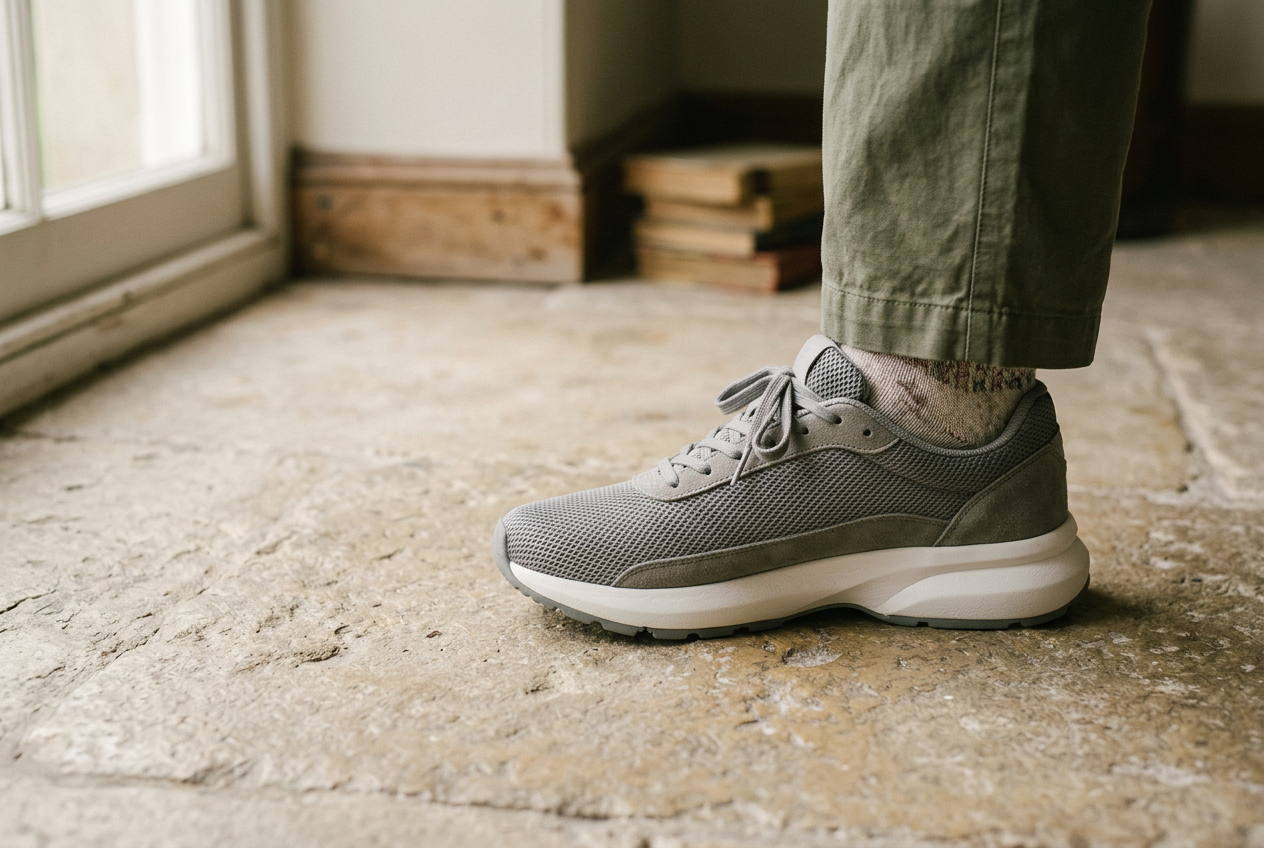
Take one common fitting-room failure: a soft engineered-mesh sneaker looks tidy while its wearer sits, then the right forefoot spreads beyond the outer edge of the foam platform as soon as full weight goes through it. The shoe may be labeled wide. It may not feel tight. Neither fact makes the platform wide enough.
That right shoe is the case to keep in view here. The upper is flexible, the laces close without strain, and the toes are not hitting the end, yet the smallest toe joint and the flesh behind it sit outside the structure intended to carry them. The mesh contains the foot in roughly the same way a thin sock does: visibly, but without much authority.
This is unisex fit advice. Foot shape does not follow the department sign, although size conversions, available widths and the shape used for each range can change between women’s and men’s versions of the same sneaker.
Mesh can conceal a platform mismatch
Engineered mesh, meaning a knitted or woven synthetic upper with denser and more open zones, works well when a shoe needs ventilation and low weight. It also accommodates swelling and small differences between feet more politely than rigid leather. The tradeoff is that soft mesh can expand sideways instead of signaling that the base of the shoe is too narrow.
A width label usually describes the internal fit produced by a brand’s last, the foot-shaped form around which the shoe is built. It does not promise that every part of the midsole platform has grown by the same amount, and it does not tell you how firmly the upper will hold the foot over that platform. Two shoes carrying the same width marking can behave differently because one has a straighter base and reinforced sidewalls, while the other puts extra upper volume over a pinched waist.
That distinction matters at the forefoot. The midsole is the cushioning layer between the foot and the ground-facing rubber; if its outer edge curves inward before the foot does, a compliant upper may let the forefoot drift across it. The sensation is not always immediate pain. It can feel like a vague lack of support, pressure under the outer edge of the foot, or repeated contact between the smallest toe joint and the mesh.
The right shoe in our example passes the seated test because an unloaded foot is narrower. Standing width, the width a foot reaches under full body weight, is the useful measurement. Mesh makes the difference between those two states unusually easy to miss.
The standing check takes less than a minute
Try both shoes with the socks you expect to wear. Lace them to normal walking tension, stand naturally for at least several breaths, then look straight down and use a mirror or phone photo to inspect the outer edge. Do not twist your knee inward to get a better view, since that shifts the foot and improves the evidence in the shoe’s favor.
Press along the mesh at the widest part of the forefoot. You are locating the edge of the foot, not measuring empty upper fabric. If the foot sits over the side of the foam rather than above it, the upper may show a ledge or rounded bulge where the platform disappears underneath. Compare the right and left shoes because most people are not perfectly symmetrical, and fit the larger or wider foot rather than asking the smaller one to chair the meeting.
Next, walk and turn. A straight walk can feel acceptable even when the base is marginal, but a slow change of direction reveals whether the foot slides across the platform. The issue is clearer on a ramp or stairs, where load moves through the forefoot. This should not require a dramatic stress test in a store.
Ten deliberate steps are more useful than bouncing twice on the carpet and declaring the foam delightful.
Return to the right shoe. If its forefoot merely touches the mesh while remaining over the midsole, extra upper volume may be enough. If the foot crosses the midsole edge while standing, sizing up for more length rarely fixes the geometry; it can move the widest part of the shoe ahead of the widest part of the foot, leaving heel slip as a complimentary second problem.
Reinforcement decides how much the upper can manage
Upper reinforcement can come from fused overlays, which are thin synthetic pieces bonded to the mesh, or from denser knit zones and internal straps. These elements limit stretch and connect the laces to the base. Their placement matters more than a decorative cage that stops before the widest part of the foot.
Run a finger inside the shoe along the outer forefoot. A firmer band that reaches down toward the sole can help keep the foot centered, provided it does not press directly on the smallest toe joint. Very soft mesh with no supporting layer will be forgiving across a bunion or broad forefoot, but it asks the platform to do nearly all the stabilizing. If that platform is narrow, there is no remaining line of defense.
More structure is not automatically more comfortable. A stiff overlay placed over a prominent joint can turn a harmless bulge into a hot spot, particularly once the foot swells during a long day. The better alternative is often a shoe with a broader, straighter platform and moderate reinforcement set behind the joint, rather than an aggressively reinforced upper attempting to force the foot inward.
Soft mesh also changes with wear. It may relax after a week, especially where the forefoot pushes hardest, but the foam platform will not widen in sympathy. Buying a borderline shoe on the theory that the upper will stretch therefore solves the tightness while making containment weaker. That is a poor bargain even in a mass-market lifestyle sneaker, and harder to excuse in a premium technical pair.
Lacing can center a foot but cannot rebuild the sole
Lacing matters when the platform is adequate and the foot is drifting because the midfoot hold is loose. The eye stay, the reinforced strip that carries the lace holes, should draw the upper around the midfoot without closing the two sides into a strained V or pulling the forefoot mesh into deep diagonal creases.
Start by snugging the middle rows rather than hauling on the row nearest the toes. Keep the forefoot comfortably loose, secure the middle of the foot, then use the top holes if the heel lifts. This distributes tension where the shoe can control movement. Cranking every row tight may reduce visible spill for a few minutes, but it does so by compressing the foot and can create numbness or pressure across the top.
On the example right shoe, lacing earns one test. If moderate midfoot tension keeps the forefoot centered during turns and the foot remains over the platform, the fit may be workable. If tight lacing is required to pull the foot back onto the foam, the shoe is too dependent on its upper. Mesh is being asked to perform structural work it was selected to avoid.
Skipping or loosening a lace crossing over a tender area can reduce pressure, but it does not correct sideways overhang. Nor does a thicker insole reliably help. Added volume may raise the foot higher inside the upper, where the sidewall offers less support, and it can reduce heel security.
A better width label is only the starting point
When sideways spill appears, try a wider width in the same length first, then repeat the standing check. Some brands change upper volume more than sole width between width options, so the label alone cannot settle the matter. Compare the visible base, feel for the edge under the forefoot and turn in both directions.
If the wider version still places the foot beyond the platform, change models. Look for a straighter outer edge, less inward taper below the smallest toe joint and a midsole that remains broad through the forefoot rather than flaring only at the heel. A removable sock liner can also help with inspection: take it out, stand on it briefly and note whether the foot exceeds its edges, while remembering that the liner is a clue rather than an exact map of the midsole.
The alternative does not need to be heavy or orthopedic-looking. Mesh sneakers exist with broad platforms, and a little visible sole beyond the upper can be useful rather than clumsy. The fashion compromise is proportion: a wider base reads more substantial, especially with narrow trousers or a slim skirt, but it usually looks intentional with straight-leg pants, longer shorts or clothes carrying some volume above the ankle.
Do not pay a premium merely for a technical-looking mesh and an elaborate width menu. The useful construction is underneath. For the right shoe we have followed, the buying decision is plain: if the forefoot crosses the platform at rest, return it; if it stays centered with ordinary lacing and enough room for swelling, walk on.
Questions people ask
Is some foot bulging through mesh normal?
Yes. Soft mesh often traces the shape of a broad forefoot, and visible contact is not automatically a bad fit. The important distinction is underneath: the foot can press against the upper while remaining supported by the midsole. A rounded ledge beyond the foam edge, especially while standing, points to a platform mismatch.
Will mesh sneakers stretch enough for a wide foot?
The upper may relax where the foot presses, which can reduce surface tightness. The midsole does not become wider, however, so stretching cannot correct a forefoot that already hangs over the platform. Buy for standing width first; treat any later relaxation as extra room, not as the fitting plan.
Can different lacing stop sideways foot spill?
Lacing can improve midfoot hold and limit sliding when the platform already supports the forefoot. Snug the middle rows and avoid crushing the toe area. If the laces must be pulled hard enough to cause top-of-foot pressure or deep mesh creases, they are compensating for the wrong base.
Should
I size up when a mesh sneaker feels narrow?
Only if the shoe is also too short or its widest point sits behind yours. Extra length can misalign the forefoot and loosen the heel without adding useful platform width. Try the same length in a wider option, inspect it while standing, and change models if the sole still tapers beneath the foot.
One update a day
Today's fashion update, in your inbox
One fashion update each morning — no hype, no filler, just pieces worth wearing.