A Cobbler Can Stretch a Toe Box, but Not Into a New Size
Leather and suede can yield enough to ease a tight little-toe spot. Mesh, bonded synthetics, and reinforced toe caps offer much less room for negotiation.
October 18, 2026 · 8 min read
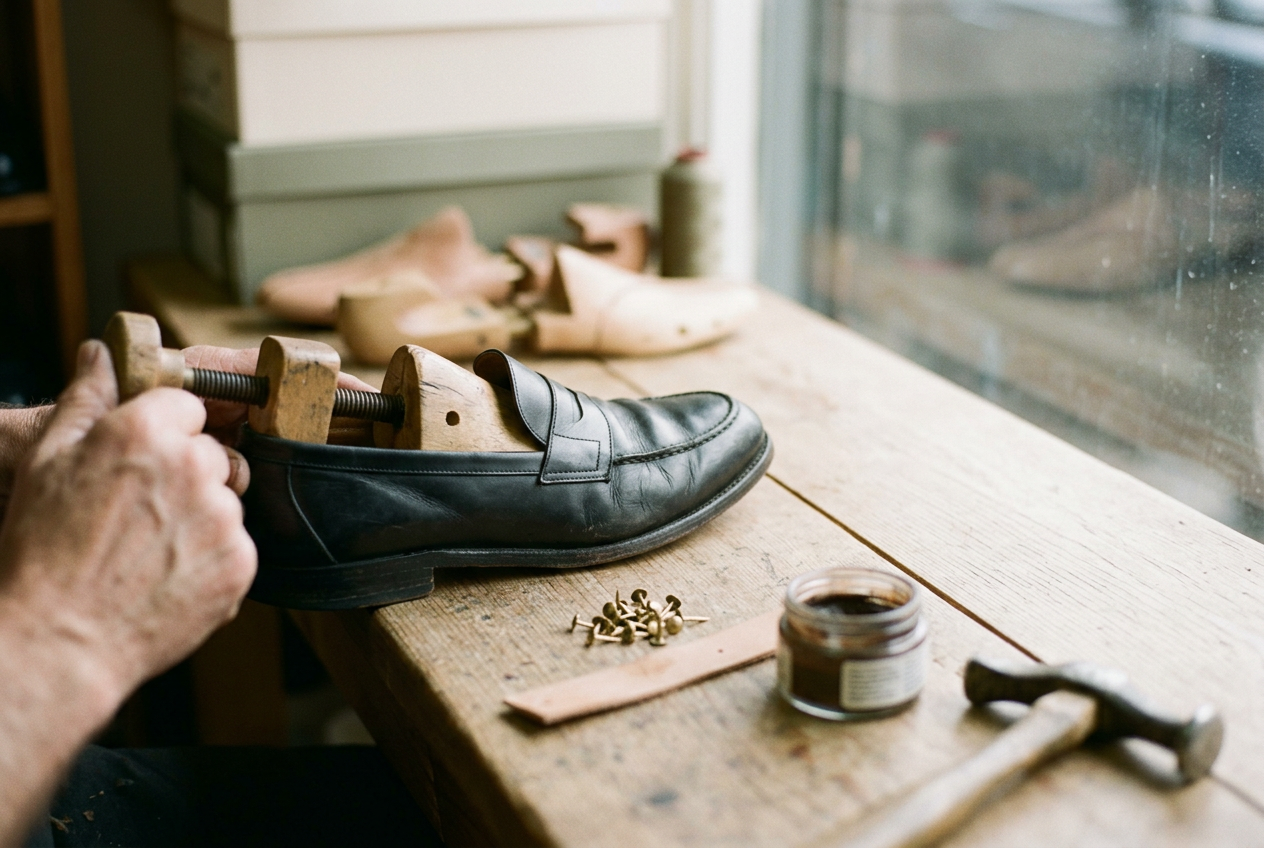
Use one ordinary fit failure as the reference pair: a black calfskin penny loafer worn for half-hour commutes over one week. The heel stays put, the longest toe has clearance, and the left shoe feels fine, but the right little toe meets the sidewall by minute 20. The upper creases normally. The toe does not go numb, yet it is increasingly interested in filing a complaint.
That is a plausible stretching job. The problem is local, the material can yield, and the shoe already fits in length. This is unisex advice because the mechanics do not change across women’s and men’s footwear, although available width labels and the shape of the underlying shoe vary by brand.
What stretching can change
A cobbler stretches a shoe over a last, meaning a foot-shaped form, or uses an adjustable stretcher that presses outward from inside. For the reference loafer, a small plug can concentrate pressure at the right little-toe joint instead of expanding the whole forefoot. The shoe may stay on the device overnight or longer, with gradual adjustments rather than one heroic crank.
The realistic gain is modest. Think relief, not conversion: enough space to reduce pinching, accommodate a slight width mismatch between feet, or make a seam stop sawing at one spot. Stretching cannot reliably turn a standard-width shoe into a true wide fitting, and it cannot add a full size in length. A short shoe remains short, now with stressed material.
Length stretching is especially limited because the sole, heel counter, and toe structure establish the shoe’s footprint. Even if the upper gives, the foot does not receive more platform beneath it. If the longest toe touches the front while standing, return or replace the pair rather than paying someone to rearrange the discomfort.
The best candidate feels snug across the widest part of the foot but fits through the heel and instep. The worst candidate is tight everywhere. Stretching one zone cannot correct a narrow sole, a misplaced arch, or a heel that slips because the wearer sized up to buy toe room.
Leather and suede respond gradually
Calfskin and many other natural leathers can relax because their fiber structure responds to controlled pressure and moisture. A cobbler may use a stretching solution, but the treatment and force should suit the leather’s finish. Patent leather, heavily coated leather, and very thin fashion leather deserve more caution than sturdy, uncoated uppers.
Our black calfskin loafer has a reasonable chance of gaining useful space at the right little toe. The cobbler can target that point, leave the left shoe alone, and inspect the lining and stitching before starting. Afterward, the leather may show a slightly different crease or contour. That tradeoff is often preferable to spending every commute thinking about one toe, though pristine collectors should not expect the upper to emerge cosmetically untouched.
Suede is also stretchable and often feels more forgiving because its surface finish does not show fine creasing in the same way. It can still distort, develop a bulge, or lose dye where a chemical product is applied. Dark suede may hide the change; pale suede has a longer memory. A professional stretch is the sensible route when color consistency matters.
Lining changes the calculation. A leather upper with a leather lining usually moves more predictably than an upper bonded to a rigid textile backing, while thick padding may compress without creating much permanent room. If the pressure comes from a bulky internal seam, stretching the exterior may help less than flattening or covering that seam.
Mesh is flexible, but flexibility is not stretchability
Running-shoe mesh can move with the foot, which makes it feel more adaptable than polished leather. It does not follow that a cobbler can enlarge it permanently. Engineered mesh, a knitted or woven upper designed with denser support zones, may relax slightly in an open area but resist where yarn patterns, fused overlays, or stitching hold the shape.
A mesh sneaker that presses only through a soft panel might become more tolerable through wear. A sneaker that pinches under a logo overlay or along the edge of a rubber toe bumper is unlikely to gain useful width from a traditional stretcher. Force can tear yarns, separate adhesive, or leave a visible dome without changing the sole beneath it.
Removing a thick removable insole can create volume, but it also changes cushioning and heel position. Replacing it with a thinner insole is a cleaner experiment. If the foot then sits securely and the arch placement still makes sense, the problem was internal volume; if the forefoot spills over the sole, the shoe is too narrow.
Bonded synthetics have hard limits
Synthetic leather often uses a polyurethane or polyvinyl chloride surface bonded to a fabric base. It may soften temporarily with warmth, yet it lacks the same forgiving fiber structure as natural leather. Pressure can produce whitening, cracking, bubbling, or delamination, which is the separation of bonded layers. None of those effects counts as fit improvement.
Some synthetic uppers tolerate a tiny spot adjustment. Others rebound as soon as the stretcher comes out. A repair shop should inspect the exact upper rather than treating “vegan leather” as one material category, since that retail label describes what is absent more clearly than how the shoe is built.
Heat is a particular gamble. Internet methods involving hair dryers and thick socks can soften adhesives as readily as the upper, especially around glued soles and decorative films. The result may fit no better while looking as though it spent an afternoon beside a radiator. For an inexpensive synthetic shoe, replacement in the correct width is often better value than paid stretching with uncertain results.
The hidden structure may refuse to move
The visible material is only part of the toe box. Many shoes contain a toe puff, meaning a stiff reinforcement placed between the upper and lining to hold the front shape. Safety footwear may use a steel, alloy, or composite toe cap. Fashion boots can also carry firm internal stiffeners even when the exterior feels soft.
A cobbler cannot meaningfully stretch a safety toe cap. If the toes contact that structure, the shoe needs a different size, width, or toe shape. Square and round toe shapes often offer more usable room than sharply tapered ones, but the outline alone is not proof; the internal last determines where the width sits.
The reference penny loafer has an almond toe, yet its pressure point sits behind the reinforced front, at the little-toe joint. That location keeps it in the possible column. If the same foot struck the rigid tip, stretching the side leather would miss the problem.
Soles matter too. A flexible upper attached to a narrow rubber or leather sole cannot provide stable space beyond that sole edge. If the foot already overhangs the platform, widening the upper can create a pouch rather than a better-fitting shoe. It may remove rubbing while leaving the wearer balanced on the sidewall, which is an expensive route to a different annoyance.
What to ask at the repair counter
Bring the shoes and wear the socks or hosiery intended for them. Mark the pressure point with removable tape, or put the shoe on and show the cobbler precisely where it hurts. “The toe box is tight” is less useful than identifying the right little-toe joint, the top of the big toe, or a seam across the forefoot.
Ask whether the shop recommends a spot stretch or a general width stretch, how long it will hold the pair, and whether the finish could change. A routine stretch commonly sits in the tens-of-dollars part of a repair menu, while delicate finishes, boots, and repeated sessions can cost more. Get a quote before leaving the shoes, particularly when they were inexpensive or remain returnable.
One conservative session is preferable to demanding the maximum immediately. Leather can be stretched again; it cannot be neatly unstretched after the upper bulges or the topline distorts. Try the pair indoors afterward, then repeat the original half-hour walking test. The black loafer succeeds if the right little toe stops meeting the sidewall while the heel remains secure.
It does not need to feel like a slipper. Few loafers do, despite what their product copy may have been feeling that morning.
The return decision comes first
Do not stretch a new shoe before checking the return policy. Alteration may end return eligibility, and a properly wide version preserves the intended proportions better than forcing a standard-width upper outward. When several sizes and widths are available, order around the larger foot and adjust minor looseness on the smaller one with a tongue pad or thin insole.
Keep the shoe when the length is right, the sole supports the whole forefoot, and one stretchable area causes the trouble. Exchange it when the toes hit the front, both sides pinch, the foot overhangs the sole, or a hard cap creates the pressure. The same verdict applies if sizing up fixes the toes but makes the heel lift: look for a wider last rather than a longer shoe.
For our calfskin loafer, a targeted professional stretch is proportionate. For its look-alike in bonded synthetic material with a rigid toe puff, the same payment buys uncertainty. That pair belongs back in the box while the return label is still emotionally available.
Questions people ask
Can a cobbler stretch shoes one full size?
Not reliably. A cobbler may gain modest width or relieve a localized pressure point, particularly in leather or suede, but the sole and internal structure limit the result. A shoe that is a full size short needs replacement, not a more ambitious stretcher.
Can only one shoe be stretched?
Yes. Feet commonly differ, and a cobbler can stretch only the tighter shoe or target one spot with a plug. Bring both shoes so the shop can compare their shape, but do not enlarge the comfortable one merely for symmetry.
Will stretched leather shrink back?
Leather may settle after the stretcher is removed, especially if the shoe is left unworn for long periods, though a controlled professional stretch should retain some change. Wearing the pair during short indoor sessions can help confirm the fit before another adjustment is requested.
Can a cobbler stretch mesh sneakers?
Sometimes a shop can create slight temporary relief, but mesh itself may rebound and reinforced zones rarely move much. If pressure comes from a fused overlay, rubber bumper, or narrow sole platform, a wider sneaker or different last is the more dependable choice.
One update a day
Today's fashion update, in your inbox
One fashion update each morning — no hype, no filler, just pieces worth wearing.