Leather Sandals Should Soften, Not Injure Your Feet
Leather straps can relax with wear, but misplaced edges, short footbeds, exposed seams and buckle pressure will not improve enough to justify damaged skin.
Women's · October 14, 2026 · 7 min read
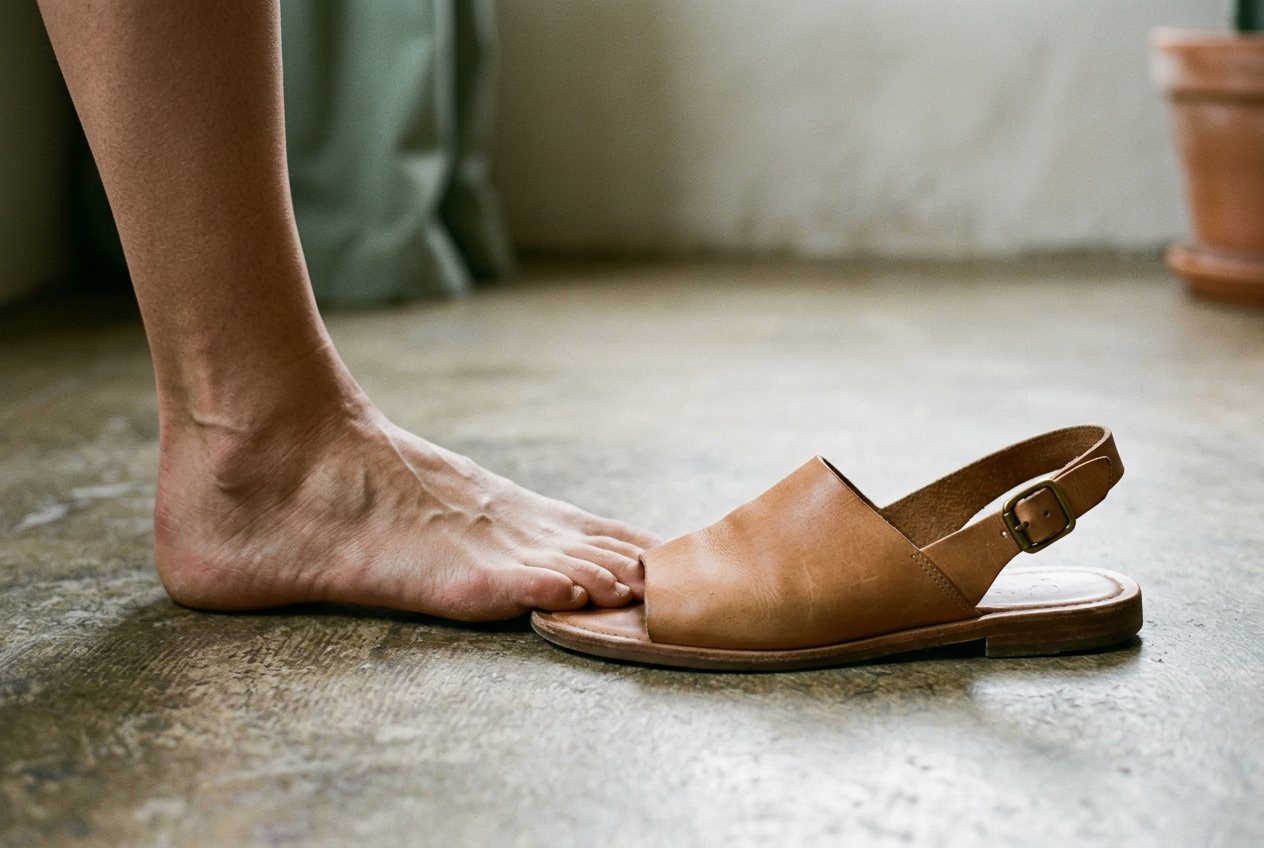
The pair that clarified this was a women’s tan leather slingback sandal with a low stacked heel, a leather-covered footbed and two broad forefoot straps. On paper, it was the sensible summer shoe: polished enough for a dress, low enough for errands and made from smooth leather that should become more flexible with wear.
During an indoor fitting, the upper strap began to relax. The lower strap did not become more promising. Its outside edge crossed the little-toe joint, and every step drove that edge into the same spot while the foot shifted toward the outer rim of the footbed. After two short sessions, the leather showed a slight bend and the foot showed a red line.
The sandal went back.
That distinction matters. Leather can soften; geometry remains geometry. A break-in period may reduce general stiffness across a correctly placed strap, but it cannot move that strap away from a joint, lengthen an undersized sole or relocate a buckle that presses against bone.
This is women’s footwear coverage, although the fit mechanics apply to any leather sandal built with fixed straps and a shaped footbed.
Normal leather softening feels broad, not sharp
New full-grain or smooth leather straps often resist flexing because the fibers have not yet bent repeatedly around the foot. A lined strap, meaning two layers are joined so the finished side touches both the outside and the skin, can feel firmer still. During a reasonable break-in, that resistance should be spread across a broad area and ease after several minutes as the material warms.
The tan slingback had this normal stiffness across its upper forefoot strap. It felt snug while standing, then allowed a little more flex after walking through two carpeted rooms. There was no hot point, no edge digging into a toe joint and no need to alter the gait. That was a plausible break-in issue.
Watch the skin when the shoe comes off. A faint, even impression that disappears promptly can come from a close fit. A bright line following one strap edge, tenderness that lingers or a spot that feels hotter with every lap indicates concentrated pressure. Leather may become more pliable around that pressure point, but the foot still meets the same edge at the same part of each stride.
Suede and unlined leather usually feel softer sooner, though softness does not guarantee good placement. Patent leather and heavily coated leather tend to give less readily because the surface finish limits flexibility. Thick vegetable-tanned leather can mold attractively over time, yet it asks for patience only when the underlying shape already suits the foot. Pain is a poor leather conditioner.
Strap placement decides more than strap softness
A forefoot strap should hold the foot without crossing a toe joint at the point where it bends. On the test pair, the lower strap looked generous from above, but its outer edge landed directly over the little-toe joint. The problem became clearer while walking because the foot widened under load and met the edge more forcefully.
No amount of wearing around the house could shift that sewn attachment point. A cobbler might stretch a leather strap slightly, which can help when the placement is sound and the volume is marginally tight, but stretching cannot change its angle or move its edge farther back. Paying for alteration also makes little sense before deciding whether a new pair deserves to stay.
Footbed size deserves the same scrutiny. The footbed is the surface beneath the foot, not merely the visible outline of the sole. Toes should sit within it rather than gripping the front, and the heel should not balance on the back rim. A sculpted footbed also needs its raised arch and toe contours to meet the corresponding parts of the foot; otherwise, an apparently correct numerical size can feel oddly aggressive.
Width is easy to misread in open shoes because uncovered toes create the impression of space. Stand normally and look straight down. If the little-toe side spills over, the big-toe joint sits on the edge or the footbed vanishes beneath the widest part of the foot, the sandal is too narrow in practice. Sizing up may add unwanted length without supplying enough width, so a wider last, meaning the form used to shape the shoe, is the better alternative.
The replacement shape for the tan pair was straightforward: a broader forefoot platform with the toe strap set slightly farther back. Less dainty from above, perhaps. Considerably less interested in removing skin.
Seams and hardware need their own inspection
Run a fingertip along the inside of every strap before wearing the sandals. The inside should not reveal a stiff seam allowance, an exposed thread end or a ridge of dried adhesive. These details can feel minor in the hand and become much louder once body weight and repeated movement are involved.
Pay particular attention beneath buckles and decorative metal pieces. Hardware should sit over enough leather or lining that its edge does not contact the foot, even when the strap bends. On an ankle strap, slide a finger under the buckle while standing; if the metal already meets the ankle bone indoors, it is unlikely to negotiate more politely outside.
A buckle tongue can also protrude through its hole and press into the skin beneath. Changing holes may solve that only if the sandal remains secure and the strap tail stays contained. Do not accept a loose ankle merely to move hardware away from bone. A sandal that forces a choice between rubbing and instability has failed the fitting.
Exposed seams are particularly poor break-in candidates. Leather around them may soften, while the thread, folded edge or metal component remains firm. Adding adhesive pads can rescue an older favorite, but a new full-price pair should not require an upholstery project before leaving the house.
Use a short indoor trial before committing
Start late enough in the day that the feet have reached their ordinary walking size, rather than trying sandals first thing in the morning when they may fit at their smallest. Use the floor surface allowed by the retailer’s return policy, keep the soles clean and resist adding conditioner, stretching spray or protective sole film until the decision is made.
Wear the sandals for about ten minutes with normal standing and walking. Do not merely sit in them. Walk at an everyday pace, turn in both directions, pause on one foot and climb a few stairs if clean indoor stairs are available. The purpose is to make the sandal perform its job without creating enough exposure to cause a blister.
Take them off and inspect both feet. Note exactly where any mark appears, then inspect the corresponding part of the shoe. A broad pressure mark beneath a firm leather strap may justify another brief session. A narrow red line at an edge, a circular mark under hardware or a sore point over a seam already identifies the mechanism.
Repeat once after the feet have rested and the marks have faded. On the tan slingback, the upper strap felt easier during the second session, while the little-toe edge produced the same line in the same place. Consistency settled the decision. A fitting problem that repeats precisely is giving useful information, not issuing a challenge.
Stop the trial if a spot becomes painful, numb or visibly abraded. Continuing until the skin breaks does not reveal anything important about the shoe, and it can make every other pair uncomfortable for days. The time cost of a return is irritating. The time cost of walking badly through a weekend is worse.
Return problems that leather cannot solve
Return a sandal when the foot extends beyond the footbed, the heel lands on a raised rim or the arch contour sits in the wrong place. Those are size or shape mismatches. They do not improve through softening.
The same answer applies when a strap edge crosses a bending joint, hardware contacts bone, an internal seam creates a concentrated ridge or the foot slides far enough that the toes grip for stability. Sliding can occasionally be adjusted with a buckle, but fixed straps leave little room for negotiation, especially when tightening one area pushes pressure somewhere else.
A pair may deserve another indoor session when the foot is fully supported, the straps sit on fleshy areas rather than joints and the only complaint is even firmness from untreated leather. Improvement should appear quickly during the trial, even if complete softening takes longer. There should be a direction of travel.
Do not let the visual success of a sandal overrule the fitting. The tan pair had the right heel height, worked with the intended clothes and looked better than the wider alternative when both were sitting in their boxes. Only one could be worn for more than a room-length photograph. Shoes eventually have to leave the box.
Questions people ask
How long should leather sandals take to break in?
Correctly fitted leather straps may become noticeably more flexible over several short wears, but they should feel tolerable from the start. If the same edge creates sharp pressure or a persistent red line during two brief indoor sessions, more time is unlikely to correct the placement.
Can a cobbler stretch tight leather sandal straps?
A cobbler can sometimes add a small amount of room to a leather strap when the strap sits in the right place and feels evenly tight. Stretching will not reposition a strap, enlarge the footbed or stop a buckle from landing on an ankle bone, so assess the construction before paying for work.
Should my toes reach the end of a sandal?
Toes can sit near the front, but they should remain supported by the footbed while standing and walking. If they extend beyond the edge, grip to keep the sandal on or strike a raised rim, try a different size or a shape with more usable length and width.
Will leather conditioner make new sandals more comfortable?
Conditioner may make suitable leather more supple, but it can darken the finish, change the texture and affect return eligibility. Complete the clean indoor trial first. If the sandal has bad strap placement, exposed seams or an undersized footbed, conditioner only makes a nonreturnable problem smell organized.
One update a day
Today's fashion update, in your inbox
One fashion update each morning — no hype, no filler, just pieces worth wearing.