Leather Sandals Break In at the Straps, Not the Toe Post
Leather can relax across the foot, but it cannot relocate the hardware or lengthen the sole. This indoor trial separates useful softening from a return-worthy fit.
September 25, 2026 · 8 min read
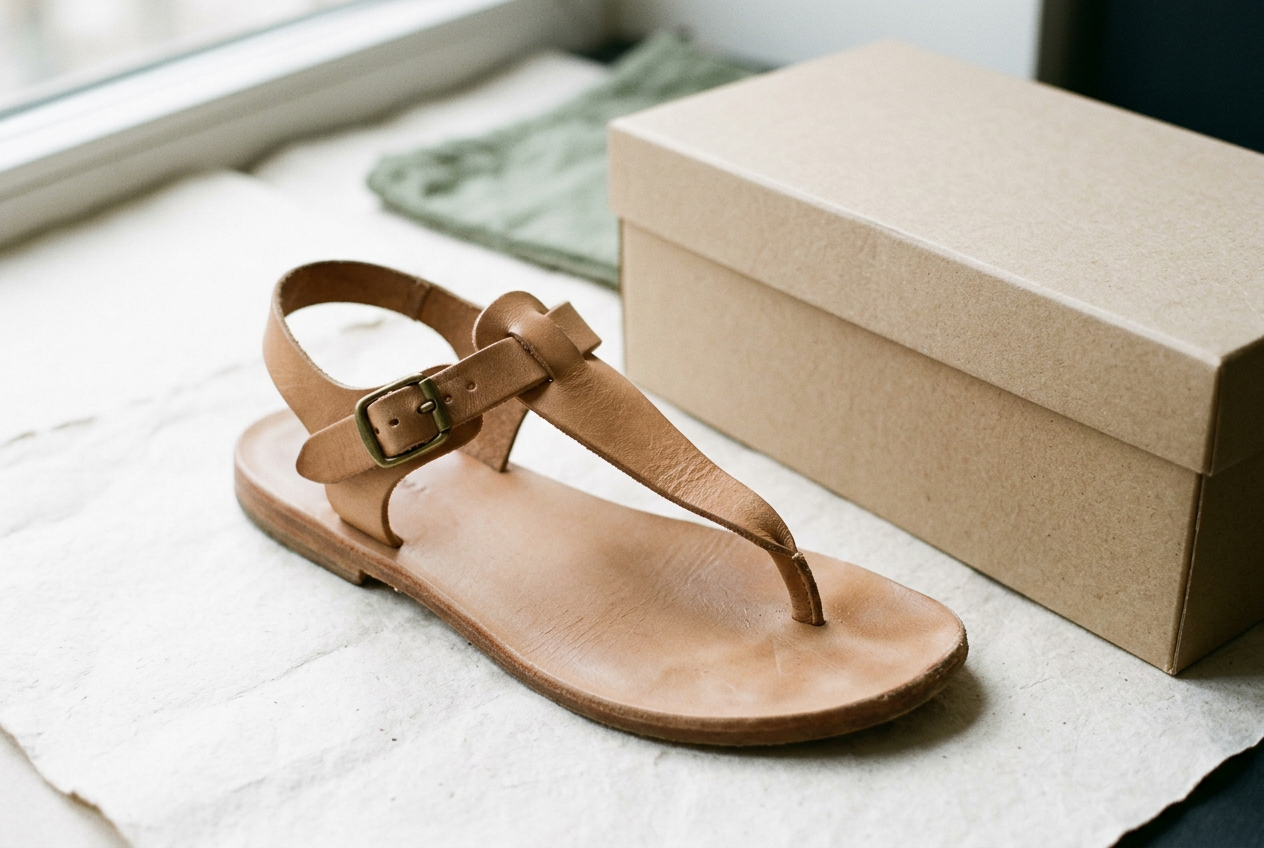
The reference pair for this walkthrough is a natural vegetable-tanned leather thong sandal with a broad instep strap, adjustable heel strap, leather footbed, and stitched rubber outsole. Vegetable-tanned leather, meaning hide treated with plant-derived tannins, often arrives firmer than heavily softened leather and develops creases quickly.
On this pair, the broad strap felt stiff but evenly snug. The toe post, the upright piece that sits between the toes, pushed against the second toe on the right foot. Those sensations may both be described as “tight,” yet only one had a reasonable chance of improving.
This is unisex fit advice. Sandal shapes are often sold under women’s or men’s sizing, but the useful evidence comes from foot length, width, toe position, and strap placement rather than the label printed on the box.
First separate stiffness from misalignment
Leather breaks in where repeated movement bends or compresses it. A strap across the instep can relax slightly as body heat and flexing soften the fibers, particularly when the pressure is broad and the foot remains centered on the footbed, the surface directly beneath the foot. The crease near the ball of the foot can become easier too, provided the outsole already bends in roughly the right place.
Expect modest change. A stiff leather strap may become less board-like, and an unlined edge can lose some of its initial crispness, but the sandal will not gain meaningful length or width. A tightly cut strap also cannot be trusted to stretch by an entire size without becoming distorted, weakening around a punched hole, or keeping the wearer busy with blisters in the meantime. Discomfort is not a craftsmanship ritual.
The reference pair made that distinction plain. Its instep strap spread pressure over a wide area without leaving a narrow red line, while the right toe post applied sideways force at one fixed point. The strap moved whenever the foot flexed. The post stayed exactly where the maker had put it.
A leather lining can make a firm strap feel smoother before the outer leather relaxes. Raw or painted edges may also become less noticeable after light wear, but an edge that cuts into the ankle bone, catches beneath a toe, or presses into the side of the foot is aimed at the wrong place. Softening a badly aimed edge only produces a somewhat softer badly aimed edge.
Stage one: protect the return before wearing the shoe
Read the return terms before removing tags or peeling protective film. Policies differ, and an indoor trial does not guarantee acceptance if the outsole becomes marked, the leather creases heavily, or the packaging is incomplete. Photograph the sandal and its sole when it arrives, then keep every insert and fastening in the box.
Set up on a clean, dry floor covered with plain paper or a clean mat that will not transfer lint or color. Avoid carpet fibers, kitchen grit, damp bathroom tile, and any experimental stroll to the mailbox. A rubber outsole can reveal outdoor use with impressive efficiency.
Do not oil, condition, heat, soak, hammer, or manually fold the leather during the trial. Those techniques change the material and may end the return option; they also disguise the question that matters, which is whether the sandal fits before home cobbling begins.
Try both sandals late enough in the day that the feet are not at their smallest. Feet commonly spread with standing and walking, so a pair assessed only while seated first thing may feel less generous several hours later. Wear them as intended. Socks can protect skin during an early strap check, but they alter volume and are useless for judging a toe post.
Stage two: map the foot while standing still
Stand naturally for a minute without gripping the sandal with the toes. The longest toe should remain on the footbed with a small visible margin ahead of it, while the heel should not sit on or beyond the rear edge. Exact spare space varies with the shape of the sole, but skin should not become part of the outsole.
Check width under full body weight. A little visual overhang from soft tissue can occur on open shoes, especially at the forefoot, yet the weight-bearing part of the foot should feel supported rather than perched across a hard perimeter. If the little-toe joint sits on the sidewall or the heel spills inward, leather stretch will not widen the sole beneath it.
Now examine the toe post. It should rise into the natural gap between the toes without pulling the foot diagonally or forcing one toe to ride against another. On the reference pair, the right foot had to rotate outward to escape the post; once the foot rotated, the heel no longer sat centrally. That was not break-in.
It was a shape mismatch.
Fasten the heel strap at a usable hole rather than the final hole with no adjustment left. The buckle should clear the ankle bone, and the strap should secure the heel without dragging the foot backward against the toe post. If correcting heel movement creates forefoot pain, the adjustment system is balancing two incompatible placements.
Stage three: add movement without manufacturing wear
Walk for about ten minutes on the protected surface, using a normal stride rather than the delicate shuffle reserved for expensive mistakes. Stop and inspect the skin. A diffuse impression under a wide strap can be acceptable if it fades promptly and has no burning or pinching; a narrow red groove, hot spot, numb patch, or broken skin ends the trial.
Listen to where the sandal flexes. The main bend should sit near the ball of the foot, where the toes join the forefoot. A fresh leather sole may resist at first, but it should not force the heel to lift dramatically or drive the toe post backward on every step. If the shoe bends behind or ahead of the foot’s flex point, more walking will deepen a crease in the wrong place.
The reference pair’s instep strap began to feel less abrupt during this stage, without becoming loose. Its toe post became more annoying because each step repeated the same sideways pressure. That contrast is useful: normal stiffness tends to distribute and ease as the material warms, whereas poor placement often becomes clearer once motion repeats it.
Remove the sandals for at least half an hour, then check whether any marks linger. A second indoor session later that day, bringing the total trial to roughly an hour, is more revealing than one continuous endurance test because the feet and leather cool between sessions. The assignment is fit evaluation, not proving moral strength to a shoe.
The faults leather will not negotiate
Return a sandal when the toes or heel reach the sole edge during ordinary standing. Length does not break in. The same applies when the arch contour, buckle, stitched seam, or raised rim lands on a sensitive joint and cannot be shifted through a normal strap adjustment.
A hard edge deserves judgment based on direction as well as firmness. An upper edge that lies flat against a fleshy part of the foot may round off with wear, particularly if it is smooth and the pressure remains broad. An edge that points inward, sits under the ankle bone, or catches the little toe has a construction or shape problem; the material would need to move farther than responsible break-in can promise.
Toe posts are especially unforgiving. Leather around a post can soften, and a fabric-wrapped post may become less abrasive, but the attachment points do not migrate. If the post splits the toes at an angle, sits too far forward, or pulls backward when the heel strap is secured, choose another last, the foot-shaped form used to build the shoe, or a sandal without a toe post.
Price does not alter this rule. More expensive leather may age attractively and skilled finishing can reduce harsh edges, but neither feature compensates for a sole that is too short or hardware sitting on bone. The better alternative to the reference pair was not a longer break-in plan. It was a different sandal shape with the toe opening set farther inward.
Make the return call before the evidence disappears
After the second session, compare the first fitting notes with the final sensations. Keep the pair if broad strap pressure has eased, the foot remains centered, the sole flexes under the ball, and the skin shows no concentrated irritation. Minor stiffness is a reasonable tradeoff when every fixed component is correctly placed.
Pack it back up if pain remains tied to one immovable point. Do not rely on extra buckle holes when the existing strap geometry is wrong, and do not size up automatically to escape a toe post if that larger sole leaves the arch and flex point misplaced. A different model is often the cleaner answer.
The reference pair went back with an unmarked outsole and no conditioned leather. The broad instep strap probably would have improved. The right toe post had already supplied the useful information.
Questions people ask
How long should leather sandals take to break in?
A well-positioned leather upper may feel easier after several short wears, but it should be wearable from the start without sharp pain, numbness, or broken skin. Break-in can soften broad pressure and flex resistance; it should not be treated as a multiweek correction program for poor alignment.
Will a leather toe post soften enough to stop hurting?
It may become smoother and less rigid if the post is placed correctly and the initial sensation is mild surface friction. It will not move to a different gap between the toes, stop pulling the foot sideways, or correct a sole that is the wrong length.
Is heel or toe overhang acceptable in sandals?
The foot should remain supported by the sole during standing and walking. A small amount of soft tissue near an open edge may be harmless, but toes or heels touching the ground-facing perimeter signal insufficient length, while weight-bearing joints spilling over a hard side edge signal insufficient width.
Can
I condition stiff sandals before deciding whether to keep them?
Wait until the fit is settled and the return decision is final. Conditioner can darken vegetable-tanned leather, soften it unevenly, and create visible handling marks; none of that fixes misplaced hardware. Run the clean indoor trial first, then follow the maker’s care directions if the pair stays.
One update a day
Today's fashion update, in your inbox
One fashion update each morning — no hype, no filler, just pieces worth wearing.