Square Toe Flip-Flops Catch Where Your Toes Don’t
A week on stairs and curbs showed that the fashionable extra ledge can become a trip point. The right fit leaves only a narrow strip of sole ahead of the toes.
Women's · September 23, 2026 · 7 min read
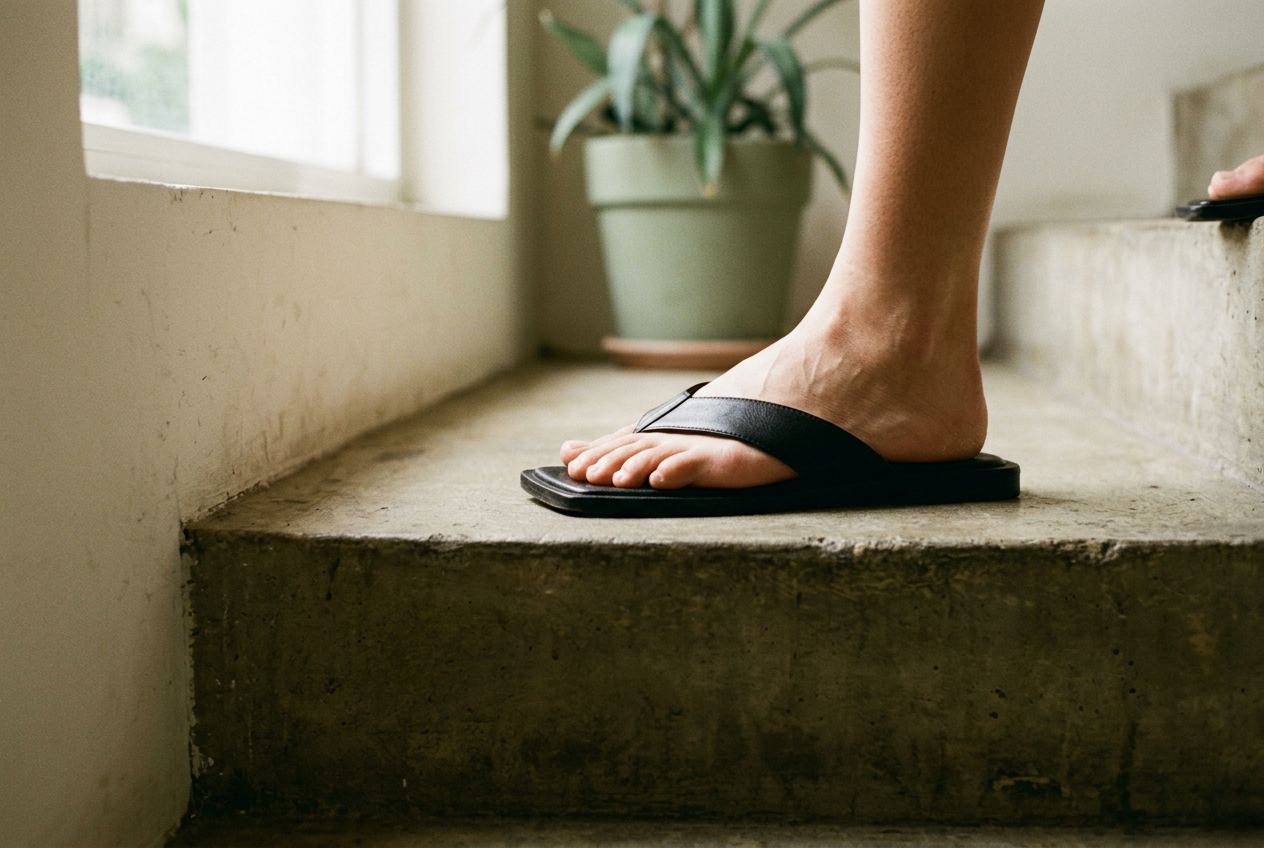
The test pair was a plain black women’s thong sandal with slim synthetic straps, a molded EVA footbed and a thin rubber outsole. EVA, or ethylene-vinyl acetate, is the lightweight foam commonly used to cushion casual sandals. The heel fit correctly, the straps held without pinching, and the square sole continued past the longest toe by a conspicuous strip.
That last detail looked polished while standing still. During a week of ordinary city walking, it was also the part that met the stair first.
This is women’s footwear coverage, although the mechanical issue applies to any square-toe sandal constructed with an extended front platform. Women’s sizing makes the fit especially inconsistent because a sandal may be graded mainly by length even when the wearer needs more width, encouraging shoppers to size up and acquire extra sole they never requested.
The front edge arrives before the foot
Toe clearance is the space between the longest toe and the front edge of the sole. A little clearance keeps toes off pavement and allows for the slight forward movement that happens during a step. The test pair had more than that functional margin: it had an empty ledge, particularly in front of the shorter outer toes, where the square corners projected far beyond the shape of the foot.
On level pavement, the extra sole mostly behaved. Flip-flops already ask the toes to help retain the shoe, so the stride became a touch shorter, but the front did not repeatedly scrape. Stairs exposed the geometry. Going up, the leading edge occasionally touched the vertical face of a step before the foot had risen enough to clear it, especially when I placed only the forefoot on a shallow tread.
The sensation was small but unmistakable. The sandal stopped; the foot continued. No dramatic tumble followed, but my toes gripped the footbed and my next step became cautious, which is how a shoe quietly adds work without qualifying as painful.
Curbs produced a related problem. Approaching straight on gave the broad front edge the best chance of contact, while stepping up at a slight angle made the outside square corner the first point to arrive. Rounded flip-flops taper away from that corner. This pair kept every millimeter of it.
The issue was less noticeable going down. Gravity moved the empty ledge away from the obstacle, although the sandal could still slap the curb edge if the foot landed close to it. Descending stairs remained manageable because the thin sole allowed me to feel where the tread ended. A thick platform with the same projection would reduce that feedback and demand another test.
Flex decides whether a catch becomes a stumble
Sole projection explains where contact happens. Flex explains what follows.
The forefoot flex point, meaning the place where the sole bends as the heel lifts, should sit close to the ball of the foot. On the black test pair, the foam and rubber bent there with moderate hand pressure, but the empty front section stayed comparatively flat because no toes were loading it. When its edge met a stair, the corner resisted briefly before folding upward.
That small amount of give prevented the contact from feeling like a hard stop every time. It did not make the projection disappear. A stiffer fashion sandal with a dense platform, a rigid footbed or a heavy outsole can preserve its crisp square outline more effectively, yet that same structure gives the front edge less opportunity to deflect when it catches.
This is the tradeoff worth checking in a store. Hold the heel in one hand and press upward beneath the ball area with the other. The sole should bend where your foot bends, not hinge in the middle, and the front should yield enough that a curb does not have to negotiate with a plank. Excessively soft foam is not the automatic winner, either.
It can fold under the toes, wear down at the corners and feel vague on an uneven step.
After the week, the outsole showed the most abrasion at the two front corners rather than evenly across the toe edge. That wear pattern matched the walking notes: the square points were making first contact even when the center of the sandal cleared. The damage was cosmetic, but it identified the working part of the design with unusual efficiency.
Empty space stops being protective quite quickly
The useful amount of front space is a narrow visible border. To judge it, stand naturally with full weight on both feet rather than lifting the sandal toward your face, which lets the toes retract and makes a poor fit look tidy. The longest toe should remain on the footbed with a little sole visible ahead of it. A full finger-width of empty platform is likely to feel more substantial in motion than it looks in a mirror.
Check both feet. If one foot is longer, fit that one and make sure the shorter foot does not end up swimming behind an ornamental patio of foam. Also look at the outer corner. A square-toe sandal can have modest clearance in front of the second toe while leaving much more material beyond the little toe, because the sole follows a rectangle rather than the natural diagonal of the toes.
Sizing down may reduce that corner, but only if the heel remains inside the footbed and the thong post sits comfortably between the toes. On the test pair, moving the foot forward to imitate a smaller size brought the toes closer to the edge while pulling the heel away from its intended position. It fixed the photograph and spoiled the fit.
The better alternative is a different last, the foot-shaped form around which a shoe is designed. Look for a square toe that is softly clipped rather than extended, with corners that begin to taper near the little toe. You keep the current silhouette, but the sole no longer reaches the curb several moments before the person wearing it.
The store test needs a stair
A flat showroom walk misses the problem. If the store has a safe step or low fitting platform intended for customers, approach it normally and notice whether the front edge taps before your foot lands. Do not exaggerate the stride to force a result. The useful test is boring, because ordinary walking is what the shoe has to survive.
Next, walk across a hard floor and make a gentle turn. A projecting outer corner may skim the ground as the foot pivots, particularly if the straps allow lateral movement. Strap security matters here: the synthetic straps on the black pair held the foot close enough to the center, while a looser thong would let the sole rotate and make its corners harder to place.
Finally, lift the heel slowly while keeping the forefoot down. Watch whether the sole bends under the ball of the foot and whether the empty tip rises with the toes. If the foot bends but the front platform remains flat, stairs will expose that disagreement. Five useful minutes in the store beat an evening spent discovering it outside a subway entrance.
Online shoppers can perform a preliminary check with product photos, though images cannot reveal flex. Look for a top-down view with a foot in the sandal rather than an empty product shot. If the model’s toes sit well behind the edge, do not assume that is a styling choice; compare the foot shape, front projection and outer corners before ordering two sizes and hoping one develops manners.
The square shape is not the entire problem
The black pair remained wearable. Its thin sole flexed, its straps controlled sideways movement, and the extra front space was noticeable rather than disastrous. I would wear it for level routes, a dinner reached by cab, or any outing where the main obstacle is deciding whether the hem works with the toe shape.
I would not choose it for a day built around station stairs, quick curb changes and crowded sidewalks. A rounded thong sandal with the same foam-and-rubber construction cleared those obstacles more naturally because its front followed the toes, while a softly squared alternative would deliver most of the visual effect with less unused material.
Price does not resolve the geometry. An inexpensive molded sandal can fit neatly, and a costly leather version can still carry an oversized sole beyond the foot. Leather may improve the straps and footbed with wear, but it does not shorten the outsole. Pay for materials and construction after the front edge passes the stair test.
Questions people ask
How much space should square toe flip-flops have in front of the toes?
Aim for a narrow visible strip that keeps the longest toe on the footbed without creating a broad empty ledge. Stand with full weight on both feet to check it. If the gap approaches a full finger-width, test stairs and curbs before keeping the pair, because the projection may lead your stride.
Should
I size down if the square toe looks too long?
Only if the smaller size keeps the heel fully supported and leaves the thong post in a comfortable position. Sizing down can remove front space while creating heel overhang or pressure between the toes. A softly squared sole built on a better-shaped last is often a cleaner fix than forcing a shorter size.
Do thick square toe sandals catch more than thin ones?
Thickness alone does not decide it, but a thick, stiff platform usually gives less when its front edge meets a step. Check where the sole flexes and how far it projects beyond the toes. A thin sandal can still catch, while a thicker one with limited projection and a well-placed flex point may clear obstacles better.
Can worn front corners tell me the fit is wrong?
Scuffing concentrated at the square corners suggests those points are reaching pavement or steps before the rest of the toe edge. It does not prove the size is wrong, since walking pattern and outsole softness also affect wear, but it is a useful reason to reassess front clearance and strap security.
One update a day
Today's fashion update, in your inbox
One fashion update each morning — no hype, no filler, just pieces worth wearing.