A Square Toe Can Still Make Your Toes Work Overtime
The wide-looking front of a square toe flip-flop is only part of the fit. Toe spring, sole stiffness, and a slippery footbed can turn that extra room into extra work.
September 6, 2026 · 7 min read
A square toe promises room. The front edge looks broad, the outline avoids pinching the little toe, and the extra sole extending past the foot can make a minimalist sandal seem more substantial. None of that tells you whether it walks well.
The overlooked detail is toe spring, meaning the sole’s upward curve at the front. A small rise can help a stiff sole roll forward, but a high or rigid rise may sit above the toes instead of moving with them. Add a smooth footbed and the wearer starts curling or pressing the toes to keep the sandal nearby. The shoe remains spacious.
The foot is still doing admin.
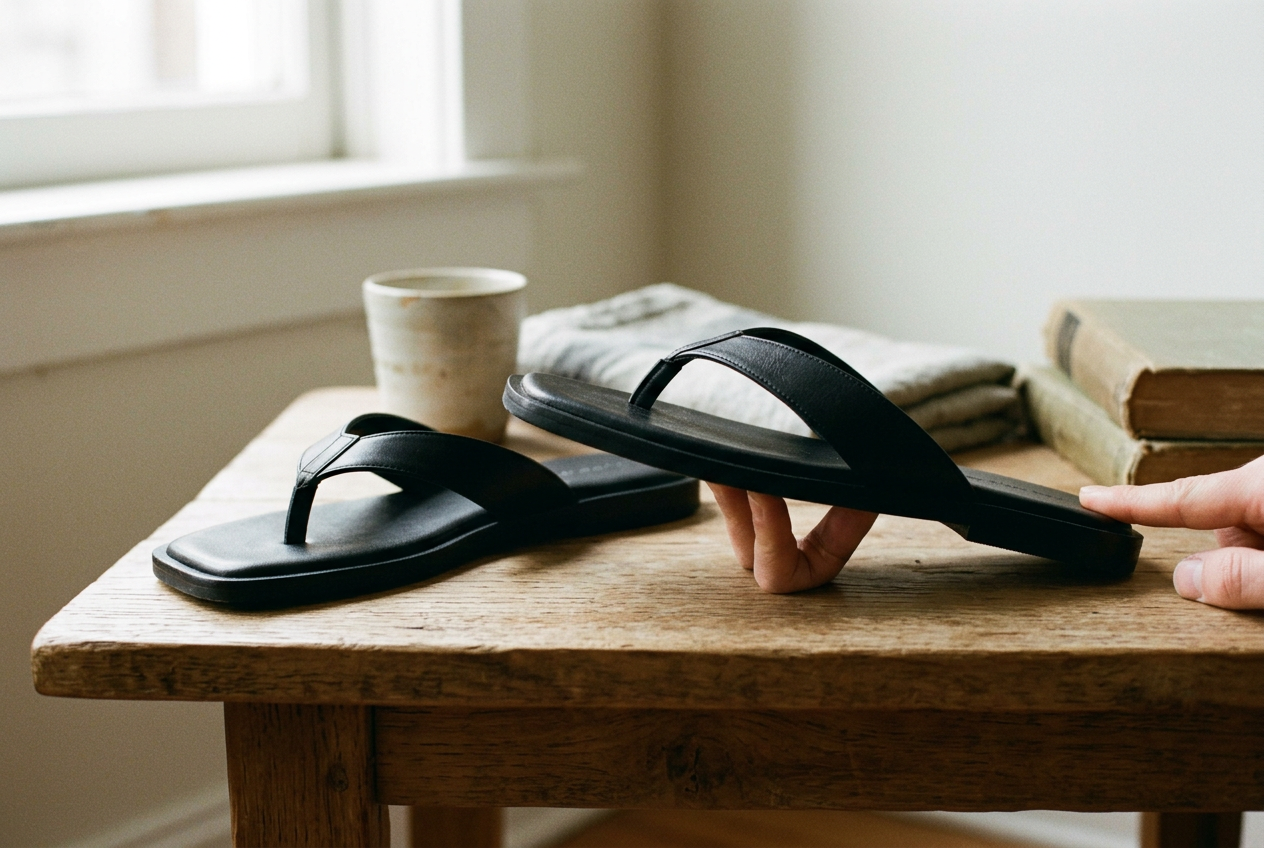
Use a plain black molded-rubber square-toe flip-flop as the reference pair: slim thong straps, a mostly flat footbed, roughly a thumb’s width of sole visible beyond the longest toe, and a front edge that turns upward when the sandal sits on a table. This unisex fit advice applies across wardrobes, although shoppers should compare foot measurements rather than assume that women’s and men’s size labels convert neatly.
The roomy outline can mislead you
Square toe describes the perimeter, not the usable platform. A foot can sit inside the visible outline while landing on a narrower raised section of the footbed, especially when the sandal has a beveled edge or a molded border. The toes look accommodated from above, yet the little toe may balance on a slope and the big toe may drift toward the inner edge as the foot slides forward.
On the black reference pair, the important distance is not from the toe tip to the square edge. It is from the toe tip to the point where the front begins to rise. If that curve starts beneath the toe pads, the toes are standing on a ramp. A shallow curve beginning ahead of them is less intrusive, while a steep curve that begins farther back reduces the flat area the shoe appeared to offer.
This explains why sizing up is an unreliable fix. A longer pair adds more material in front, but it may also place the foot farther back against the thong post, leaving the toe spring in much the same place relative to the toes. If the straps are loose, the extra length gives the sandal more room to move independently. Now there is a bigger sole to retrieve at every step.
The better fit leaves a modest border around the toes without using that border as walking space. The ball of the foot should sit over the widest part of the sole, the thong post should not pull between the toes, and no toe should need to lift merely to clear the curved front.
Toe spring is only useful when the sole cooperates
Toe spring often appears on thicker or firmer sandals because a rigid slab cannot bend easily during push-off, the part of the step when the heel rises and body weight moves through the forefoot. The curved front gives that slab somewhere to roll. This can work in a closed shoe that follows the foot securely. A flip-flop has one small thong junction and two straps doing the same job, with considerably less enthusiasm.
Forefoot flexibility matters more than softness under a thumb. The flex point, meaning the place where the sole naturally bends, should sit beneath the ball of the foot rather than halfway through the arch or directly under the toes. Hold the heel with one hand and press upward beneath the front with the other. The sandal should resist enough to avoid folding in half, then bend where the foot bends.
Do not judge it by twisting the whole shoe into a spiral. That demonstrates twistiness, which is useful mainly if your commute includes wringing out footwear. Press the sole as it would be loaded during a step.
Return to the black reference pair. If its molded-rubber sole has a pronounced front rise but barely bends under the forefoot, the wearer must first lift the heel, then persuade the sandal to roll over its fixed curve while the toes keep contact with the footbed. A mild toe spring with a responsive sole asks less. A nearly flat front can also work, provided the material flexes without slapping the pavement or creasing sharply beneath one toe joint.
Material changes the result. Dense molded rubber often feels substantial and may grip pavement well, but thickness can make it reluctant to flex. EVA, meaning a lightweight foam commonly used in midsoles and molded sandals, usually bends more easily at a similar visual bulk, though very soft versions can compress unevenly or let the foot wobble over the edge. A thin leather sole may flex readily after wear, while a smooth leather footbed can become slick with heat until it develops texture.
No material guarantees the right motion. Construction wins.
Footbed grip decides how much the toes intervene
A flip-flop is never strapped to the foot like a sneaker, but it should remain close enough that the toes can relax between steps. Footbed grip comes from surface texture, shape, and the friction created when skin meets the material. A lightly pebbled rubber surface generally holds more securely than a polished synthetic finish, although sweat, sunscreen, dust, and water can change the result quickly.
The fitting-room test is brief. Put on both sandals, walk at a normal pace, then stop without shortening the last step. Look at where the feet finished. If they slid toward the square edge, repeat the walk after wiping both feet and footbeds dry.
Continued movement points to the fit or surface rather than temporary moisture.
Listen as well. A sharp slap does not automatically mean poor fit, since flexible flip-flops make noise, but repeated clacking combined with toes curling downward suggests the sole is falling away and being caught again. Watch the tendons on top of the foot. They should not stand out through every step as though the toes have accepted a temporary warehouse job.
The black reference pair should also survive a gentle incline. Walk up and down a ramp or sloped section of the store if one is available. On the descent, the foot should not shoot forward until the thong post stops it. Going uphill, the heel should not leave the sandal so far behind that the toes clamp down to bring it along.
A contoured footbed can help, but contour must match the foot. A shallow heel cup, the raised rim that cradles the heel, may limit forward drift without feeling restrictive. An aggressive toe bar placed behind the toe joints can give the foot something to hold, yet a misplaced ridge becomes one more hard object under load. Texture is usually the less complicated intervention.
Give the fit one week, not one hopeful lap
A store walk catches obvious sliding and misplaced flex. It cannot reproduce a warm sidewalk, slightly damp feet, or the point late in the day when the foot spreads and patience becomes a limited resource. Keep the pair indoors until the return policy is clear, then wear it in several short sessions on clean floors rather than committing to one long outing.
During that week, note what happens after ten minutes and again near the end of each wear. Mild awareness of the thong strap may settle as the skin adjusts, but increasing pressure between the toes, burning under the toe pads, or repeated toe cramping is not useful break-in. A molded sole with fixed toe spring will not flatten dramatically because optimism has been applied to it.
Check the black pair on a table after each session. If the front rise was molded into the sole, expect it to remain. If the sole has developed a new crease directly beneath the toes rather than under the ball of the foot, the shoe is bending in the wrong place for that wearer. Deep compression under one edge also shows that the foot is not landing squarely on the usable platform.
Pay attention to the upper. Straps that stretch over the week can reduce rubbing but also allow more footbed movement, particularly on a flat sandal without a heel cup. A pair that fit loosely on the first day rarely becomes more cooperative after the straps relax.
The alternative does not have to be a rounded sandal. Look for the same square silhouette with a lower front rise, a thinner forefoot, a textured footbed, or broader straps that stabilize the foot without pulling hard at the thong post. The polished effect comes from the outline and upper finish, not from carrying a rigid serving board under each foot.
The buying decision belongs at floor level
Square toe flip-flops are worth considering when the square platform follows the foot’s width and the sole bends beneath the ball. They are less convincing when the visual drama comes from an extended, sharply lifted front attached to a smooth slab. That construction may photograph cleanly, but walking asks for cooperation the image does not record.
Price is a weak guide here. An inexpensive molded pair can flex in the correct place, while a costlier leather or sculpted synthetic sandal may prioritize a crisp profile. Spend for durable materials and a finish you will wear, but do not pay extra to negotiate with the shoe.
Before buying, set the sandal on a flat surface and view it from the side. Press beneath the ball area, rub a dry thumb across the footbed, and walk far enough for the foot to settle into its natural position. If the toes remain flat and the sandal follows without being clawed back into place, the square toe is providing room rather than merely drawing it.
Questions people ask
How much toe spring is too much in a flip-flop?
There is no universal height because sole thickness and flexibility alter how the curve behaves. It is too much for your foot when the rise begins beneath the toe pads, the sole will not bend beneath the ball, or your toes lift and curl to manage the sandal during an ordinary walk.
Should my toes reach the edge of square toe flip-flops?
They should sit inside the usable flat area, with a small border of sole visible in front and at the sides. A large extension can make the sandal harder to control, while toes resting on a beveled edge or front curve have less stable space than the outline suggests.
Will stiff square toe flip-flops soften with wear?
Straps and thin leather soles may relax, but a thick molded-rubber or foam sole usually keeps much of its original toe spring and flex pattern. Do not rely on break-in to move the bending point from beneath the toes to beneath the ball of the foot.
Are textured footbeds always more comfortable?
No. Light texture can reduce sliding, but coarse ridges may rub when feet are damp, and molded contours can press in the wrong place. Test the sandal on an incline and check whether the foot stays put without gripping; the useful texture is the one you stop noticing.
One update a day
Today's fashion update, in your inbox
One fashion update each morning — no hype, no filler, just pieces worth wearing.