Square Toe Flip Flops Can Put Too Much Sole Before Your Toes
A square front can look neat while behaving like a small shovel on stairs. This fitting test checks whether toe projection, sole stiffness, and thong placement make the extra sole unsafe.
Women's · August 21, 2026 · 8 min read
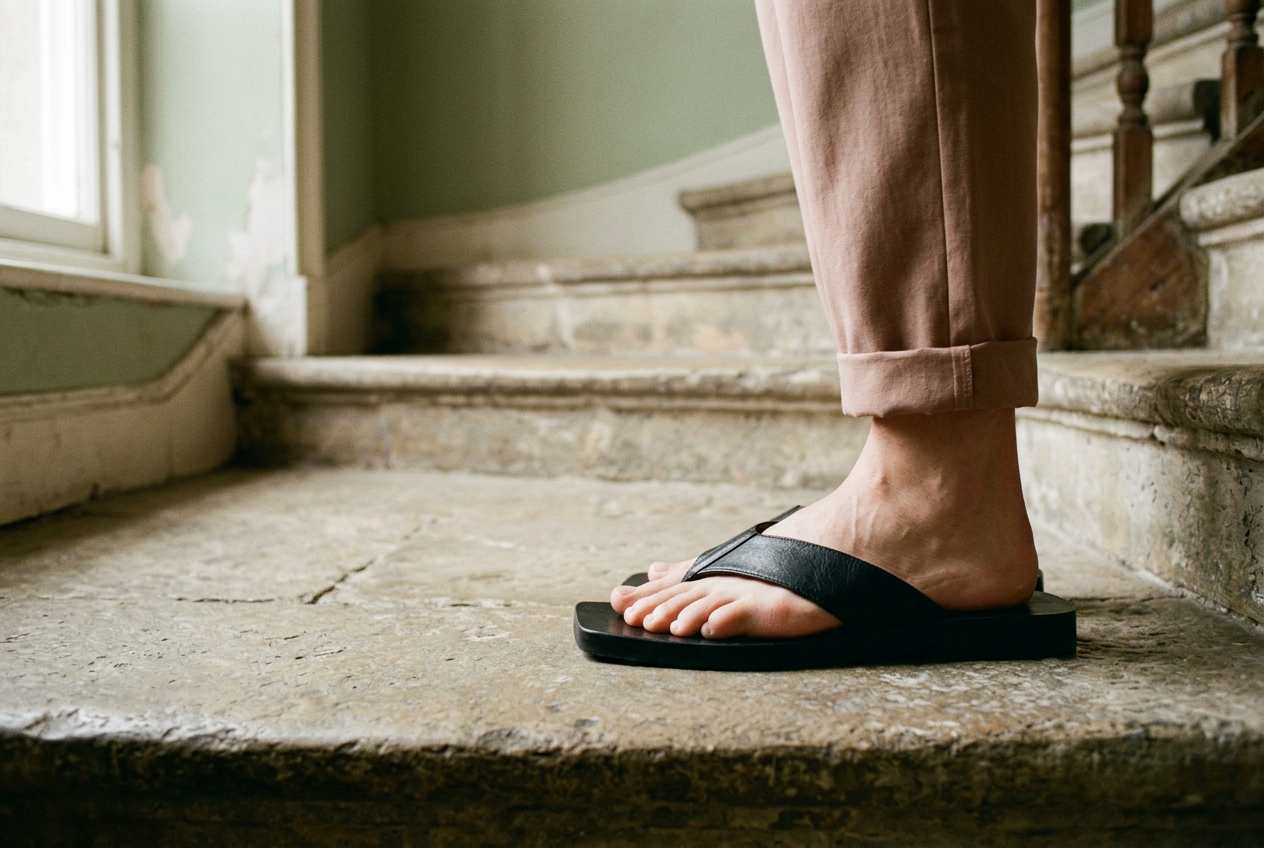
The pair that prompted this test was a women's black square-toe flip-flop with a molded foam footbed, a firm rubber outsole, and a slim synthetic thong. On level flooring, the straight front edge looked tidy and the fit appeared correct. On stairs, the empty platform ahead of the toes arrived first.
That does not make every square-toe sandal hazardous, nor does it mean the shortest possible sole is best. Toes need enough room to spread without crossing the footbed edge. The useful question is whether the sandal leaves more platform than the wearer can reliably lift, control, and clear.
This is women's coverage because the sample came from women's sizing and reflects the long, narrow footbeds common in that market. The fitting mechanics also apply to comparable thong sandals elsewhere, but sizing labels are not interchangeable.
Front overhang is only the visible part
Toe projection, meaning the distance from the longest toe to the leading edge of the sole in the direction of travel, is easiest to see while standing. It is not always easiest to judge.
A square sole may leave open corners beside tapered toes without creating much extra length directly ahead of them. Those corners usually matter less during a straight stride, although a person whose feet turn inward or outward may bring one corner into the path of a stair edge. Look along the travel line of each foot rather than judging the entire square as wasted space.
On the black sample, the gap looked moderate from above. The problem became clearer after walking across the room, because the thong held the foot slightly behind the visual center of the footbed and the firm sole kept the front section extended as one flat piece. The toes had not run out of room. They were occupying the wrong part of it.
Do not assess this by pushing the foot forward until the longest toe reaches an attractive position. That produces a fitting photo, not a walking fit. After several natural steps, the foot should settle where the straps put it; if the sandal repeatedly leaves a conspicuous ledge in front, believe the ledge.
Start with the level-floor reset
Try the sandals on a clean, dry, hard floor so they can still be returned. Walk at your normal indoor pace for about a minute, including a few turns, then stop without shuffling either foot into place.
Check the heel first. It should sit on the footbed rather than hanging off or floating far inside the rear edge. Next, look straight down at the longest toe and note the empty sole directly in front of it. A small visible margin can be reasonable, particularly when the foot spreads under weight, but there is no universal safe measurement because stride height, foot shape, and sole behavior change the result.
Now take another pass across the room while paying attention to toe gripping. If the toes curl to keep the sandal attached, the foot is spending effort on retention rather than clearance. This can pull the toes farther back, increase the effective overhang, and make a supposedly comfortable loose fit feel like clerical work for the feet.
The sample pair stayed aligned at the heel but encouraged a slight toe curl. That detail mattered more than the static gap. A flip-flop that requires constant gripping may feel secure for five minutes and exhausting after an afternoon, which is not a comfort feature no matter how soft the foam feels under a thumb.
Test the sole where the foot needs it to bend
Sole stiffness decides whether the projecting front edge follows the toes or continues forward like a flat extension. Hold the sandal at the heel and press upward beneath the ball area, which is the broad forefoot just behind the toes. The main bend should occur near that area, not through the middle of the arch.
A very soft sole is not automatically safer. If the front flops downward, it can brush a stair riser; if the whole sandal twists freely, the foot may land partly off the platform. What helps is controlled forefoot flex, enough for the front to rise with the toes without turning the sandal into loose packaging.
The black sample resisted bending until more force was applied than the walking foot seemed to provide. Its outsole was not exceptionally thick, yet the combination of the rubber layer and molded foam made the square front travel as a firm panel. That construction looked polished compared with a thin beach flip-flop, but polish has limited value when the shoe meets architecture.
Compare both sandals. One sole can be stiffer because of molding variation, storage, or uneven wear, and the pair should not ask one foot to clear a different obstacle from the other.
Let the thong reveal the real size
Thong placement can create overhang even when the printed size sounds right. The toe post should sit between the first and second toes without forcing the webbing of the foot hard against it, while the side straps should hold the forefoot without pushing the entire foot backward.
On the sample, the V-shaped upper met the sole far enough back that the foot settled behind the available front space. Sizing down shortened the sole but also brought the heel too close to the rear edge, so the smaller size was not a real alternative. This was a shape mismatch, not a customer failing to understand her own shoe size.
Check for strap dents after the short indoor walk. Deep pressure at the toe post, whitening skin beneath a strap, or a foot that repeatedly retreats from the upper suggests the sandal will not stay in its intended position. Materials can soften with wear, especially some synthetic uppers and leather straps, but buying a trip-prone fit on the promise of future stretching is a poor use of both money and stairs.
A better match may have the same square outline with the thong anchored slightly farther forward, or a shorter, clipped-square footbed that removes the unused front corners and length. A back strap also improves retention, though it changes the minimal look and does not rescue a sole that is too long.
Use one bottom stair as the final fitting room
Only test stairs at home on a dry, clear staircase with a handrail. Do not begin with a full flight. Use the bottom step, move slowly, and stop if the sole catches.
First, climb onto the step with the whole forefoot rather than balancing on its edge. Watch whether the square front taps the vertical riser before the foot lands. Repeat with the other foot leading because gait and leg strength are rarely perfect mirror images. A helper can record from the side at floor level, which often shows contact that the wearer feels only as a faint interruption.
Next, step back down as if leaving a low curb. The front should follow the toes without folding under, hanging on the edge, or forcing an exaggerated knee lift. Then approach the step at a slight angle, since real staircases involve people turning around bags, other people, and the occasional object left exactly where it should not be.
The black sample made light contact during ascent when the leading foot approached close to the riser. The firm front edge did not collapse, which prevented a full snag, but it announced that the clearance margin was too dependent on deliberate high stepping. Shoes worn for ordinary life should tolerate ordinary lapses in choreography.
A pass means the sole clears without tapping, the foot stays in place, and the wearer does not alter her stride to manage the shoe. If the sandal fails one part, test the cause rather than declaring all square toes unsuitable. Less projection may fix it; a more flexible forefoot may do enough, while better thong placement can move the toes into the space already purchased.
Curbs expose a different failure
Stepping up a curb resembles the stair test, but there is often no handrail and the approach may be faster. A projecting, rigid sole can strike the curb face before the toes rise above it. The wearer then either shortens the step or lifts the knee higher, adaptations that may work until attention moves to traffic or a phone.
On the way down, retention matters more. A loose thong lets the sandal lag behind the heel, and the front may land at an angle instead of following the foot. Test the motion on the lowest stair, not beside moving cars, and reject any pair that twists under the forefoot.
Wet conditions deserve a separate assessment because water changes footbed grip and can let the foot slide forward or sideways. An indoor dry test cannot certify rain performance. It can, however, eliminate the pair that already struggles before weather contributes its opinion.
Questions people ask
How much space should square toe flip flops leave in front?
There is no single safe measurement for every foot and sole. Leave enough room that the toes remain on the footbed when standing and walking, but reject a pair if the front edge taps a stair riser, catches during a slow ascent, or makes you lift your foot differently.
Should I size down to reduce the empty sole?
Only if the smaller size keeps the heel fully supported and does not crowd the toes or toe post. If sizing down fixes the front while creating rear overhang or strap pressure, the sandal's shape is wrong for your foot and another last is the better option.
Does a flexible sole make square toe flip flops safer on stairs?
Controlled flexibility at the forefoot can help the sole rise with the toes, but a sole that droops or twists introduces other problems. Test where it bends and then use the bottom stair; hand-flexing alone cannot show how the thong and footbed behave during a step.
Can a square toe corner catch even when the front gap is small?
Yes, particularly if your feet turn inward or outward as you climb. Check the corner that leads in your natural walking line, then approach the bottom stair at a slight angle. A clipped-square shape can preserve the look while removing sole that your toes never use.
One update a day
Today's fashion update, in your inbox
One fashion update each morning — no hype, no filler, just pieces worth wearing.