A Wide Square-Toe Sole Doesn't Mean the Flip-Flop Is Too Big
Square-toe flip-flops are supposed to look wider than the foot. The useful fit clues are toe-post placement, heel position, and whether the sole follows you through a full step.
Women's · August 10, 2026 · 8 min read
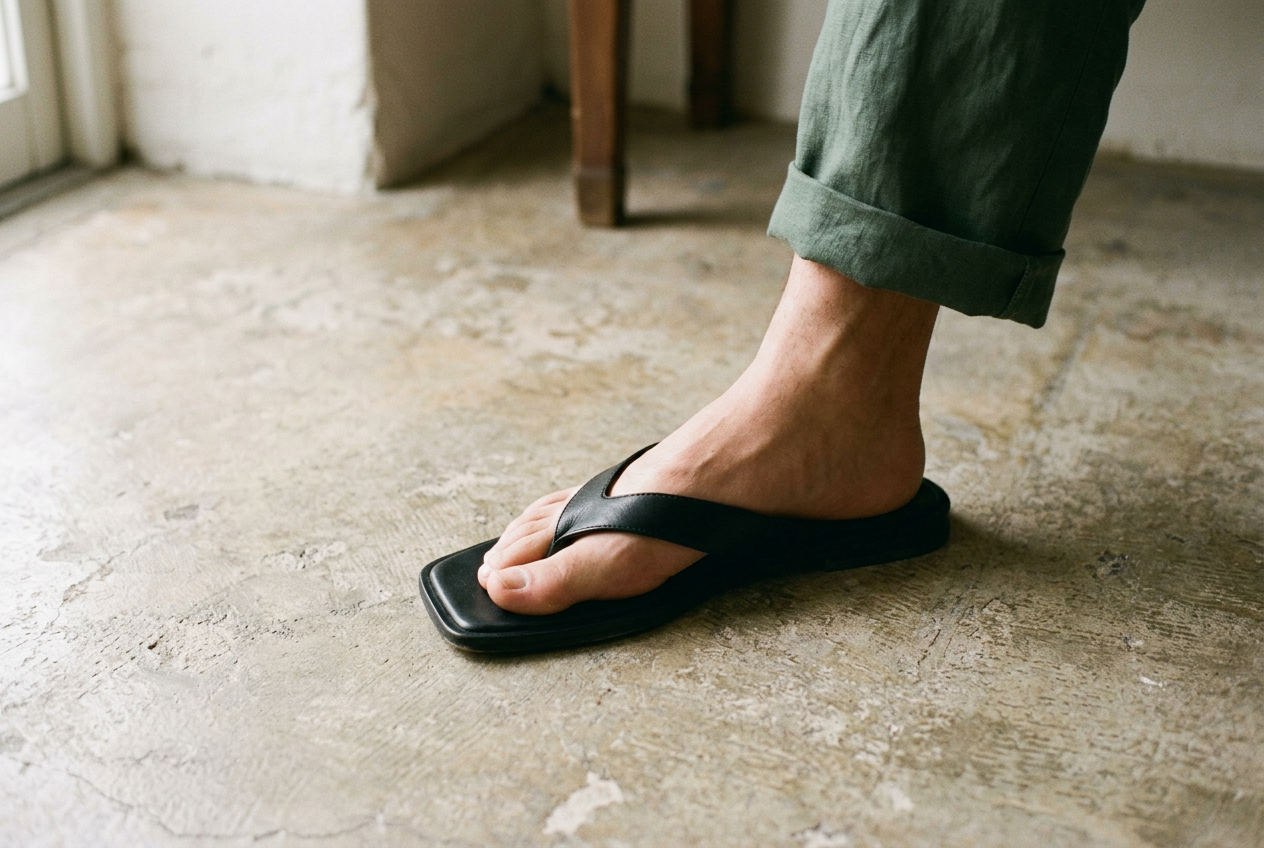
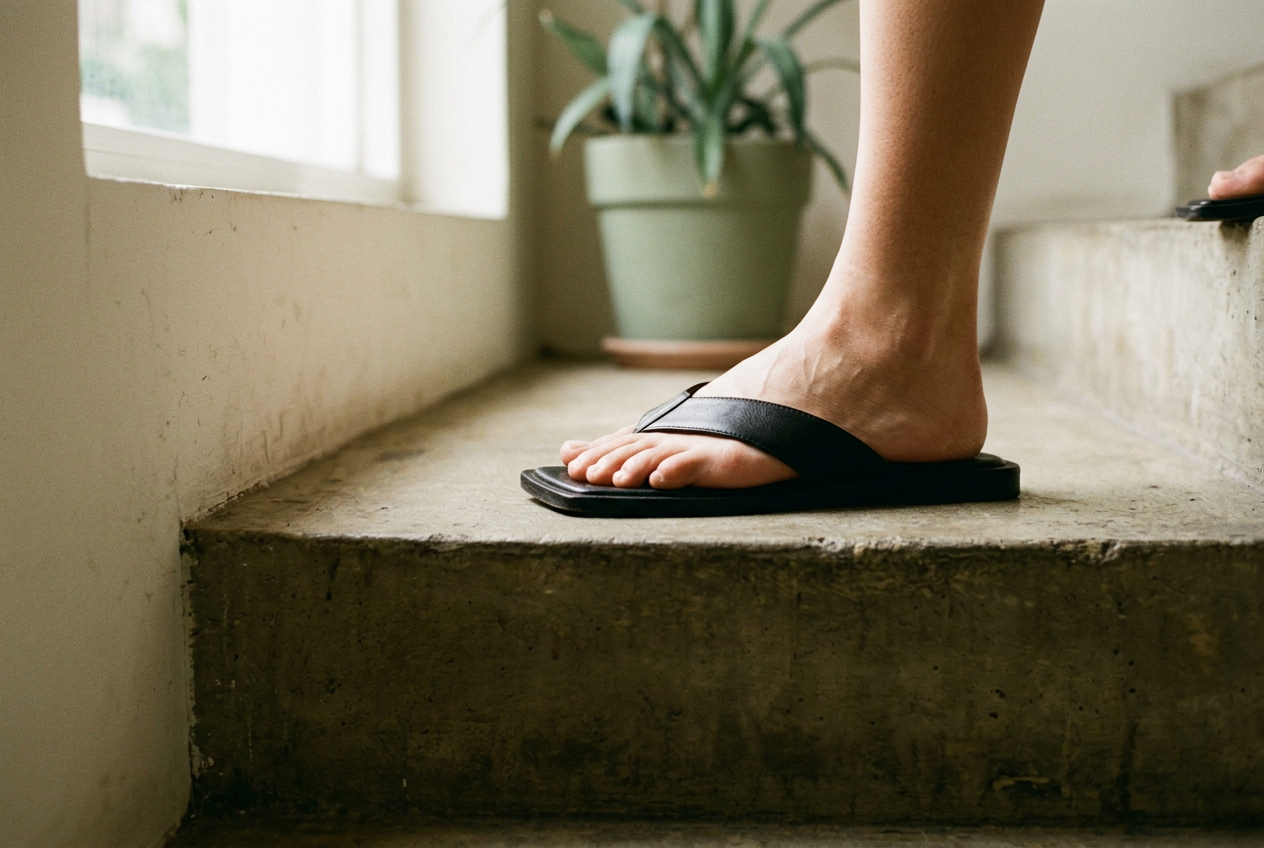
The reference pair for this guide is a black women’s square-toe flip-flop tested in two adjacent whole sizes: a molded EVA footbed, meaning a top surface made from lightweight foam, with slim synthetic thong straps and no heel cup. The larger size looked broad enough to serve snacks on. It also fit better.
That apparent contradiction is the point. A squared sandal sole is drawn wider at the front than the average foot, particularly around the little-toe edge, because the silhouette needs a clean geometric outline rather than a sole that traces every toe. Side space can be design. Extra length is usually a sizing problem.
Across a week of short walks and ordinary errands, the larger sample kept its heel centered and its toe post in the natural gap between the first two toes. The smaller one looked tidier while stationary, but the post sat too far back, pushing the foot forward until the toes approached the front edge and the heel landed against the rear edge. Fashion had won the mirror test and lost at walking.
This guide uses women’s sizing, although the fit mechanics apply to any comparable thong sandal. Brand size charts remain useful for choosing a starting size, especially when they give foot length rather than only a familiar US number, but the shape of the sole can make the correct pair look larger than expected.
The side overhang may be intentional
Start by separating width from length. On a square-toe flip-flop, the sole may project beyond both sides of the forefoot while leaving only a modest margin in front of the longest toe. That is a normal visual effect when the front edge is cut straight, because toes form a curve and the sole does not.
The useful distinction is between a stable border and an unsupported ledge. A stable border remains roughly even around the forefoot while the foot stays centered over the sole. An unsupported ledge appears mostly on one side, often because a narrow foot is sliding toward the inside edge or because the toe post does not match the wearer’s anatomy.
On the black sample, the outside front corner remained visible beside the little toe in both sizes. Sizing down did not remove the corner; it shortened the sandal and made the straps pull harder. That is why choosing the smallest sole that contains the foot is unreliable. The squared outline is part of the shoe, not packaging to be trimmed away with your dignity.
A very narrow foot can still be overwhelmed by a broad platform. If the straps do not hold the forefoot near the center, the foot will travel sideways while the sole continues straight ahead. In that case, a narrower square last, meaning the foot-shaped form used to determine the shoe’s proportions, is a better answer than another size.
Toe-post placement decides where the foot sits
The toe post should rise through the natural space between the big toe and second toe without dragging the webbing of the toes forward or pressing into it from behind. This is the first fit point to check because it controls the foot’s position on the entire sandal.
If the post sits too far back, the foot is forced forward. The front margin disappears, the toes may grip to keep the sandal attached, and the heel can look as though it has plenty of room even though the working length is wrong. The smaller black sample failed this way: its total sole length seemed plausible, but the post dictated a position the foot could not maintain without tension.
A post that sits too far forward creates the opposite problem. The foot settles behind it, leaving a conspicuous shelf in front while the heel approaches or crosses the back edge. This is excess length, even if the straps feel pleasantly loose in the fitting room. Loose is not a synonym for comfortable; sometimes it is merely a delay before slapping noises begin.
Check the post while standing, not while holding the sandal against the sole of the foot. Body weight spreads the forefoot and changes where the toes rest. Walk several passes on a clean, hard floor, then notice whether the post remains neutral or starts rubbing one side of the toe gap. A returnable sandal should not require the skin between the toes to negotiate terms.
The heel should land inside the rear edge
Once the toe post is correct, look at the heel. It should sit fully on the footbed with a visible but restrained border behind it, rather than hanging over the edge or floating far forward from it.
A heel ending exactly at the back may look precise in a photograph, yet it leaves no allowance for the foot’s backward movement during a stride. On a flat flip-flop, that often means the heel touches the edge at each step. A raised platform makes the mistake less forgiving because landing partly on a hard rim can tip the foot or create concentrated pressure.
The larger black sample left more sole behind the heel than the smaller size, but the difference stopped looking excessive once the shoes moved. The heel landed inside the platform, the forefoot stayed aligned with the post, and the rear edge did not catch under the foot. Those facts matter more than a perfectly cropped outline while standing still.
Too much rear space is easy to spot in motion. The sandal trails behind the foot, the heel lands well ahead of the back edge, and the platform may twist before it meets the floor. If the toe post is correctly placed and a large rear shelf remains, the sandal is too long or built with proportions that do not suit the foot.
Walk the square corners around a turn
Straight-line walking can flatter a mediocre fit. Turns expose it.
Walk normally, make a tight turn, and step sideways once or twice. The sole should rotate with the foot rather than arriving a fraction later. Pay attention to the outside front corner, which carries less body weight than the center of the forefoot and can feel detached on a particularly wide design.
Some visible corner overhang is harmless when the straps secure the foot and the foam flexes with the stride. It becomes a practical failure when the corner catches the floor, folds under, or makes the ankle correct the platform after each turn. Thick, stiff platforms are more likely to magnify poor alignment because they do not bend enough to follow the foot.
Material changes the result. EVA compresses and flexes, although very soft foam can wobble when the sole is wider than the foot. Dense rubber usually gives better ground contact but adds weight. Leather footbeds may mold slightly with wear, while synthetic straps can soften at pressure points without changing the basic location of the toe post.
None of these materials can repair the wrong length.
After a week, the larger black sample showed light compression where the heel and forefoot loaded the foam, but its broad front still tracked under the foot. The smaller pair had looked more proportional out of the box; its rear edge remained the place the heel met resistance. Break-in had no useful job available there.
Use two sizes, then reject the wrong shape
When a style comes only in whole sizes, try the sizes on either side of the brand’s length recommendation if returns allow. Keep the pair in which the post sits neutrally and the heel remains inside the rear edge during a full stride. Do not size down solely to reduce visible sole at the sides.
If both sizes fail differently, stop treating size as the only variable. The shorter pair may crowd the post while the longer pair leaves the straps loose enough for sideways drift. That points to a proportion mismatch between the sandal and the foot, not a decision that can be solved by tolerating whichever discomfort seems more photogenic.
For a narrow foot, look for adjustable thong straps, a narrower footbed, or a square toe that tapers through the waist of the sandal. For a wide foot, avoid relying on a larger size if the only gain is length; the post and strap junctions must also allow the forefoot to spread without spilling over the side.
Brand documentation can narrow the search. Read whether the size chart refers to foot length or insole length, because those are not interchangeable, and check product descriptions for adjustable straps, platform thickness, or width notes. Customer fit summaries can flag a pattern, but a repeated recommendation to size up is incomplete unless it explains whether the problem was short length, tight straps, or a misplaced post.
The black sample’s larger size passed for one unglamorous reason: every structural point stayed under the foot while walking, even though the square corners remained visible. That is the fit to keep. The smaller size offered less apparent overhang and more actual interference, which is a poor exchange unless standing still has recently become your main form of transportation.
Questions people ask
Should
I size down if the square sole looks wider than my foot?
Not on appearance alone. Check whether the toe post sits comfortably, the heel remains inside the back edge, and the platform follows the foot through turns. If those points work, side overhang can be intentional. Size down only when the current pair also has excess length or cannot hold the foot centered.
How much space should sit behind the heel?
There should be a small visible border so the heel does not strike or cross the rear edge during a step. A large shelf suggests excess length when the toe post already sits correctly. Judge this while walking, since a heel that looks neatly aligned at rest may move backward under body weight.
Are square-toe flip-flops suitable for wide feet?
They can be, but a wide-looking sole does not guarantee useful width. The straps and toe post must let the forefoot spread without pressure or side spill. If sizing up only adds space behind the heel, seek a genuinely wider construction rather than buying extra length and asking the platform to supervise it.
Will a tight toe post loosen after break-in?
Straps may soften slightly, depending on the material, but the post will not move to a better location. Mild surface stiffness can improve; pressure caused by incorrect placement usually does not. If the foot must slide forward or backward to tolerate the post, return the sandal before the outsole shows wear.
One update a day
Today's fashion update, in your inbox
One fashion update each morning — no hype, no filler, just pieces worth wearing.