Your Sneaker Can Be the Right Length and Still Bend Wrong
Heel lift and cramped toes can come from the same overlooked fit problem: the shoe creases somewhere your foot does not. Here is how to check before committing.
August 14, 2026 · 7 min read
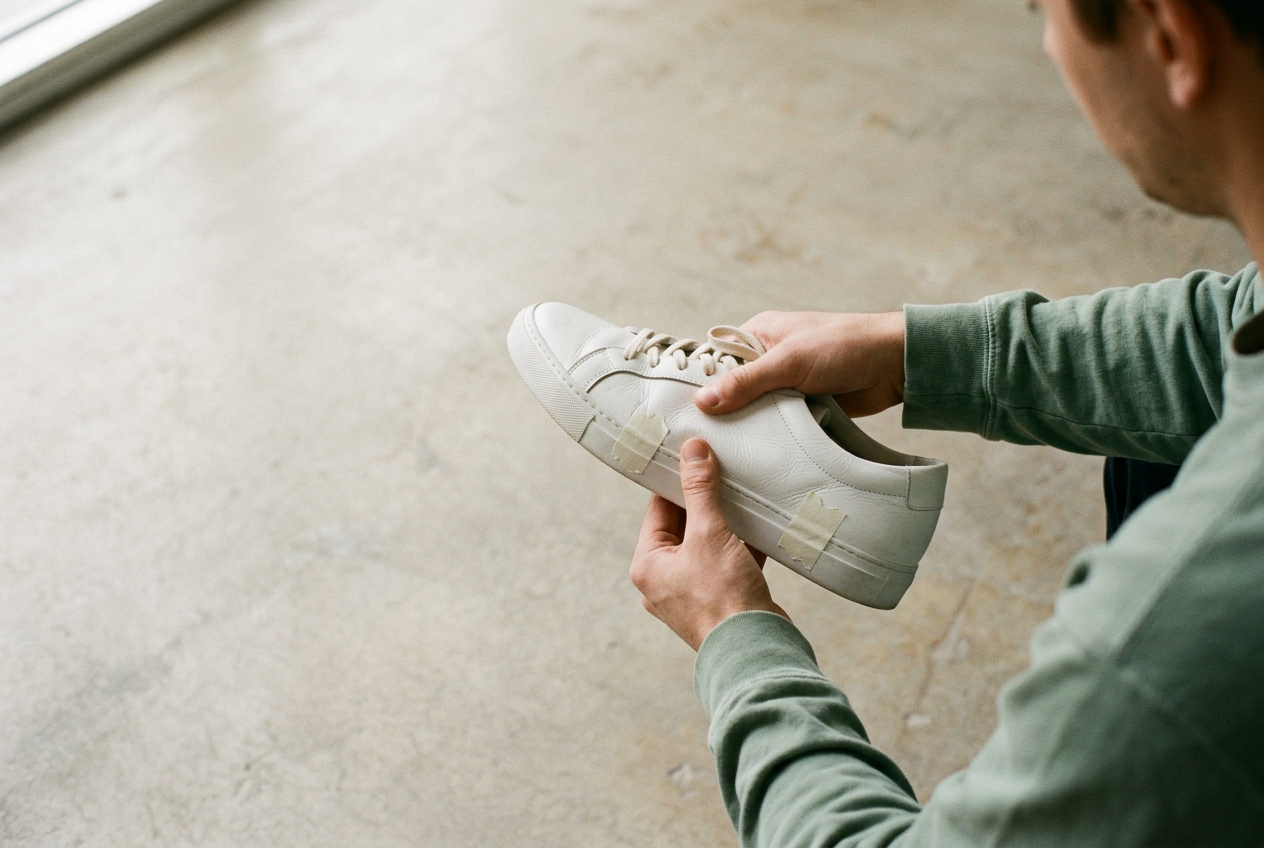
The shoe that made this obvious was a white low-top sneaker from my own closet, built with a smooth leather upper stitched to a firm rubber cupsole, meaning the sole wraps slightly up around the upper like a shallow wall. Its measured length was fine. My toes lay flat with useful space ahead, and the heel felt secure while I stood in place.
Walking was less diplomatic. Over a week of ordinary errands, the heel began lifting whenever I pushed off, while tighter lacing held the rear down only by pulling my toes toward the front. The leather soon formed a deep diagonal crease behind the widest part of my forefoot. It was the right nominal size and the wrong mechanical fit.
The culprit was the flex point, the area where the sole naturally hinges as the foot rolls forward. On this pair, that hinge sat closer to the arch than the ball of my foot did, so the shoe folded under a part of the foot that was trying to remain relatively stable. Comfort had become a negotiation conducted through the laces, which is rarely a productive meeting.
This is unisex fit advice. Men’s and women’s size labels may change the number and width assumptions, but feet and shoes still need to bend in corresponding places.
Why the measured length can lie
Heel-to-toe length answers one useful question: whether the toes have enough room. It does not tell you whether the shoe’s widest section, sole hinge and upper volume line up with the wearer’s forefoot.
The missing measurement is heel-to-ball length, which runs from the back of the heel to the ball of the foot, the padded area beneath the joints where the toes meet the rest of the foot. Two people can have the same overall foot length but different heel-to-ball lengths because their toes occupy different proportions. A sneaker shaped for one can look correctly sized on the other while bending in the wrong place.
During a step, the heel rises and those toe joints bend. The sneaker should yield across that same broad band, allowing the sole and upper to move with the foot rather than making the foot slide inside them. If the shoe hinges elsewhere, something has to compensate: the heel may lever upward, the toes may meet the front, or the upper may press across the forefoot.
None of those reactions proves a flex mismatch on its own. A loose heel counter, narrow toe box or slick sock can produce similar annoyance. The hand test narrows the diagnosis before another pair of insoles is purchased and quietly assigned responsibility for a problem it cannot fix.
Mark the ball of the foot while standing
Put on the socks you expect to wear with the sneakers, then lace the test pair with ordinary tension. Do not wrench the eyelets together in an attempt to turn a low-volume shoe into a different shoe. Stand with your weight distributed normally, since the foot becomes longer and broader under load.
Feel along the inside edge of the shoe for the prominent joint at the base of the big toe. Place a small piece of removable painter’s tape on the upper beside it. Mark the corresponding joint at the base of the little toe on the outside edge as well; the ball line often crosses the shoe at a slight angle rather than running straight across like a factory seam.
The markers belong beside the joints, not beside the ends of the toes and not automatically at the widest visible part of the sneaker. On my white leather pair, the big-toe marker landed noticeably ahead of the permanent crease that had developed during the week. The outside marker told the same story, though the gap was smaller because the flex line ran diagonally.
If the upper is soft mesh, use low-tack tape and avoid drawing on it. A rigid leather upper makes the location easier to feel, while thick padding can blur the joint, so press from inside the shoe with a finger if the opening allows. This should take less than two minutes and leave the returnable pair looking returnable.
Bend the empty sneaker without bullying it
Take the shoe off and hold the heel firmly in one hand. With the other hand, press the front of the outsole upward, using steady pressure across the forefoot rather than grabbing the tip and folding it toward the tongue. You are looking for where the shoe chooses to bend, not demonstrating that sufficient force can defeat rubber.
Watch both the outsole and upper. The center of the bend is more useful than the first surface wrinkle, since thin leather and mesh can crease before the underlying sole moves. A conventional everyday sneaker should usually flex across the forefoot, behind the toes and ahead of the arch, although the precise line depends on its construction.
Stiffness and location are separate judgments. A new rubber outsole may require more pressure than a broken-in one, yet it can still bend in the correct place; conversely, a very soft foam sole may fold easily in the middle, which feels impressive in the hand and rather less charming under an arch after an afternoon out.
Do not force this test on a deliberately rigid rocker sneaker, whose curved sole is designed to roll rather than hinge sharply, or on a plated performance shoe intended to resist forefoot bending. Those need to be judged through walking because their mechanics differ. For a standard leather, canvas or mesh sneaker with a flat-looking sole, the hand bend remains a quick and revealing check.
Compare the bend with the two markers
Put the empty shoe on a table after flexing it and locate the center of the temporary bend. Compare that area with the tape markers from the loaded foot. The lines do not need to coincide with drafting-table precision, but they should occupy the same broad forefoot band.
Next, wear the shoe and take several normal steps on a clean indoor floor. Look down or use a phone video taken from the side, keeping the camera low enough to show the heel and forefoot. The sneaker should crease close to the marked ball line as the heel rises, while the back should follow the foot without a large delay.
My white cupsole pair failed both versions. By hand, it folded behind the tape marks. On foot, the outsole tried to hinge early, the upper collapsed behind the big-toe joint, and the heel rose as the foot continued bending farther forward. Pulling the laces tighter reduced visible movement at the back but increased pressure over the toes, which changed the symptom without correcting the geometry.
Also walk up a few stairs if the store or home setup permits. Stairs demand more forefoot bend than a cautious lap around a carpet, and a mismatch that seems minor on level ground often becomes obvious during push-off. Keep the sole pristine if a return remains possible. Fit testing should not become ownership through scuffing.
Read the direction of the mismatch
When the sneaker bends behind the ball of the foot, closer to the arch, the sole can fold beneath an area that wants support. The upper may crease into the forefoot, and the foot can shift forward as the shoe shortens around its hinge. That was the pattern in the white leather pair: pressure arrived from above and behind, even though there was enough static room ahead of the toes.
When the sneaker bends ahead of the foot’s ball line, the foot reaches its joint before the shoe reaches its own hinge. The rear can then lift as the foot tries to roll forward inside a sole that remains resistant at the needed point. Some wearers respond by buying shorter, reasoning that less heel movement means better fit, but the shorter size may merely bring the toe box into the dispute.
The symptom is not perfectly predictable because upper volume, outsole stiffness and lacing all affect how movement gets redistributed. The useful finding is simpler: if the marked joint line and the shoe’s natural hinge are clearly separated, changing socks or adding a heel grip is unlikely to make them agree.
Decide whether a different size can fix it
Try another size only if the ball line appears likely to move into the correct part of the shoe without sacrificing toe room or width. Going up increases heel-to-ball length as well as overall length, while going down reduces both, so a neighboring size can work when the mismatch is modest. It cannot rescue every last or shape.
A last is the foot-shaped form around which a shoe is built. If every size in a model places its widest section or flex point poorly for your foot proportions, choose another model with a different last rather than funding a prolonged break-in experiment. Leather may soften and foam may compress, but the principal hinge in a stitched rubber cupsole rarely migrates the distance needed to correct an obvious mismatch.
For the white sneaker, more wear would have deepened the crease behind my forefoot, not moved it forward. The practical alternative was another low-top whose sole bent under the tape markers during the indoor test. It was not magically comfortable. It merely stopped asking my toes and heel to settle an argument caused by the sole.
Questions people ask
Should a sneaker bend in the middle?
Most conventional sneakers should bend across the forefoot, where the toe joints flex, rather than under the center of the arch. A very flexible shoe may collapse in several places when twisted by hand, so press the forefoot upward with controlled pressure and identify the first strong hinge instead of folding the whole shoe.
Can a sneaker’s flex point change after break-in?
The sole may become easier to bend, and the upper will develop clearer creases, but the main flex location usually reflects the construction and shape of the shoe. A small discrepancy may become less irritating. A hinge that sits plainly behind or ahead of the ball line is a poor candidate for heroic break-in.
Does heel lift always mean the sneaker is too big?
No. Excess length and excess heel volume can cause lift, but a flex-point mismatch can also lever the rear away from the foot during push-off. Check toe space, mark the ball line and watch the shoe while walking before sizing down, since a shorter pair may keep the slipping and add toe pressure.
Can an insole correct a mismatched flex point?
An insole can adjust volume, cushioning or support, but it cannot reliably move the outsole’s structural hinge. A thick insert may even reduce toe-box space while leaving the original bend untouched. If the empty sneaker flexes well away from the marked ball line, returning it is cleaner than building a stack of attempted corrections.
One update a day
Today's fashion update, in your inbox
One fashion update each morning — no hype, no filler, just pieces worth wearing.