Jelly Sandal Buckles Adjust One Spot. Your Instep Is Bigger.
A buckle makes a jelly sandal more adjustable, but it cannot reshape a molded plastic upper. One clear PVC test pair showed where the idea works, where holes stretch, and where edges rub.
Women's · November 11, 2026 · 7 min read
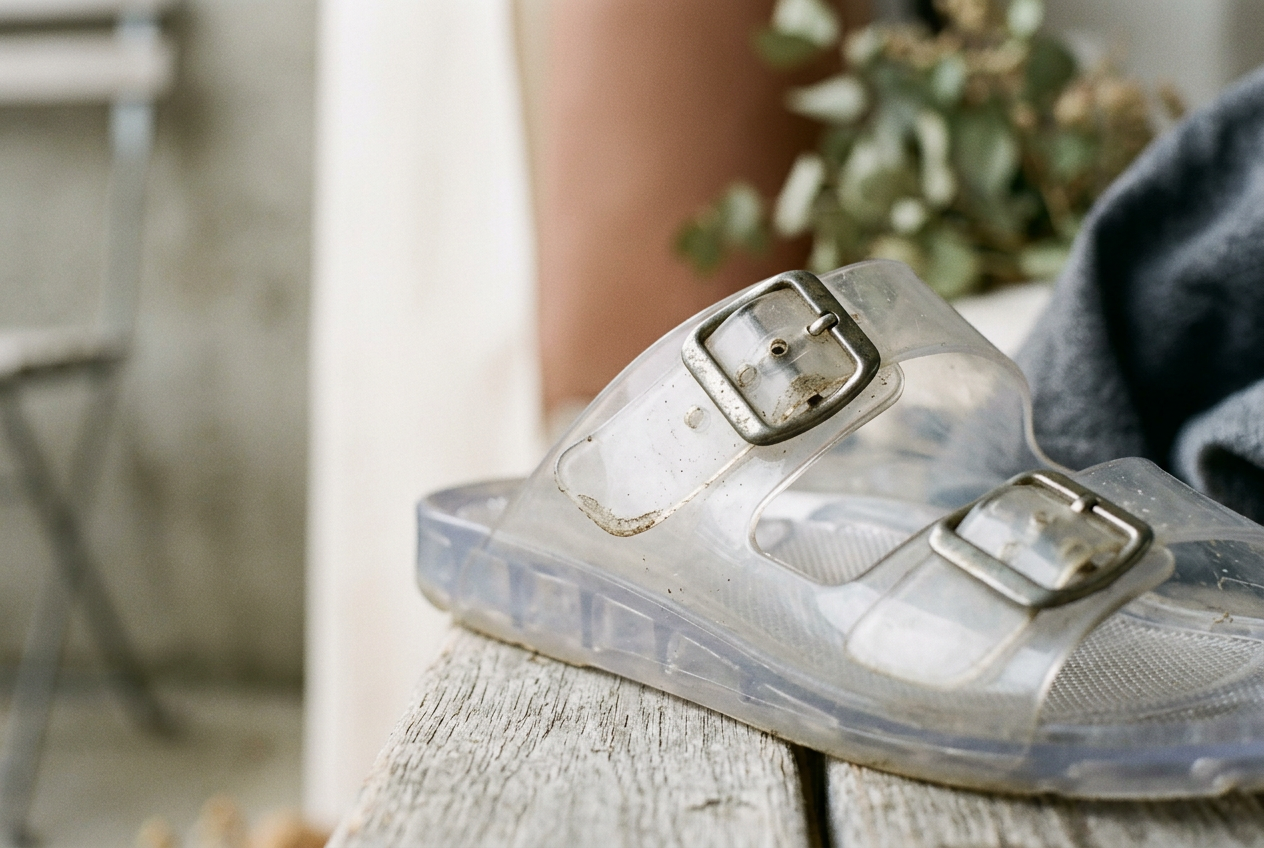
The test pair was a clear PVC jelly sandal with two broad molded straps, each closed by a metal pin buckle. PVC, or polyvinyl chloride, is the flexible plastic used in many traditional jelly shoes; it can bend and soften, but it does not drape around a foot the way leather or webbing does.
I wore the pair through one week of ordinary summer use, including short errands, standing indoors and walking on warm pavement. My right instep, meaning the raised top of the foot between the toes and ankle, sits higher than my left, so the pair offered a useful test: could separate buckles produce two genuinely different fits, or would they merely move the pressure?
The answer was both, inconveniently.
This is women’s footwear coverage, and the test pair came from a women’s size run. The mechanical points apply to any similarly built jelly sandal, but shoppers using men’s or unisex sizing should pay particular attention to footbed width and strap length rather than relying on a converted size alone.
What the buckles adjusted
On the lower-instep left foot, both straps sat flat without needing much extra room. On the right, moving the strap over the instep one hole looser reduced the obvious downward pressure and stopped the buckle pin from feeling planted against the top of the foot.
That counts as useful adjustment. It is not imaginary, and it is better than a fixed jelly slide whose upper either fits or conducts a prolonged disagreement with your circulation.
The limit appeared along the rest of the strap. Although the buckle loosened one end, the PVC still followed the curve formed at the factory, and the molded edges continued to meet the foot at nearly the same angle; extra strap length created more space near the closure, but it did not make the whole upper deeper.
A buckle works best when the sandal already fits through the broadest and tallest parts of the foot. It can then correct for swelling, a small left-to-right difference or the fit change between bare feet and thin socks, if jelly sandals with socks happen to be part of the plan. The buckle cannot rescue a strap that presses firmly across the center of a high instep even at its loosest setting.
Separate buckles matter. The test pair allowed the forefoot strap and instep strap to move independently, which kept the front secure while the higher section sat looser. A single buckle on one wide molded upper would offer less control because all the added room would enter through one point, leaving the fixed plastic shape to decide where it went.
The fit test to do before buying
Start with both feet flat on the floor, not dangling from a fitting-room bench. Fasten each strap so that one fingertip can pass beneath it without forcing the plastic upward, then walk until the foot has flexed several times and inspect the skin around every molded edge.
The useful sign is a strap that stays in contact without whitening the skin or lifting the footbed when the toes bend. A bad fit often announces itself less dramatically: the strap edge leaves a narrow pink line, the foot slides toward one side, or the buckle sits at an angle because the plastic is being pulled against its molded curve.
Check the available holes as well. If the comfortable setting uses the final hole, there is nowhere to go when feet swell in heat, and the loose tail may be too short to stay under its keeper. If only the tightest hole works, the strap may lift away from the foot while the buckle hardware remains fixed, producing a sandal that looks adjusted but still allows forward movement.
On the test pair, the right instep needed a looser setting than the left while the forefoot settings stayed matched. That independence was the strongest case for the two-buckle design. It also made the asymmetry visible, which is preferable to pretending both feet signed the same agreement at birth.
What happened to the buckle holes
After repeated fastening, the most-used hole on the higher-instep side began to look slightly oval rather than round. The strap did not release, but the change showed how a metal pin concentrates force on soft PVC whenever the foot pushes upward.
Hole stretching depends on plastic thickness and reinforcement. The test straps had no separate eyelets, meaning small rings that protect buckle holes, so the pin bore directly against the PVC. A thick strap can resist this better than a thin one, although thickness also makes the upper stiffer and may sharpen the feel of its edges.
Before buying, buckle and unbuckle the sandal once rather than accepting the display setting. The hole should flex enough to admit the pin without turning pale around the opening, and the surrounding plastic should return close to flat afterward. A hole that already looks split, cloudy or elongated has started the job you were hoping to postpone.
Do not punch another hole casually. A household punch can leave a rough opening or place the new hole too close to its neighbor, and soft plastic can tear between them under tension. If the existing spacing never lands on a comfortable setting, the strap geometry is wrong for the foot. Returning the sandal costs less discomfort than conducting materials research with your instep.
Warm hardware and warmer plastic
The metal buckles on the clear test pair warmed after the sandals sat in direct sun. They did not become painful during this evaluation, but the temperature change was noticeable when the shoes went back on, especially where the pin and frame sat close to bare skin.
Hardware color and size do not settle the issue. The more useful detail is whether plastic separates the metal from the foot, because a buckle mounted on a folded or molded tab has a buffer while exposed hardware can press and warm directly against skin. Try the sandal with the foot flexed upward; a buckle that clears the skin while standing may tip inward during a step.
The PVC changed too. Warm plastic felt more yielding and allowed slightly more movement, which sounds comfortable until the foot begins sliding and the strap edge moves repeatedly across the same patch of skin. Once the sandals cooled, the upper felt firmer again. Buckle adjustment did not prevent that cycle because the material, not the closure, controlled it.
Leaving jelly sandals in a hot car is therefore a poor fit strategy. Heat may make a tight pair seem temporarily more accommodating, but it can also encourage distortion around stressed holes and change how the molded upper sits when it cools.
The rubbing came from the edges
The first persistent irritation on the test pair appeared beside the forefoot, where the molded edge met the outer side of the foot. Loosening that buckle reduced pressure but introduced more movement, so the edge traveled farther with each step. Tightening it held the foot still but restored the pressure line. There was no ideal hole between them.
Moisture made the compromise worse. PVC does not absorb sweat, and a damp foot can slide against the smooth footbed while the strap edge keeps its shape, concentrating friction at the border rather than distributing it through the upper. The clear material also showed condensation, a visual detail nobody requested but jelly footwear supplies free of charge.
Inspect molded edges with a fingertip. They should feel rounded, with no thin ridge left from the mold seam. A seam is the line where two parts of a manufacturing mold meet; if excess plastic remains there, it can behave like a narrow scraper once the foot warms and swells.
Socks or blister patches can protect skin during a short break-in attempt, but PVC does not break in like leather. It may soften through heat and flexing, yet the underlying molded curve remains. If the same edge marks the same place after several wears, waiting longer is mainly a scheduling decision about the blister.
When the buckle is worth having
Choose the buckled version when a fixed jelly slide already fits across the foot and needs only a small tension correction, or when the left and right feet need neighboring settings. Look for two independently adjustable straps, several usable holes on either side of the likely setting and hardware that does not touch skin when the foot bends.
Skip it when the plastic upper visibly bows over the instep, when the final hole is still tight or when loosening the strap lets the foot travel across the footbed. A leather two-buckle sandal can conform more gradually, while an adjustable webbing sandal distributes tension through a softer strap; an EVA slide, made from a light foam called ethylene-vinyl acetate, removes buckle hardware but usually offers no adjustment at all.
Buckled jelly sandals range from inexpensive seasonal pairs to designer-priced versions, yet the buckle itself does not justify paying more. Better reasons include smoother molded edges, thicker material around the holes and a footbed shape that contains the heel without squeezing the forefoot. The clear test pair passed the small-asymmetry test and failed the high-instep rescue test. That is a narrower achievement than the hardware suggests.
Questions people ask
Do buckled jelly sandals work for high insteps?
They can accommodate a mildly higher instep if the molded upper already clears the foot and the buckle has room to loosen. If the plastic presses across the center even at the final hole, the buckle only shifts tension near the closure; look for a deeper upper in another shape or a softer adjustable strap.
Do buckle holes stretch in jelly sandals?
They can. A metal pin places repeated pressure on one part of the soft plastic, and an unreinforced hole may become oval or develop cloudy stress marks. Check the likely setting before purchase, and avoid a pair whose comfortable fit depends on pulling the strap hard enough to distort the hole.
Can metal buckles get hot enough to hurt?
Metal hardware can become noticeably warm after direct sun exposure, especially when it rests close to bare skin. A plastic mounting tab offers some separation, but it does not keep the whole sandal cool. Move the pair out of direct sun and let the hardware cool before putting it back on.
Where do jelly sandals usually rub?
On this pair, rubbing developed around the molded forefoot edge rather than beneath the buckle. Look for pressure lines along strap borders, mold seams and spots where a damp foot slides sideways. Loosening may reduce pressure while increasing friction, so a different upper shape is often more useful than another buckle hole.
One update a day
Today's fashion update, in your inbox
One fashion update each morning — no hype, no filler, just pieces worth wearing.