Square Toe Flip-Flops Can Catch the Stairs
The square shape is rarely the whole problem. A sole that projects beyond the toes can clip stair risers, shorten the stride, and make an elegant sandal feel oddly administrative.
Women's · November 12, 2026 · 7 min read
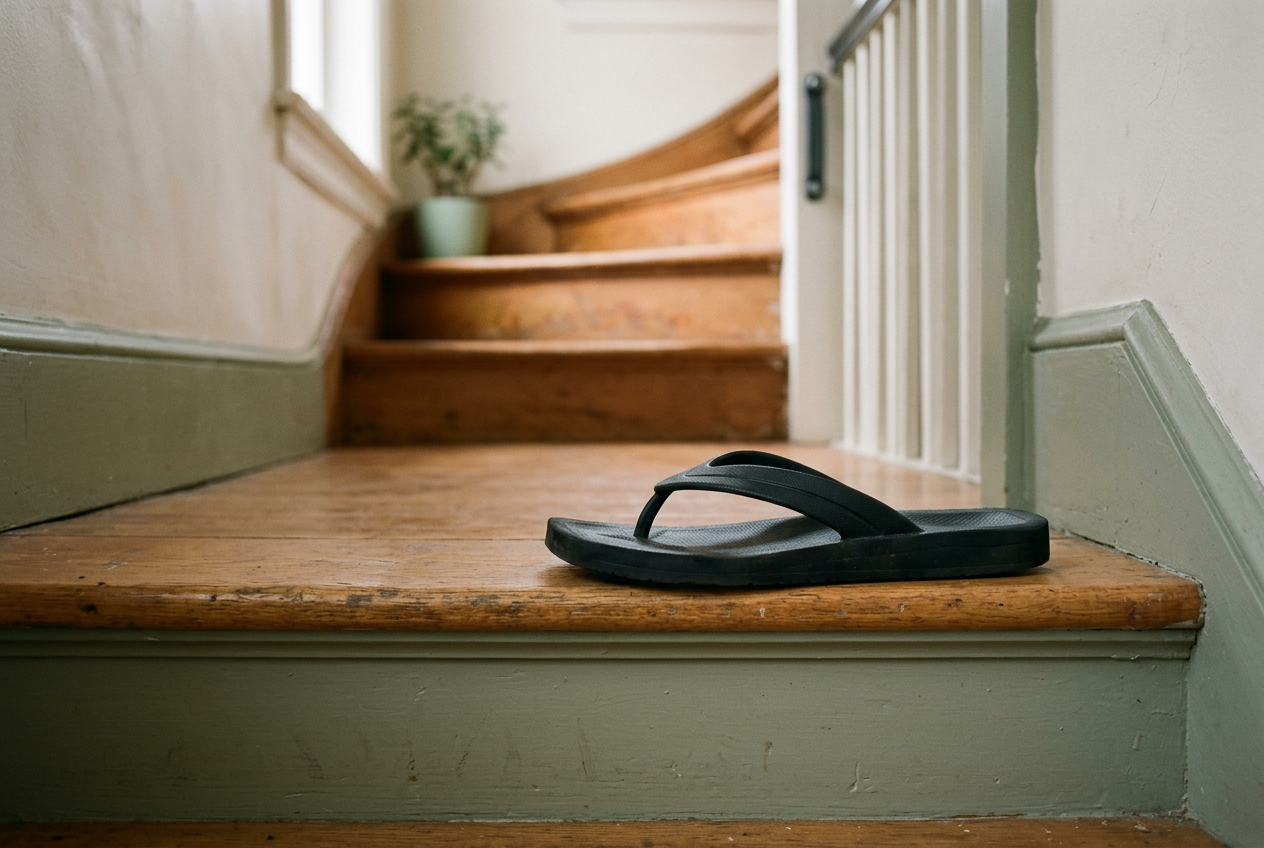
The test pair was a women’s black flip-flop molded from EVA, meaning a lightweight expanded foam commonly used for cushioned soles. Its broad front looked clean from above, but the footbed continued roughly a thumb’s width past the longest toe and ended in a thick, nearly vertical wall.
Across a week of indoor wear, that ledge changed the way the shoe met a straight staircase. On the way up, its outer front corner occasionally clipped the riser, the vertical face between stair treads. After the first few contacts, I began lifting my foot higher and placing it farther onto each step. The adjustment prevented another knock, but it also shortened the stride and made the sandal more work than its minimal construction suggested.
A thin rounded rubber flip-flop used as the comparison pair cleared the same stairs without requiring that correction. This was not a triumph of curves over squares. The rounded sole ended close to the toes and flexed more readily; those details mattered more than the outline visible in an outfit photograph.
The troublesome part is the projection
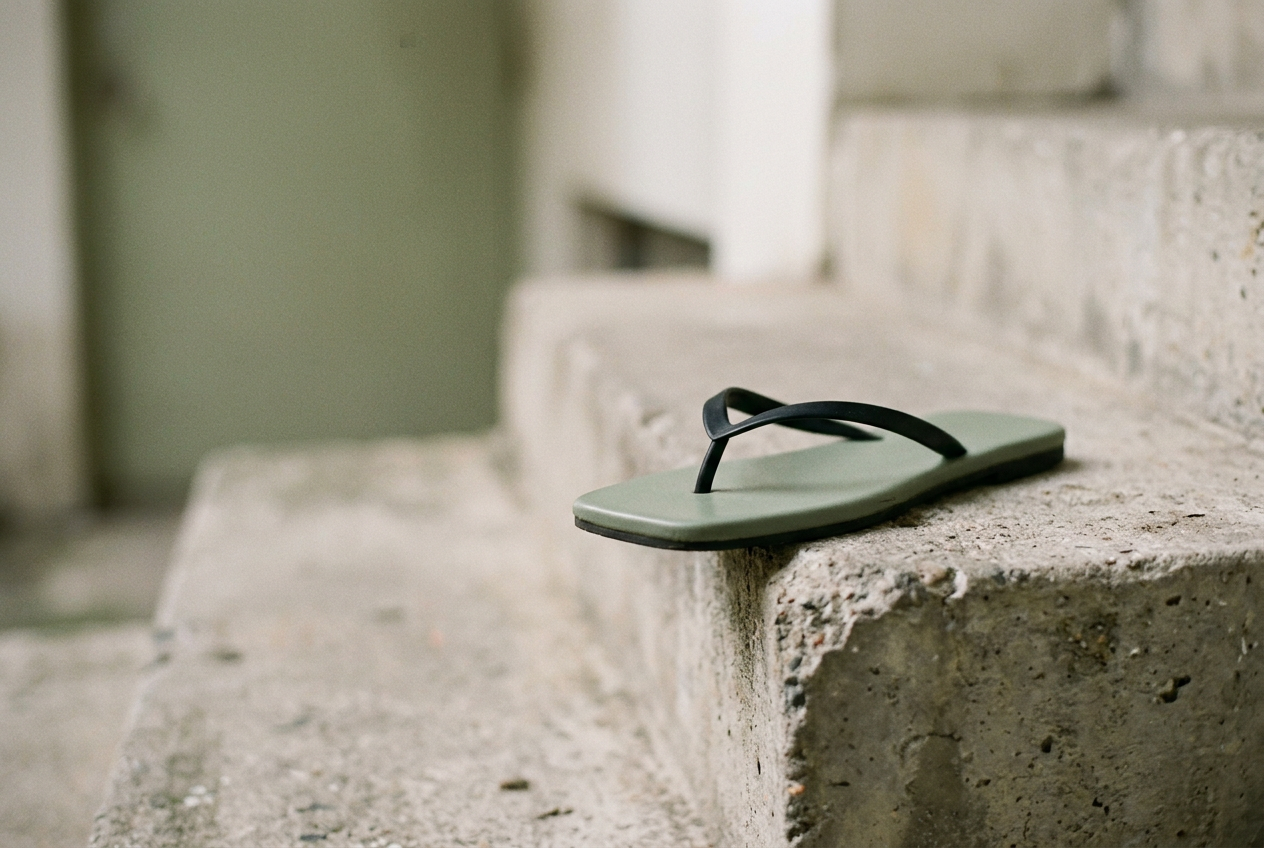
Square toe flip-flops tend to combine two separate design decisions. One is cosmetic: the front edge runs straight across rather than curving around the toes. The other is structural: the sole may be made longer and wider so the square shape remains obvious once a foot is standing on it.
The cosmetic version is usually uneventful. If the straight edge sits close to the longest toe, with only enough room to prevent skin from hanging over, it behaves much like a rounded sandal. A slightly beveled underside also helps the front pass a stair edge rather than meeting it as a blunt block.
The projecting version is different. When a substantial platform remains visible ahead of the toes, the wearer has to clear a piece of shoe that the foot cannot feel directly. Bare toes provide useful information about where the body ends. A foam ledge does not send such a courteous update.
That was the issue with the black EVA pair. The front corners extended beyond the useful footprint, while the thick sole resisted bending at the ball of the foot. During ascent, the outside corner reached the riser before my foot expected contact; during descent, the long front edge encouraged a more cautious placement because less of the next tread was visible beneath it.
The evidence appeared on the shoe. By the end of the week, a pale abrasion marked the underside of one front corner, while the central front edge remained largely untouched. The square was not catching evenly. Its extra corner was finding the stair first.
The stride changes before the wearer notices
A single clip is obvious. The quieter compromise is a shortened step.
Once I knew the EVA sole might meet the riser, I stopped advancing the foot as freely and began placing more of it on the lower half of each tread. That reduced the chance of striking the vertical face, though it also left less room behind the heel and produced the familiar flip-flop slap as the sole arrived late.
This matters beyond annoyance. A sandal can feel acceptable while standing in a fitting room, and it may remain acceptable across smooth store flooring, yet stairs ask the front edge to clear an obstacle repeatedly while the loose heel moves independently. Broad soles magnify that mismatch because they add material without giving the foot more control over it.
The thong placement also affects the result. On the test pair, the toe post held the foot slightly back from the front, leaving the square ledge exposed even though the labeled size was right. Sizing down would have reduced the projection, but it would also have pulled the heel close to the rear edge and tightened the straps across the forefoot. A smaller number was not a clean solution to a shape problem.
This is women’s footwear coverage, although the mechanical point applies anywhere the same sole appears. Women’s square toe sandals often use a visibly extended footbed as part of the silhouette, especially when the straps are fine and the sole has to do most of the visual work. The prettier the empty border around the foot looks from above, the more carefully it deserves testing in motion.
A fitting-room check can reproduce the problem
Start on a dry indoor floor. Stand naturally in both sandals rather than pushing the feet forward, then look straight down and check the distance between the longest toe and the front edge. A narrow visible border is normal. A ledge approaching the width of the end of your thumb deserves a stair test, particularly if the sole is thick and does not bend easily.
Next, hold a railing and use the bottom stair only. Step up at your normal pace several times with each foot leading, without deliberately lifting the knees higher. Listen for a scrape and notice whether the outer corner touches first. Repeat in the shoes you arrived in, which gives you a useful comparison with your ordinary stride rather than an abstract idea of good walking.
Then step down slowly. Check whether you can see enough of the tread to place the forefoot without feeling for the edge, and pay attention to whether the sandal folds with the foot or drops onto the step as one rigid slab. The test should feel boring. If it becomes an exercise in precision, the shoe is already charging too much attention for a flip-flop.
Do not use a full flight to prove a point, and do not test on polished or wet stairs. Grip is a separate issue from front clearance: an outsole, the ground-contact layer of the shoe, can resist slipping while the projecting upper portion of the sole still hits a riser.
Check the corners afterward. A fresh gray or pale mark beneath one front corner shows where the shoe met the stair, even when the contact was too slight to register as a stumble. On the black EVA pair, that mark was more useful than pacing around the living room for another ten minutes.
Material changes the severity, not the geometry
Thick molded EVA keeps a square outline crisp, but a rigid forefoot makes the projecting edge harder to lift out of the way. Softer foam may flex sooner, although very soft flip-flops can fold under the toes or compress unevenly after wear. Neither version deserves an automatic comfort award.
A thin rubber sole usually follows the foot more closely and puts less material in front of it. It may also feel harsher on pavement, especially when the footbed has little contour. Leather footbeds can look more polished and gradually take the shape of the foot, but leather above the sole does not cancel an overlong base below it.
The better construction for stairs has a front edge close to the toes, some flexibility at the ball of the foot and a beveled lower corner rather than a square vertical wall. The square outline can remain visible across the width. It does not need to project forward like a small shelf.
Price is a poor shortcut here. Square toe flip-flops run from inexpensive molded foam to leather sandals priced more like formal shoes, yet the stair problem can be seen before the material or label enters the discussion. Paying more may buy better leather, cleaner strap finishing or a replaceable outsole. It does not make excess length disappear.
For the test pair, the tradeoff was not worth keeping. The broad black sole looked polished with straight trousers and a column skirt, but the visible square edge could have been achieved with a closer-cut footbed. The rounded comparison pair was less current and less refined. It also let me climb stairs without renegotiating the location of my feet.
Questions people ask
Should square toe flip-flops extend past the toes?
A small border keeps the toes from hanging over the edge, but a long visible ledge adds clearance work without supporting the foot. Stand naturally rather than pushing forward in the straps. If the projection approaches a thumb-end width, test it against the bottom stair before deciding the fit is correct.
Does sizing down fix an overlong square sole?
Only if the heel still sits safely inside the back edge and the straps remain comfortable. On the black EVA pair, sizing down would have reduced the front ledge while crowding the heel and tightening the forefoot. That is a different poor fit, not a repair.
Are thin square toe flip-flops better on stairs?
They often clear risers more easily because there is less material to strike the stair and the forefoot can flex sooner. Thin soles may transmit more pavement pressure, however, so check underfoot cushioning separately. Close-cut geometry matters more than whether the sandal looks delicate from above.
What marks show that a flip-flop is catching stairs?
Look beneath the front corners for fresh scuffing, especially when one side is more worn than the center. Also notice repeated scraping sounds, extra knee lift or an unexplained tendency to shorten each upward step. Those small corrections show that the shoe has begun directing the stride.
One update a day
Today's fashion update, in your inbox
One fashion update each morning — no hype, no filler, just pieces worth wearing.