Soft EVA Sandals Can Go Flat Faster Than They Look
A soft first step tells you little about how an EVA sandal will feel after repeated wear. Check rebound, heel creasing and sidewall stability before paying extra.
October 29, 2026 · 7 min read
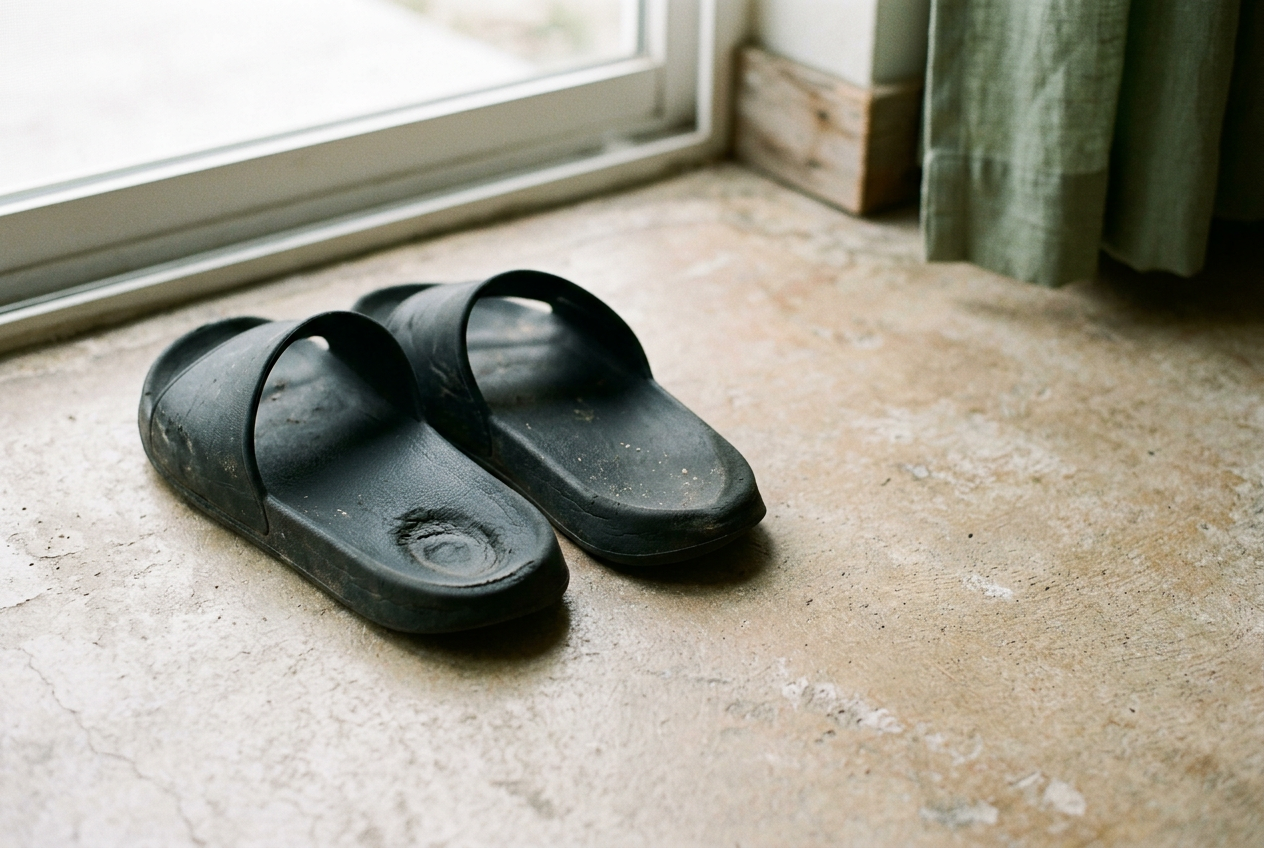
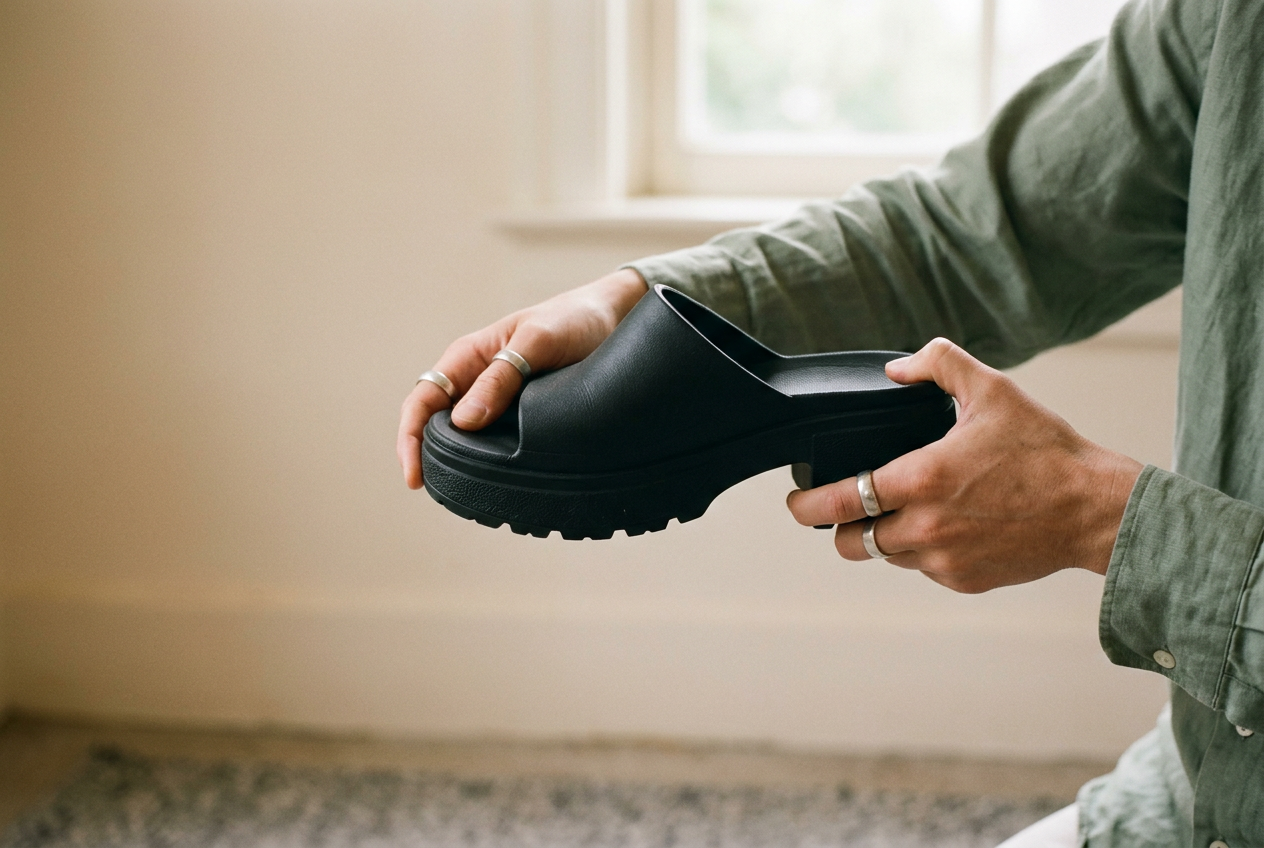
The pair on my floor is a plain black, one-piece EVA slide, meaning the upper and sole are molded from the same foam rather than assembled from separate parts. I wore it through a warm week of short errands, standing at a desk and walking on hard indoor floors. By the end, the heel showed a shallow footprint that remained after the sandals had rested overnight, while the forefoot still recovered close to its original shape.
That is a small test, not a universal lifespan claim. It does show why the store try-on can be misleading. New EVA feels yielding because its internal cells still contain plenty of air and have not been asked to carry the same load in the same places several hundred times. A few glossy laps beside a shoe display will not recreate an afternoon on pavement, regrettably for both the shopper and the pavement.
This is unisex footwear advice. Wearer weight, gait, heat and the sandal’s construction matter more than the department or size label, though a larger size can use a thicker or differently proportioned sole than a smaller sample displayed nearby.
Softness and density are different decisions
EVA, or ethylene-vinyl acetate, is a lightweight plastic expanded into foam by forming small gas-filled cells within it. The cells compress underfoot and spring back after pressure lifts. That movement creates the soft sensation associated with molded slides, flip-flops and recovery-style sandals.
Foam density describes how much material occupies a given volume. Lower-density EVA generally uses less material and more air, which can make a sandal feel impressively light and plush on first contact, but it also leaves thinner cell walls to absorb repeated loading. Denser foam tends to resist deformation better, although formulation and molding quality mean density alone cannot predict performance from a product page.
Manufacturers rarely give shoppers a useful density figure. Even when a sandal is labeled EVA, the wording does not reveal the foam recipe, how much it was expanded, or whether the sole combines firmer and softer zones. Two visually similar molded sandals can therefore behave quite differently after a week.
The black test slide initially accepted a thumb press with almost no resistance. That felt pleasant under the heel, where the foot lands, yet the same easy compression allowed the heel area to settle faster than the less-loaded arch edge. Its softness was real. It was not proof of durable cushioning, and it certainly was not a certificate of support.
Support depends on whether the foot stays reasonably positioned as the sandal carries weight. A soft bed can cushion impact while still letting the heel tilt, the arch collapse toward the floor or the toes grip to keep a loose slide attached. Feet are quite capable of finding extra work when shoes decline the assignment.
Why the heel usually tells first
Repeated compression can leave EVA with compression set, meaning the foam does not fully return to its original thickness after the load is removed. The heel often displays it first because that area takes concentrated pressure during standing and the early part of a step. A wearer who lands hard on the outside heel may also create an angled depression rather than an even one.
Body weight increases the load, but it does not create one standard timetable for flattening. The pressure at the sole also depends on foot area, walking pattern and how long the sandal stays loaded without a break. A heavier wearer in a broad, stable sandal may distribute force more evenly than a lighter wearer whose heel sits partly over a narrow edge.
Fit changes the calculation. If the heel hangs beyond the footbed, even slightly, the rear rim carries pressure it was not shaped to take; if the sandal is too long, the foot may slide and strike different parts of the foam on each step. Neither condition is improved by a squishier sole.
On my test pair, the persistent heel mark mattered less than what happened around it. The outer heel sidewall, the vertical foam edge that helps contain the foot, began to bow outward under weight. The slide still felt soft while standing, but it felt less settled when turning on a hard floor. Cushioning had not disappeared.
Stability had started to leave earlier.
Heat speeds up the uncomfortable part
EVA softens as it gets warm. A sandal heated by pavement, a car interior or prolonged contact with the foot may compress more readily than it did in an air-conditioned store, especially when the foam is already low-density. Heat alone does not guarantee permanent damage, but heat combined with sustained pressure can encourage the cells to remain distorted.
The black slide felt more yielding late in the warm test days than it did first thing indoors. I did not leave it in a parked car or deliberately bake it, because that would test neglect rather than ordinary wear. The practical change appeared after walking outside and then standing for a stretch: the heel sat lower, and the outer edge rolled more easily when I shifted weight.
Color is not a performance specification, though dark sandals left in direct sun can become unpleasantly hot. Do not judge two pairs solely by touching their exposed surfaces on a display. One may have been sitting under a light or beside a window, which makes a casual squeeze even less informative.
Rotation gives foam time without load, but rest cannot reverse a permanent compression set. Alternating sandals can slow the accumulation of continuous wear and lets damp footbeds dry; it does not turn flimsy foam into sturdier foam. Once a heel cup remains visibly lower after a full rest period, the original thickness is unlikely to return through optimism.
Run two checks before buying
Start with a rebound check. Press one thumb firmly into the heel center for several seconds, release it, then watch and feel how the foam returns. A useful test is comparative rather than absolute: repeat it at the forefoot and on the other shoe, using similar pressure. The heel should recover promptly and should not retain an obvious thumb-shaped hollow while the forefoot looks untouched.
Fast rebound does not prove long-term durability. It can, however, expose uneven molding, a display shoe that has already packed down or foam that returns sluggishly before anyone has worn it outside. If the left and right sandal react differently, ask for a fresh pair rather than assuming your feet will negotiate a settlement.
Next, check for creasing under load. Put on both sandals, stand naturally and look at the sidewalls near the heel and ball of the foot. A surface wrinkle is not automatically a defect, since molded foam bends, but a deep crease that opens and closes while the heel tips sideways points to a stability problem. Walk, turn and stop.
The sole should flex at the forefoot without folding through the middle like a travel slipper unless that is the intended construction.
Return to the rebound check after several minutes of wearing the pair in the store, if the retailer allows it. On the black slide, a second press into the warmed heel sank more easily than the first, and the side crease became clearer once I stood with full weight. That sequence disclosed more than the initial step-in softness did.
Also check position. The heel should sit within the footbed’s perimeter, the widest part of the foot should align with the sandal’s widest section, and a slide upper should hold the foot without forcing the toes to claw. This is not a three-part promise of comfort. It is a way to avoid loading soft foam at its weakest edges.
When paying more makes sense
Budget EVA sandals can be reasonable for showers, the pool or occasional short trips, where low weight and easy cleaning matter more than months of consistent cushioning. The calculation changes when the sandal will handle commuting, travel or hours of standing. A low price is less persuasive if the heel packs down quickly and the pair becomes the shoe you avoid.
Higher-priced EVA is not automatically denser, more stable or longer-lasting. Some of the price may cover shape, branding or a more elaborate mold. Before paying roughly what you would spend on a decent pair of sneakers, look for construction you can feel: a heel that stays centered, enough sole thickness beneath the lowest point of the footbed, and sidewalls that resist buckling when you turn.
A sandal that combines a cushioned top layer with a firmer carrier sole may preserve alignment better than one very soft piece of foam. Rubber on the outsole can also improve abrasion resistance, although it adds weight and does not prevent the EVA above it from compressing. For substantial daily walking, a contoured sandal with a firmer footbed is often the better investment, even when its first step feels less luxurious.
The week-old black slide remains usable for brief indoor wear. I would not choose it for a full day out because the heel depression and bowed edge now steer the foot more than they did at the start. That is the point at which softness has stopped being the main issue.
Questions people ask
How quickly do EVA sandal soles flatten?
There is no reliable universal timetable. Low-density foam worn daily by a heavier or hard-landing wearer in warm conditions may show a persistent heel impression relatively early, while denser foam used occasionally can hold its shape much longer. Watch for a depression that remains after overnight rest.
Does softer EVA mean better cushioning?
Softer EVA compresses more easily, so it may feel cushioned during a short try-on. It can also bottom out, meaning it compresses until little usable foam remains between the foot and ground. Compare rebound and sidewall control rather than treating maximum softness as maximum comfort.
Can flattened EVA recover if I stop wearing it?
EVA may regain some shape after the load is removed, particularly when the compression is recent and temporary. A heel hollow or sidewall crease that remains after the sandals have rested indicates compression set, and leaving the pair in a closet will not reliably restore its original structure.
Are expensive EVA sandals less likely to flatten?
Price does not identify foam density or durability. A costlier pair earns consideration when its heel remains centered, its sidewalls resist buckling and its sole combines cushioning with a firmer base. Perform the same press, crease and walking checks regardless of the label.
One update a day
Today's fashion update, in your inbox
One fashion update each morning — no hype, no filler, just pieces worth wearing.