Your Flip-Flops Fit. The Toe Post Is Making Them Feel Short.
A flip-flop can match your foot length and still hang your heel over the back. The overlooked measurement is the distance between the heel edge and toe post.
August 30, 2026 · 8 min read
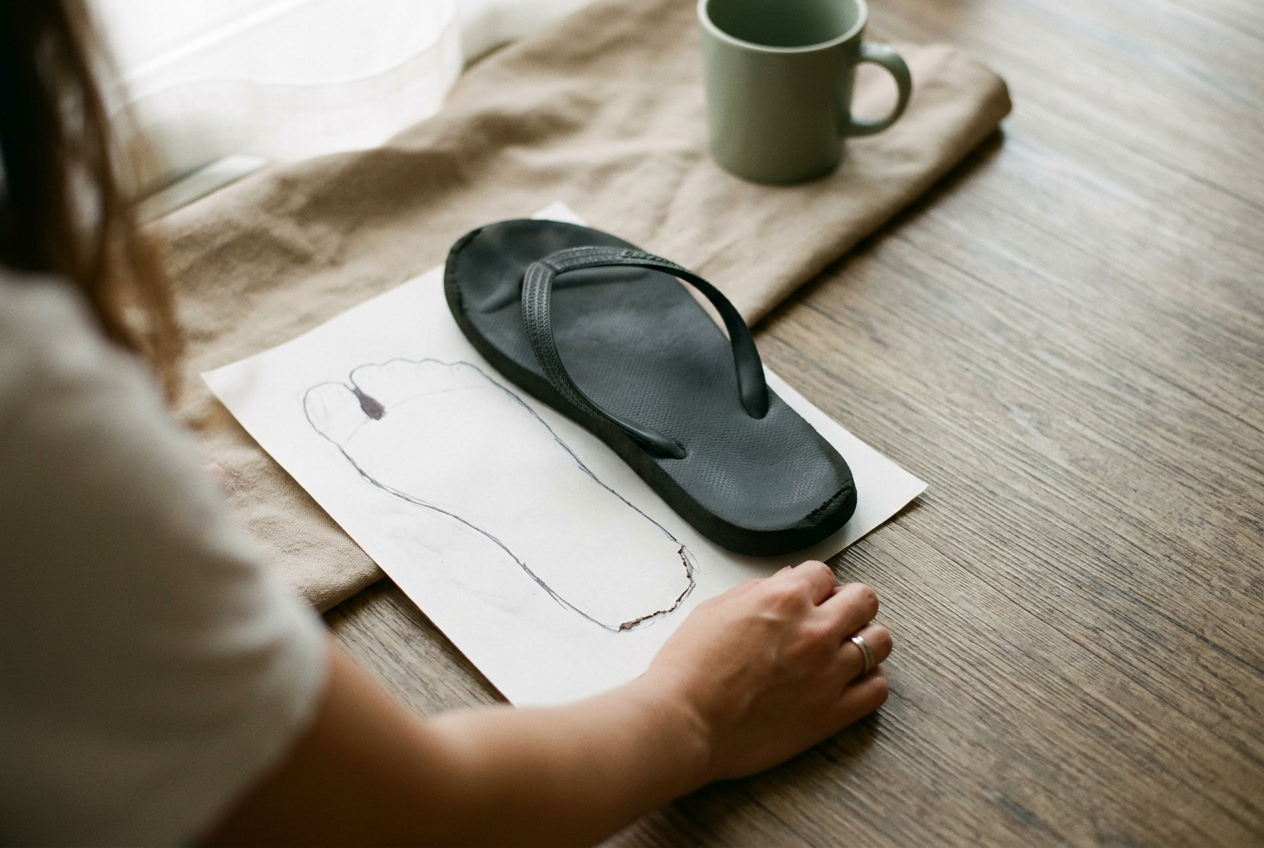
The black flip-flop on my desk looks, by every ordinary test, like the correct size. Its sole is slightly longer than my foot, the widest part lines up reasonably well, and my toes do not cross the front edge. Yet after a week of short walks, my heel kept settling at the back lip, where it felt one careless step away from pavement.
The problem was not total length. It was the toe post, meaning the upright piece that sits between the big toe and second toe. On this pair, the post was positioned farther back from the front edge than it was on another same-size pair, leaving a generous patch of unused sole ahead of my toes while taking that space away from my heel.
This is unisex fit advice. Toe-post position affects women’s, men’s and gender-neutral flip-flops in the same mechanical way, although foot shape and brand sizing decide how obvious the mismatch becomes.
The useful measurement starts at the heel
Most shoppers judge a flip-flop from the front. Toes hanging over the edge look wrong, so the instinct makes sense, but the front edge does not control where the foot begins. The toe post does.
The useful comparison is the heel-to-post distance, which is the length of sole between the back edge and the center of the toe post. Once the post sits between your toes, that span determines where your heel can land. If it is shorter than the equivalent distance on your foot, the heel gets pushed backward even though the sandal may have plenty of overall length.
That was the black pair’s trick. It had enough sole. It had placed too much of it in front of the post.
A foot does have some freedom to shift because the upper straps flex, especially when they are made from soft rubber, fabric or leather. That movement is limited. Pulling the foot forward to gain heel room can jam the post into the webbing between the toes, while letting the foot sit naturally may leave the heel touching the raised rim or hanging beyond it. Neither option improves because the foam is described as cushioned.
The effect can be more pronounced on square-toe flip-flops, where the broad front platform makes excess space look intentional and sculptural. A long, clean toe shape may be part of the design, but if the post also sits far from the front edge, the sandal can appear roomy while fitting short where it matters. Geometry remains unmoved by styling.
A tracing shows where the missing length went
The quickest check needs paper, a pencil and the pair itself. Stand with your full weight on the paper and trace around one bare foot, keeping the pencil upright rather than angling it under the toes. Mark the point where the toe post would sit between the big and second toes. Repeat for the other foot if one tends to run longer or wider.
Place the flip-flop over the tracing with its heel edge aligned to the back of the drawn heel. Do not center the outline by eye. Look through from above and check whether the actual toe post reaches the marked gap on the tracing without forcing the toes into an unnatural position.
On the black pair, aligning the heel exposed the mismatch at once: the post sat behind the marked toe gap, while the front of the sole extended well beyond the outline. Sliding the sandal forward until its post met the mark made the heel line fall at the very back. That was exactly what happened while walking, minus the repeated hope that the shoe might negotiate.
For an online purchase, trace the foot, add the toe-gap mark and compare it with any true overhead product image that shows the complete sole. This is less reliable than handling the shoe because product photographs may be cropped, tilted or scaled, but it can reveal an unusually large area between the post and front edge. A printable sole template is better when a retailer or maker supplies one at verified scale.
Size charts based only on total foot length cannot settle this fit issue. Two flip-flops can share the same listed sole length while dividing that length differently around the post, just as two feet of equal overall length can have different toe proportions. Shoppers with relatively long toes may need the post farther from the heel; those with shorter toes may need it closer to the front.
Check the fit while the foot is loaded
A seated try-on is flattering to many bad sandals. Standing spreads the forefoot, lengthens the loaded foot slightly and shows where the heel lands under real pressure, so make the decision upright and walk more than a few polished steps beside the mirror.
Let the foot choose its natural position instead of gripping with the toes. The heel should remain on the footbed, meaning the top surface of the sole that supports the foot, with a small visible margin rather than resting on a raised edge. At the front, the longest toe needs enough clearance to avoid catching the ground, but a large empty platform is not compensation for a heel that has run out of sandal.
Watch the post during several normal strides. A post that starts pressed hard against the webbing may become more irritating as the upper warms and the foot swells. One that forces the toes to claw for control creates another kind of work, particularly in a loose pair with a flat ethylene-vinyl acetate sole, or EVA, the lightweight foam used in many molded flip-flops.
During the week with the black pair, the foam itself was not the main offender. It compressed modestly underfoot, as molded EVA does, but compression did not relocate the post. The straps softened a little without producing usable heel room. Break-in can reduce a sharp edge or stiff strap; it cannot redraw the sole.
That distinction matters at every price. A supple leather upper may feel better against the skin than a rigid plastic strap, and a denser sole may resist flattening, yet neither material upgrade fixes a post placed in the wrong spot for your foot. Paying more can buy better finishing. It cannot buy compatible proportions after the fact.
Sizing up is an imperfect workaround
Moving up one size may increase the heel-to-post distance, but it also adds width and front length. On a narrow foot, the straps can become loose enough that the sandal slaps or slides sideways; on a square-toe style, the already prominent front platform may start looking less deliberate and more like unoccupied real estate.
Still, sizing up is worth testing when the smaller pair fits across the straps and fails only at the heel. Compare both sizes while standing, then choose based on post position rather than the printed number. If the larger sandal places the post correctly and holds the forefoot without gripping, the extra sole is doing useful work.
The better alternative for the black pair was another flip-flop in the same nominal size with a longer heel-to-post distance. Its overall sole did not need to be dramatically longer. More of that sole sat behind the post, so my heel gained a margin without my toes disappearing into a front porch of foam.
This is also why reviews that say only “size up” or “true to size” have limited value. A reviewer may have the right toe proportions for the post placement, while another person with the same foot length does not. Comments about heels hanging off, posts feeling too close to the webbing or excessive space ahead of the toes are more informative because they describe the mechanism.
The return decision should be quick
Do the paper check before wearing a new pair outdoors. Then stand on a clean floor, walk normally and inspect both feet from above and behind. If the heel reaches the edge while unused sole sits in front, the sandal is proportioned badly for that foot.
Do not count on a week of discomfort to solve it. My black pair became familiar, which is not the same as becoming correct. The practical choices are a different size, if its straps still hold the foot, or a different last, meaning the foot-shaped form that determines the sandal’s proportions.
Keep the tracing. Taking it to a store is mildly inelegant and considerably more useful than collecting another pair of flip-flops that fit only while motionless.
Questions people ask
How much space should be behind the heel on flip-flops?
A small visible margin is preferable to having the heel sit directly on the edge or a raised rim. The exact amount varies with sole shape, but the heel should remain supported during a normal stride rather than crossing the back whenever the foot relaxes.
Can a tight toe post stretch into the right position?
The strap material may soften, and leather can give more than molded rubber or plastic, but the post’s anchor point in the sole will not move. Stretching can reduce pressure around the toes; it cannot create more sole behind the heel.
Does sizing up fix a flip-flop that feels too short?
Sometimes. A larger size may place more sole behind the post, but it can also loosen the straps and add unwanted width. Try both sizes standing up, and reject the larger one if the foot slides sideways or the toes must grip to keep it on.
Can
I check toe-post placement when shopping online?
Use your foot tracing and a verified-scale sole template when one is available. Overhead product photos can offer clues, especially when there is a large gap between the post and front edge, but perspective and image scaling make them less dependable than an at-home try-on with returns still allowed.
One update a day
Today's fashion update, in your inbox
One fashion update each morning — no hype, no filler, just pieces worth wearing.