Sizing Up a Pointed Flat May Leave Your Toes in the Same Place
A pointed shoe can look longer in the next size while offering almost no extra room where the toes sit. Width, vamp depth, and the last often matter more.
Women's · October 9, 2026 · 7 min read
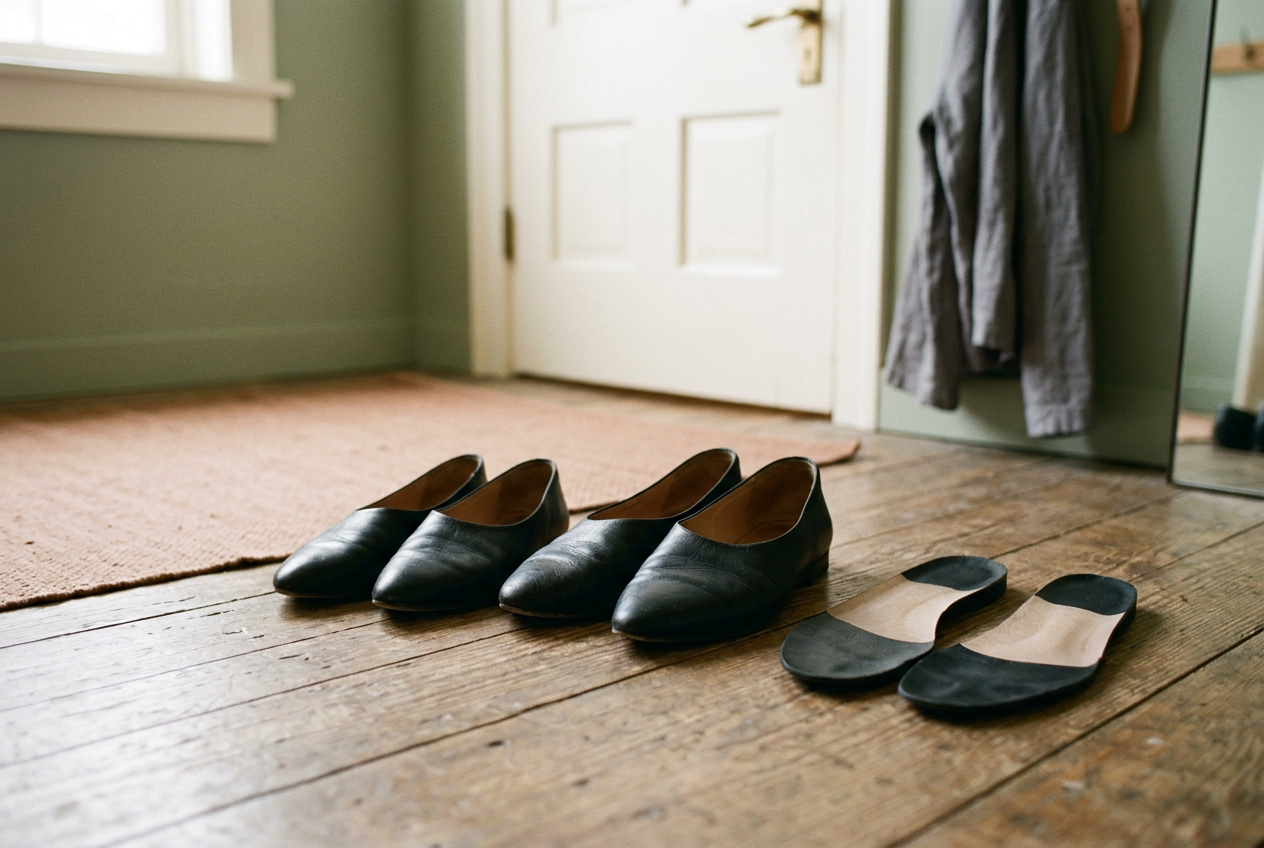
The fitting case here is one black pointed flat tried in two adjacent women’s sizes. Both versions had a smooth leather upper, leather lining, low heel, firm counter around the back, and the same sharply tapered outline; they were worn indoors on a clean hard floor in short intervals so the fit could be assessed without asking a return policy to fund the experiment.
The smaller size held the heel and placed the widest part of the foot over the widest part of the shoe, but pressed the little toe and the outer edge of the big toe. The half size up looked longer. It also slipped at the heel, flexed slightly behind the natural bend of the forefoot, and left the same two toes under pressure.
This is women’s footwear coverage, and the size references follow women’s sizing, although the construction problem is not exclusive to it. The useful distinction is between the length visible from the outside and the space a foot can occupy inside. Pointed flats are particularly good at making those two measurements look related when they may barely be on speaking terms.
The point can be mostly decoration
A decorative toe extension is the portion of a pointed shoe that projects beyond the usable toe area. It creates the silhouette, but the foot is not meant to fill it. A well-shaped pointed flat allows the toes to remain in a more natural arrangement behind that extension, with the point continuing forward as empty structure.
Look inside the shoe rather than judging its length against a rounded flat. In the black test pair, the lining narrowed quickly after the ball of the foot, and the final section of the point was too shallow and narrow to receive a toe. The longer size added visible shoe in front, yet much of that addition remained decorative. The toes stopped where the sides and upper stopped them.
This explains the familiar fitting-room error: a pointed flat pinches, the next half size appears to offer more runway, and the wearer buys it expecting the toes to move forward. They cannot move forward if the interior has already narrowed below the width of the toe spread. The extra length may sit beyond them, while the heel has gained enough room to lift.
The point itself is not automatically the problem. A long, narrow-looking flat can fit well when its interior stays broad through the toe joints before tapering, while a shorter point can be punishing if the upper closes in early. Exterior drama is a poor measurement tool.
What a half size changes
A last is the foot-shaped form around which a shoe is built. Moving up half a size usually scales that form in length and may add a small amount of width or overall volume, but the exact change depends on the brand and last; there is no reliable rule that every adjacent size adds useful space in the same place.
On the black flat, the half size changed heel security more clearly than toe pressure. The larger shoe let the heel rise during a normal step, and the foot shifted forward to recover stability. That movement drove the toes back into the tapered section, canceling much of the theoretical benefit of extra length. A heel grip might reduce slipping, but it would also push the foot forward.
Insoles take up volume throughout the shoe and can raise the toes into a shallow upper. Neither accessory changes the last.
A half size is useful when the original shoe is short in a conventional sense: the longest toe reaches the front boundary of the usable toe box, the ball of the foot sits ahead of the shoe’s widest point, or the toes contact the end during a downhill step. In that case, added length can reposition the foot over the flex point and create real clearance.
It is less useful when the ball of the foot already aligns correctly and pressure arrives from the sides or above. Going longer then trades one fit problem for another. The receipt may show a new size; the toes have received paperwork.
Check the shoe’s bend before accepting that trade. The sole should flex near the ball of the foot, where the toes join the forefoot. If the larger flat creases behind that point, or the foot has to grip to keep the heel attached, the shoe is too long even if the front looks elegantly vacant.
Width and vamp depth create different pressure
Width describes side-to-side room, but width labels alone do not reveal where that room has been placed. A wider pointed flat may add space through the ball and toe joints, which helps if the upper presses the big-toe joint, little-toe joint, or both. Some wide versions mainly enlarge the heel and middle of the shoe, leaving the taper nearly unchanged. Try the shoe; do not award it points for the letter on the box.
The vamp is the upper section covering the front and top of the foot. Its depth determines how much vertical room sits above the toes and forefoot, an issue that can feel like a length problem because the toes hit the sloping upper before reaching the front.
Press lightly over the toe joints while standing. A small amount of upper material should be available without the leather cutting across the nails or outlining every joint. Smooth leather can relax modestly across a pressure point, particularly when it is unlined or softly lined, but it will not turn a shallow last into a deep one. Patent leather and heavily reinforced synthetics usually offer less forgiveness.
Stretching may buy millimeters; it does not redesign the shoe.
In the test pair, side pressure remained in both lengths, while the larger size introduced movement at the back. That combination points away from length and toward a mismatch in width or taper. If pressure had sat across the tops of the toes instead, a deeper vamp or higher toe box, meaning the enclosed space around the toes, would have been the more relevant change.
Toe shape matters too. A foot with a relatively straight big-toe side often fares better in an almond point that keeps the inner edge straighter before tapering. Toes that spread broadly across the front may need a wider almond or softened square shape, even when the sharply pointed exterior is the whole reason the shoe reached the fitting room. Fashion has presented its terms.
The foot is allowed to decline.
A fitting-room test that separates length from shape
Try the usual size and the next half size in the same model, with the hosiery or bare-foot setup you intend to wear. Stand before deciding; seated feet reveal little about forefoot spread. Keep both shoes on for several minutes, then walk on a firm surface at an ordinary pace rather than taking two ceremonial steps beside the mirror.
First, locate the ball of the foot by bending onto the toes once. It should line up with the broadest and most flexible part of the shoe. If that alignment is sound in the smaller size, note whether the pressure comes from the front, sides, or top rather than treating all discomfort as shortness.
Next, compare heel movement. A slight change in the collar’s contact is normal between sizes, but repeated lifting, toe gripping, or a visible gap with each step means the added length is not free. It has imposed work elsewhere. Soft flats can make this easy to overlook because they do not clatter or resist; the toes still spend the day trying to retain custody of the shoe.
Finally, remove the removable insole if the construction allows it and stand on it. This does not reproduce the full interior, since the upper’s angle and volume are missing, but it can show whether the foot is already wider than the platform through the ball. If the little-toe joint spills beyond the insole in both sizes, extra length is unlikely to solve the lateral pressure.
Do not rely on a thumb-width rule at the visible point. The end may be decorative, and the upper may stop the toes well behind it. Judge the location of pressure and the alignment of the foot instead.
When to change the last rather than the size
Choose the half size up when it places the ball correctly, releases genuine end pressure, and still holds the heel without gripping. Choose a wider fitting when the length and flex point work but the sides compress the toe joints. Look for a deeper vamp when the nails or tops of the toes meet the upper, particularly if adding length only creates heel slip.
Change the last when two adjacent lengths repeat the same pressure pattern. The practical alternatives are a point that begins tapering farther forward, an almond toe with a straighter inner edge, or a softly squared toe that preserves more usable width. These may look marginally less sharp from above. They are also more likely to complete a commute without turning the final block into a private dispute.
For the black test flat, the larger size was not the better purchase. The smaller one had correct ball placement but insufficient room at the outer toes, while the larger one retained that pressure and lost heel control. A wider or less aggressively tapered last was the only defensible next try. Leather stretch, heel pads, and optimism would all cost additional time, with no evidence that they would put space where it was needed.
Questions people ask
Should my toes fill the pointed end of a flat?
No. In a properly fitted pointed flat, the toes usually sit behind some decorative extension rather than entering the narrow tip. The important checks are whether the toes can rest without side or top pressure, and whether the ball of the foot aligns with the shoe’s widest, most flexible area.
Will leather pointed flats stretch enough to become comfortable?
Smooth leather may relax slightly across a localized pressure point after wear, especially when the upper is soft and lightly structured. It will not create a wider platform, raise a shallow toe box by much, or move the taper forward. If multiple toes are compressed during fitting, start with another last rather than scheduling a painful break-in.
Can a heel grip fix pointed flats that are too long?
A heel grip can reduce a small amount of looseness at the back, but it also moves the foot forward and may intensify pressure in a tapered toe. If the larger size already makes the toes slide into the narrowing front, adding padding behind the heel treats the visible gap while worsening the original fit.
Is a wide size always better for pointed flats?
No. A wide size helps only when its added room appears where the foot needs it, usually through the ball and toe joints. If the heel becomes loose or the point still narrows too early, compare another last. Keep the pair that holds the heel and leaves the toe joints inside the insole’s edges.
One update a day
Today's fashion update, in your inbox
One fashion update each morning — no hype, no filler, just pieces worth wearing.