Foam Slides Can Shrink in a Hot Car. Don’t Boil Them Back.
A parked car can distort molded foam sandals enough to change their length, strap position and footing. Most viral reheating fixes contradict brand care guidance.
October 15, 2026 · 7 min read
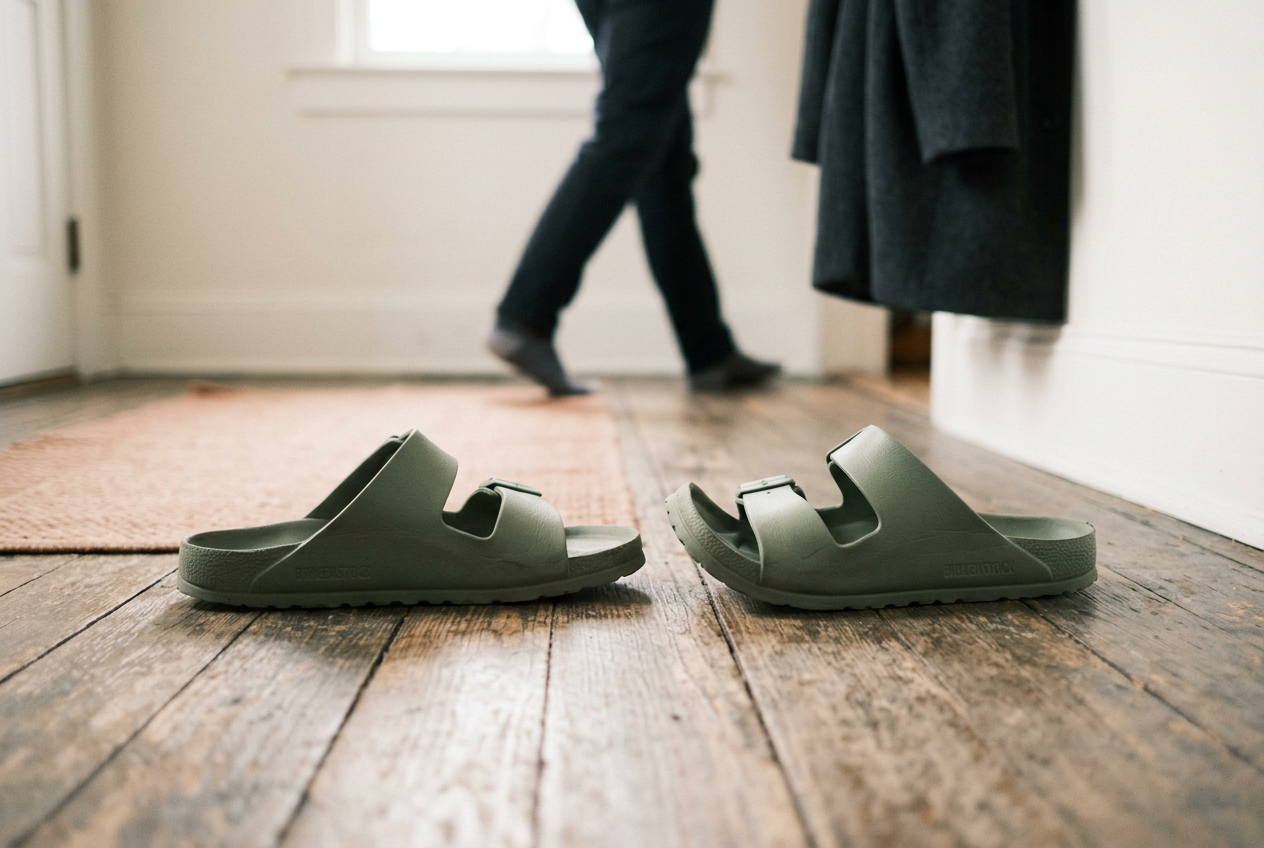
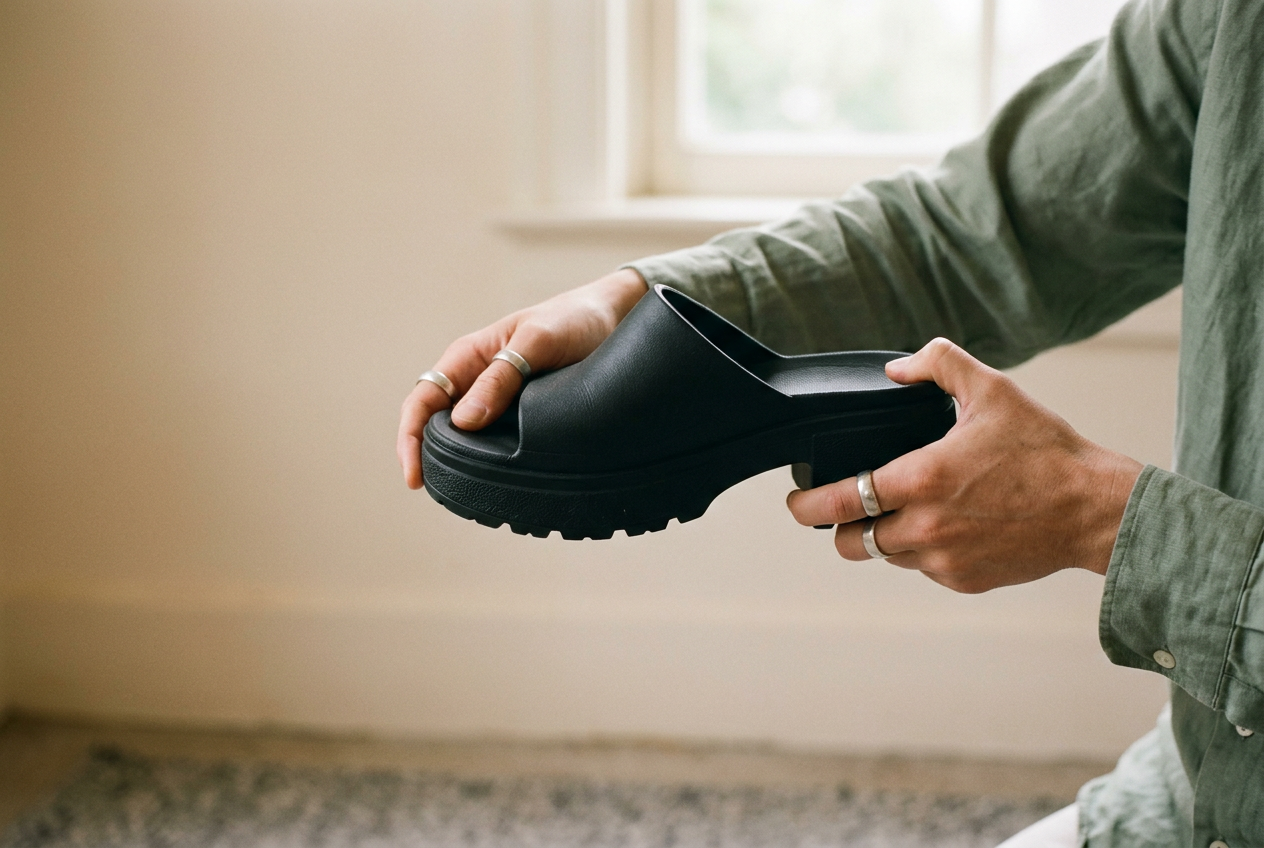
The shoe on the table was a unisex Birkenstock Arizona EVA, the one-piece molded version of the familiar two-strap sandal. After time in a closed car, its right footbed had shortened, the toe edge curled upward and both straps sat farther back over the foot; the unaffected left sandal provided an unusually blunt comparison.
This was not the minor curl that appears when a soft sandal gets wedged beneath a weekender bag. The right sandal changed the location of the foot inside the shoe. Toes that had sat behind the front rim now approached it, while the raised edge stopped meeting the floor evenly.
Birkenstock’s published EVA care guidance warns against leaving its sandals in direct sunlight or closed cars because extreme heat can damage them. Crocs gives similar advice for its proprietary Croslite material, a closed-cell resin whose exact formulation the brand does not present as ordinary EVA: avoid excessive heat, including hot cars, because shoes may shrink or warp. Two different molded materials, same practical instruction. The trunk is not a shoe cupboard in summer.
Why the sandal changes size
EVA, meaning ethylene-vinyl acetate, is the lightweight foam used in many molded slides, water sandals and sneaker midsoles. Manufacturers vary its density, softness and blend, so two EVA sandals need not react identically, but the useful shared point is that EVA is a thermoplastic foam: heat makes its polymer structure more pliable, while trapped gas cells give it volume and cushioning.
A molded sandal leaves the factory with a fixed shape created under controlled heat and pressure. Concentrated, uneven heat can soften parts of that structure enough for internal stresses to relax, foam cells to compress and edges to curl, particularly when the shoe is pressed against another object or rests on a hot, uneven surface. Once it cools, it may hold the new dimensions.
That explains why “shrinking” does not always look like a neatly scaled-down sandal. The Arizona EVA’s damaged right shoe was shorter through the footbed, yet the more consequential change was geometric: the front platform tilted, the sidewall no longer followed the same line as the left shoe and the straps met the foot in different places. A slide can retain roughly the expected width at one point while becoming unwearable elsewhere.
Closed cars make the problem worse because heat builds around the whole shoe, and a dark floor mat or direct sun through glass can create a hotter contact area. Exact results depend on the material, color, position and duration of exposure. A soft fashion slide may distort sooner than a denser molded sandal, but no useful universal temperature threshold exists for shoppers.
The low-risk check before giving up
I did not heat the Arizona EVA again. That matters, since many online fixes begin by repeating the condition that caused the damage, only with a saucepan, dryer or hair tool added.
Instead, I followed the conservative part of Birkenstock’s care direction: mild soap, lukewarm water and air-drying away from direct heat. After a full day at room temperature, the right sandal was clean and cool but still shorter than its mate. Gentle hand pressure could temporarily lower the curled toe edge; once released, it returned to the distorted position. Cleaning removed grime, not polymer memory.
This limited check is worth doing because a sandal taken straight from a hot car may still be soft, and judging it or wearing it immediately can press in another unwanted shape. Put both shoes on a flat indoor surface, let them reach room temperature without weights or forced cooling, then compare the heel cups, strap positions and front edges. Photographing the pair from directly above makes a length difference easier to see.
Next, press each outsole against the floor without putting a foot inside. A small cosmetic ripple at an unloaded sidewall may be tolerable. A sole that rocks, a toe platform that stays lifted or a heel that twists off center changes how the shoe meets the ground, which is a fit problem rather than an appearance problem.
Only then try the shoe on indoors, provided the outsole lies flat and the material has no split areas. This advice applies across women’s and men’s wardrobes because the construction, not the labeled size range, controls the risk. Stand near support, keep the check brief and stop if the foot slides sideways, the toes cross the rim or a strap presses somewhere it did not before. Discomfort is information, occasionally delivered with the subtlety of a cupboard door.
Why hot-water reshaping is a poor bet
The popular theory is understandable: if heat shrank the shoe, controlled heat should expand it. The difficulty lies in the word “controlled.” A kettle, hair dryer or clothes dryer does not reproduce the mold, pressure and temperature management used during manufacturing, while heating one area by hand can soften it faster than the surrounding foam.
Hot-water tutorials often suggest warming the whole shoe, putting it on over thick socks and walking until it cools. That asks a softened outsole to take its shape from a moving foot on a floor. It can also expose skin to hot material, make the shoe buckle underfoot or stretch one strap without restoring the shortened platform. Nobody needs a home spa treatment in which the sandal is the dangerous participant.
The method also runs against the care guidance cited here. Birkenstock tells owners to keep EVA sandals away from extreme heat. Crocs warns that heat can shrink or warp its shoes. Even if a reheating attempt produces a roomier upper, that result does not prove the outsole recovered its original alignment or cushioning.
There is another distinction worth keeping. A traditional sandal with an adjustable leather strap can feel tight because the strap setting changed or the leather got wet and stiff; moving a buckle or conditioning the material according to its maker’s directions may address that fit. A one-piece molded slide has no independent upper to adjust. When the strap moves, the body of the shoe has moved.
When replacement is the safer call
Replace the sandal when heat distortion puts the toes over the front edge, leaves the heel outside its cup, shifts a molded arch into the wrong place or prevents the outsole from sitting flat. Cracks, torn strap junctions and areas that remain unusually soft after cooling also end the experiment. Forcing a foot into a newly shorter slide does not restore the shoe; it transfers the correction job to the toes.
The decision is less urgent when the change is cosmetic and the shoe still matches its partner in length, lies flat and holds the foot in the same position. Even there, keep the sandal for low-stakes indoor wear before trusting it on stairs, wet pavement or a long walk. Molded slides already offer less heel security than closed shoes, and warping removes more margin.
The damaged Arizona EVA failed that test. The right foot sat farther forward, the front edge remained raised and gentle room-temperature handling did not hold a correction. Replacing one sandal separately was not a realistic retail option, but replacing the pair was safer than turning a heat-damaged shoe into an ongoing fitting project.
For prevention, store molded sandals in the passenger compartment only while traveling, then take them inside. Do not leave them on a dashboard, rear shelf or sunlit seat, and keep them away from radiators and clothes dryers at home. If shoes must remain in a vehicle briefly, shade and an insulated bag may reduce direct exposure, but neither converts a parked car into controlled storage.
Questions people ask
Can shrunken foam slides return to normal on their own?
A hot sandal may relax slightly as it reaches room temperature, so cool it indoors before deciding. Permanent shortening, a shifted footbed or an outsole that remains curled after a day is unlikely to correct itself through ordinary wear, and walking in it can press the softened structure into a different distortion.
Why did only one slide shrink?
The affected shoe may have received more direct sun, rested against a hotter surface or been compressed beneath another item while warm. Molded foam also varies by formulation and geometry, so thinner strap and edge areas can respond differently from the thicker platform even within the same sandal.
Is a hair dryer safe for reshaping EVA sandals?
It is a poor choice. A hair dryer concentrates heat without showing the temperature inside the foam, and it can soften one section before the rest of the sandal moves. That conflicts with manufacturer warnings to avoid excessive heat and offers no reliable way to restore the factory shape.
Can
I keep wearing a warped slide if it does not hurt?
Only consider brief indoor wear if the outsole sits flat, the foot remains centered and no strap junction is cracked or unusually soft. Replace the pair if the heel spills out, the toes reach the rim or the shoe rocks on the floor, even when the first fitting feels tolerable.
One update a day
Today's fashion update, in your inbox
One fashion update each morning — no hype, no filler, just pieces worth wearing.