A Soaked Cork Footbed Can Dry. A Warped One Stays Warped.
Dry cork-and-latex sandals slowly, then inspect the footbed rather than admiring the newly conditioned straps. Some water marks lift; distorted support does not.
October 13, 2026 · 8 min read
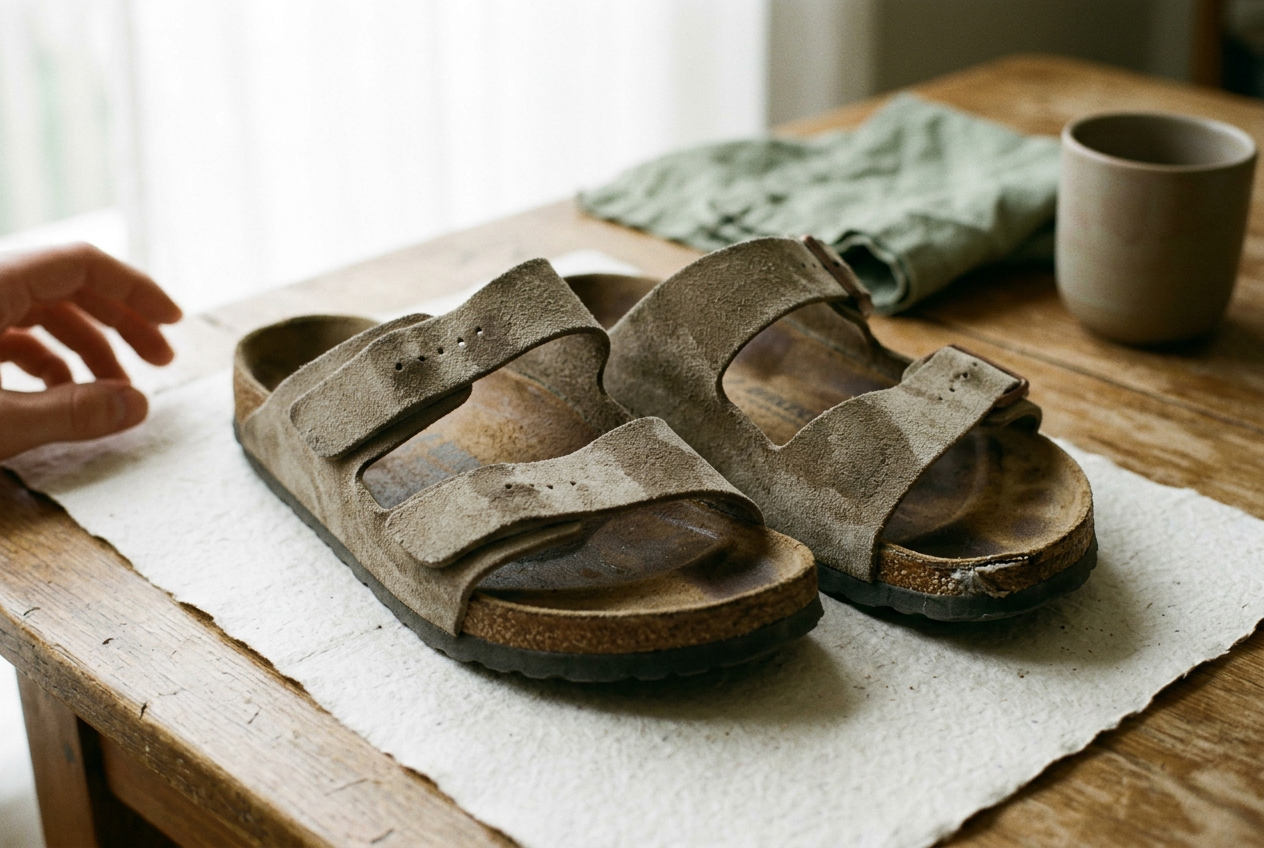
Use one concrete pair as the test case: a suede Birkenstock Arizona worn barefoot through a wet commute, soaked enough for the footbed to darken from heel to toe, then brought home before anybody reaches for a hair dryer. The Arizona is useful here because its visible cork edge makes damage easier to read, although the same checks apply to other molded cork-and-latex sandals.
This is unisex care advice. The relevant fit points are the foot’s position inside the heel cup and over the arch, not which side of a size chart the sandal occupies.
First, know what got wet
A footbed is the shaped platform directly beneath the foot. In a classic cork sandal, the structural center is a cork-and-latex core: granulated cork supplies lightness and some give, while latex binds those particles into a molded form. Depending on the model, fabric layers help stabilize that core, a suede lining sits on top, and an EVA outsole, meaning a lightweight foam sole, meets the ground.
Water does not affect those parts equally. A suede surface may darken, flatten or feel stiff before recovering reasonably well. Exposed cork can absorb moisture around a worn edge, while prolonged saturation may disturb its binder or the adhesive holding neighboring layers together. Heat adds another problem by drying materials at different rates, which can encourage curling, cracking or separation.
Birkenstock’s public care guidance tells owners to keep its footwear away from extreme heat, including direct sunlight and radiators, and to let wet pairs dry slowly. That is the useful instruction, even if it is less emotionally satisfying than attacking the Arizona with the bathroom hair dryer. Fast is not the same as rescued.
Dry the pair without changing its shape
Start by taking the sandals off. Wearing a saturated molded footbed asks softened materials to support body weight while they are least equipped to hold their original contour; even a short walk around the house can press a damp toe area flatter or deepen one heel more than the other.
Blot standing water with a clean, absorbent cloth. Press rather than scrub, especially on the suede lining, because rubbing wet suede can roughen one patch while compressing another. If grit has collected on the surface, lift loose particles gently with the cloth instead of grinding them into the nap, the raised fibers that give suede its texture.
Open the Arizona’s straps fully so air can reach the footbed around the buckles. Set both sandals right side up on a flat, dry surface in a ventilated room, away from a radiator, heating vent, fireplace, sunny window or enclosed hot car. Do not balance them on an edge, hang them by a strap or bend the sole to “open” the cork. The whole point is to preserve the molded shape while moisture leaves.
A fan across the room is less aggressive than concentrated hot air, but ordinary room ventilation is the safer default. Newspaper can sit beneath the pair to catch moisture; it should not be packed tightly against the shaped upper surface, where pressure and ink transfer create fresh problems. Replace the paper underneath if it becomes damp.
Leave the soaked Arizona unworn until the footbed no longer feels cool or damp compared with its dry mate or another dry cork sandal kept in the same room. Drying time varies with humidity, airflow and how deeply the water traveled, so a confident universal countdown would be decorative rather than useful. The visible suede may lighten before the cork underneath has finished drying.
Only after the pair is dry should you use a suede brush to lift flattened fibers, working gently in a consistent direction. A suitable suede cleaner may address dirt or a tide mark, but test it discreetly and follow the product instructions. Water repellents can reduce future surface wetting; they do not turn an open cork footbed into rain footwear.
Read the cork edge before resealing it
The Arizona’s exposed sidewall is the first useful checkpoint. Cork sealer is a flexible protective coating applied to the visible cork edge, and on a healthy pair it can lose its slight sheen as wear removes that coating. Once the sandal is dry, a dull but firm edge may only need a fresh application of a compatible cork sealer, used according to its instructions and kept off the suede.
Flaking coating is different from failing cork. Rub a fingertip lightly over the dry edge. A thin surface film that peels while the cork beneath remains compact points to worn sealer; loose cork granules, pits that enlarge under light pressure or an edge that feels soft and friable indicate deterioration in the footbed itself. Adding more sealer over unstable material may make the edge look tidier without restoring its structure.
Compare both sandals. On the wet-commute Arizona, the inner arch and heel-side cork deserve attention because they receive concentrated pressure during walking. If one edge has bulged beyond the outsole, narrowed inward or developed a crack that opens when the sandal flexes normally, stop treating the issue as cosmetic. A cobbler familiar with cork footwear can judge whether localized cork repair is worthwhile.
Do not use household glue as a substitute for cork sealer. Rigid glue can create a hard patch beside flexible material, and stray adhesive on suede is an excellent way to convert one repair into two.
Lifted suede is a bond failure
Once dry, sight across the footbed from heel to toe under side lighting. A normal suede lining follows the molded surface closely, even when its color and nap vary. A blister, loose flap or wrinkle that can be pressed down and released is delamination, meaning two bonded layers have separated.
Cleaning cannot rebond those layers. Brushing may disguise a small change in texture, but it will not remove trapped space beneath the lining, and that raised area can rub the sole of the foot during a long day. Adhesive failure near the toe grip is particularly noticeable because the toes flex over it repeatedly; at the heel, a loose lining may creep or bunch as the foot lands.
A tiny lifted edge can be assessed by a repair shop. Broad bubbling across the Arizona’s arch or heel is less promising, especially if the suede has stretched while wet, because flattening it may leave excess material with nowhere to go. Avoid pouring cleaner into the gap. Extra liquid can carry dirt and cleaning agents farther into the bond.
Compare the contours, not just the color
Set the dry sandals side by side on a level table. Look from the back at the heel cups, the hollows intended to center the heels, then compare the height and position of each arch. From the front, inspect the toe area and the toe grip, the raised ridge that sits beneath the toes on many molded footbeds.
Some asymmetry already comes from wear. The useful question is whether the soaked sandal has changed abruptly: one heel cup now leans outward, the arch has collapsed relative to its mate, or the front edge rocks instead of resting evenly. Pressing the footbed with your hand will not tell you how it behaves under body weight, so try the fully dry pair indoors and stand naturally before taking a few controlled steps.
The Arizona should locate the heel without forcing it toward an edge, and the arch should meet the foot in the same familiar place. New pressure under one arch, a sensation of sliding downhill inside the sandal or a toe ridge that suddenly feels misplaced points to a changed contour. Cleaning cannot reverse that geometry. Continued wear may merely train the foot to tolerate a worse position, which is a bleak form of break-in.
Upper conditioner cannot repair the platform
Conditioning has a narrow job. On a smooth-leather upper, a compatible conditioner can help replenish oils and reduce post-drying stiffness; suede requires products made for suede, and ordinary leather cream may flatten or stain its nap. Neither treatment reaches through the lining to rebuild cork, restore softened adhesive or remold a distorted arch.
That distinction matters with the wet Arizona because refreshed straps can make the whole pair look recovered. Fit tells the truth. If the buckles now need a different hole because the upper stretched, adjust them and reassess, but do not use tighter straps to pin the foot onto a footbed that has started leaning or flattening.
Repair is most sensible when the straps remain sound, the contour still fits and the damage is limited to resealing firm cork or securing a small edge. Once the core crumbles, the lining lifts broadly or the molded shape changes underfoot, ask a specialist whether a footbed rebuild is available for that construction. On a less expensive cork sandal, labor may approach replacement cost. The discomfort arrives free.
Questions people ask
Can
I dry cork sandals with a hair dryer on a cool setting?
Skip concentrated airflow if ordinary room ventilation is available. Even a nominally cool dryer can create uneven drying at close range, while hands tend to move it nearer when patience expires. Keep the sandals flat, open the straps and let air circulate around them away from direct heat.
Does dark suede mean the footbed is permanently damaged?
Not by itself. Wet suede often darkens and its nap may flatten, then lighten as it dries before responding to gentle brushing. Structural concern begins when the dry lining stays bubbled or wrinkled, the cork beneath feels loose, or the footbed’s heel and arch no longer match their previous contours.
Can cork sealer fix a crumbling footbed?
Cork sealer protects a firm exposed edge after the sandal has dried; it does not bind a weakened core back into its original molded strength. If granules shed with light rubbing, pits deepen or a crack moves during normal flexing, have the pair assessed rather than painting over the evidence.
Is it safe to wear the sandals while they are still damp?
Wait until the lining and underlying footbed feel dry. Body weight on a saturated molded footbed can encourage compression or distortion, and damp suede raises the odds of rubbing. For the soaked Arizona, that means choosing another pair for the next outing rather than conducting an all-day drying experiment with your feet.
One update a day
Today's fashion update, in your inbox
One fashion update each morning — no hype, no filler, just pieces worth wearing.