Some Leather Sandal Straps Will Never Break In
Stiff leather can soften. A strap that crosses the wrong part of your foot cannot relocate itself, however earnestly you limp around the house.
September 1, 2026 · 7 min read
The useful distinction is between leather resisting movement and a sandal resisting the anatomy of your foot. One can improve. The other tends to produce a blister, followed by an unreasonable amount of loyalty to a shoe that has done nothing to earn it.
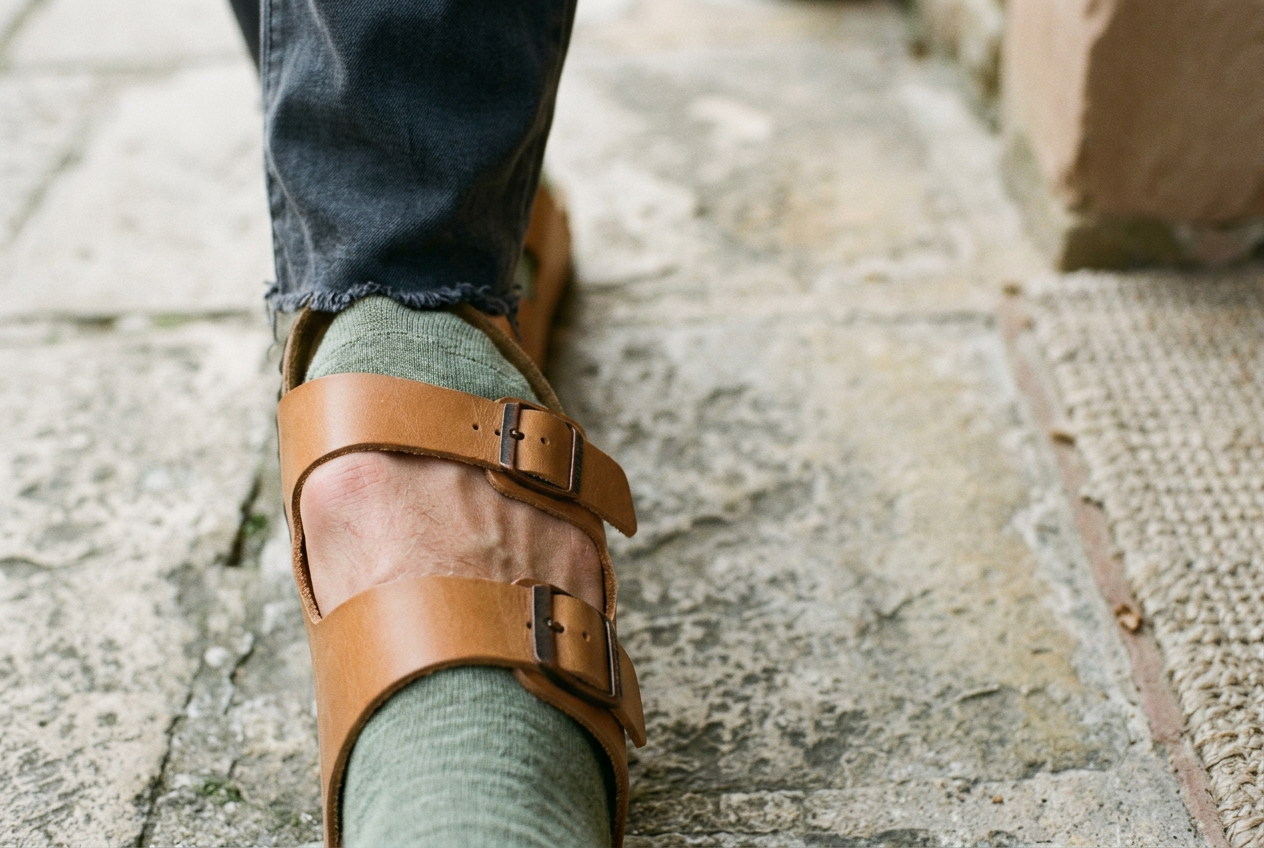
I used a tan, vegetable-tanned leather two-strap sandal as the test case here. Vegetable-tanned leather is hide treated with plant-derived tannins, and it often starts firmer than soft garment leather. The sandal had adjustable buckles, cut leather edges and a flat leather-covered footbed. Across one week, I wore it indoors for four short sessions of about 20 minutes, long enough to see where the upper flexed but not long enough to make the pair unreturnable.
The instep strap began stiff and then formed a shallow crease in line with the foot. That was break-in. The front strap crossed the base joint of the big toe, and its lower edge pressed the same point during every step. That was placement.
The first strap improved; the second remained a small, tan administrative error.
This advice is unisex. Foot shape matters more than the department named on the box, though shoppers with broad forefeet, bunions or prominent toe joints need to be particularly suspicious of low, narrow front straps.
Start with the sandal’s flex point
A flex point is the place where a shoe bends as the foot rolls forward. On a sandal, the sole should flex near the ball of the foot, while the straps should allow the toes and forefoot to spread without holding a leather edge against a moving joint.
Put on both sandals and stand before deciding anything. Sitting hides trouble because the forefoot spreads under body weight, especially late in the day or in warm weather. Walk at a normal pace, turn, and rise onto the ball of each foot once. The leather may feel firm across a broad area, but it should not produce a sharp line of pressure at one edge.
On the test pair, the instep strap bent over a fleshy, relatively stable part of the foot. Its first crease appeared between the buckle and the inside attachment point, close to where the foot naturally flexed underneath it. After several indoor wears, that crease became more cooperative and the strap stopped feeling like a new belt buckled around an ankle.
The front strap behaved differently. Its inner edge landed on the big-toe metatarsophalangeal joint, meaning the large joint where the big toe meets the foot. Each step pushed the joint upward into the same cut edge. The leather did crease, but the crease was not evidence of a successful break-in; it showed that the strap was being forced to hinge over a hard, mobile point.
Look for repetition. General stiffness often disperses as the upper takes the shape of the foot, while bad placement produces a precise red line, hot spot or pinch in the same location within a few laps of the room. Pain that grows faster when you lengthen your stride is especially unpromising because outdoor walking will ask more of the same joint.
Read the edge, not just the leather
Strap material gets most of the attention, but the finishing at its edge often decides whether a firm sandal becomes wearable. A folded edge wraps the upper material inward, leaving a rounded boundary against the skin. A burnished edge, meaning a cut leather edge smoothed by friction and finishing compounds, can also feel clean if it has been polished evenly.
A raw cut edge may soften with wear, although thickness and finish matter. Run a fingertip along the underside rather than relying on how neat it looks from above. If the edge feels dry but smooth, short wears may round it slightly. If it has a burr, an uneven corner or a hardened ridge of edge paint, repeated friction will still be repeated friction after the leather around it relaxes.
The test sandal used cut edges with a light surface finish. The instep edge felt square on the first wear but became less noticeable once the strap curved. At the big-toe joint, the same type of edge stayed intrusive because the foot drove into it from below. This is why material alone cannot settle the matter: one piece of leather on the same shoe may break in acceptably while another remains badly located.
Check stitching too. A seam allowance, the narrow strip of material between a seam and its cut edge, can create a firm ridge beneath a lined strap. It may flatten modestly, but a knot, overlap or bulky seam positioned over a toe joint has little room to disappear. Premium pricing does not repeal this.
It may buy better hides and cleaner finishing; it does not guarantee that a brand’s strap pattern matches your foot.
Strap position has a narrow margin for error
A front strap works best when it holds the forefoot across a relatively broad area without clipping the toe joints as they lift. On many feet, that means sitting behind the visible knuckle line or covering enough of it that pressure spreads across the strap. A skinny edge placed directly through the highest point of a joint concentrates the load.
Use the sandal’s other side as evidence. If the strap feels fine on one foot but rubs the other, compare foot shape while standing. Most people are not perfectly symmetrical. A more prominent joint or slightly longer foot can shift the contact point, and buying a larger size may move the sole under you without moving the strap far enough to solve it.
Width is often the more relevant variable. A sandal built on a broader last, the foot-shaped form used to determine a shoe’s dimensions, gives the forefoot more room to spread before it meets the strap attachments. An alternative with a wider front band may distribute pressure better than a delicate narrow band, even if both are made from equally firm leather.
Adjustable buckles help with volume, not geography. Loosening the test pair reduced downward pressure, but it also allowed the foot to slide forward and brought the strap edge into the joint more forcefully. Tightening it held the foot back, yet the edge still crossed the same anatomical point. Once every buckle hole creates a different version of the same rub, stop negotiating.
Conditioner has a limited job
Leather conditioner can add lubrication and flexibility to dry, unfinished or lightly finished leather. It cannot alter the pattern, move an attachment point or turn a narrow strap into a broad one.
Before using any product, check the care guidance for that sandal and protect the return option. Conditioner can darken pale leather, mark an absorbent lining and make a worn pair impossible to send back. It is also unsuitable for many suede, nubuck, patent, coated or metallic finishes unless the product specifically says otherwise.
For a pair you have decided to keep, patch-test a small amount of neutral leather conditioner in a hidden area. Apply a thin film rather than saturating the strap, keep it off the footbed, and let the leather dry before wearing it. Concentrating product on the underside can help a firm edge feel less dry, but excess conditioner may soften the strap unevenly or transfer to skin and clothing.
Conditioner would have helped the test pair’s instep strap a little, although ordinary flexing was already doing the job. It would not have rescued the front strap. Treating that area before making the return decision would have traded a useful return window for a darker version of the same problem.
Give break-in a controlled audition
Keep the first wears indoors, on a clean surface, with uncreased soles and labels intact. Start with the length of time you would tolerate an unfamiliar shoe at home, then remove the sandals when a hot spot begins rather than after the skin is damaged. Broken skin is not a construction test.
A promising strap changes over several short wears. The leather begins to curve around the foot, pressure spreads, and the initial stiffness takes longer to announce itself. The foot should look normal shortly after removal. A faint, broad impression is less concerning than a bright line that matches one edge exactly.
Return the pair if the strap catches a joint, forces a toe inward, makes the foot slide to escape pressure or leaves the same focused mark every time. Also return it when the only proposed fix requires adhesive pads, stretching tools and strategic bandages before the shoe has reached a sidewalk. Those additions can be useful for an otherwise good pair, but they should not form the basic engineering department.
After four indoor sessions, the test sandal’s instep strap had softened enough to judge as workable. The front strap still pressed the big-toe joint at the same point, and loosening the buckle made the foot less stable. The pair went back. The better alternative was not softer leather alone; it was a sandal with its front band positioned farther behind the joint and enough width for the forefoot to spread.
Questions people ask
How long should leather sandal straps take to break in?
You should notice some improvement over several short indoor wears, not after weeks of damaged skin. Firm leather may need more time to mold fully, but pressure should become broader and less sharp as a crease develops. If the same edge creates the same hot spot from the first session through the next few, placement is the likelier problem.
Can leather conditioner stop a sandal strap from rubbing?
Conditioner may help dry, firm leather flex and can reduce the harsh feel of a cut edge. It will not move a strap away from a toe joint or correct a narrow forefoot fit. Check the sandal’s care instructions, patch-test first, and do not condition a pair while you are still considering a return.
Will sizing up fix a strap that crosses my toe joint?
Sometimes a half-size changes where the foot sits, but extra length can also cause sliding and leave the strap in nearly the same position. Compare the joint with the strap while standing. If width or strap geometry causes the contact, choose a broader last or a differently positioned front band instead.
Are raw leather edges always uncomfortable?
No. A well-smoothed cut edge can become comfortable once the strap curves around a stable part of the foot. Trouble starts when the edge is rough, coated with a hard ridge or placed over a moving joint. Judge the finish with a fingertip, then confirm its position while walking indoors.
One update a day
Today's fashion update, in your inbox
One fashion update each morning — no hype, no filler, just pieces worth wearing.