Wide-Foot Sandals Need Adjustment in Front, Not Just at the Ankle
We compared four common strap systems, using the Birkenstock Arizona as the baseline. The useful ones create room over the forefoot; the rest mostly stop your heel leaving without you.
August 10, 2026 · 8 min read
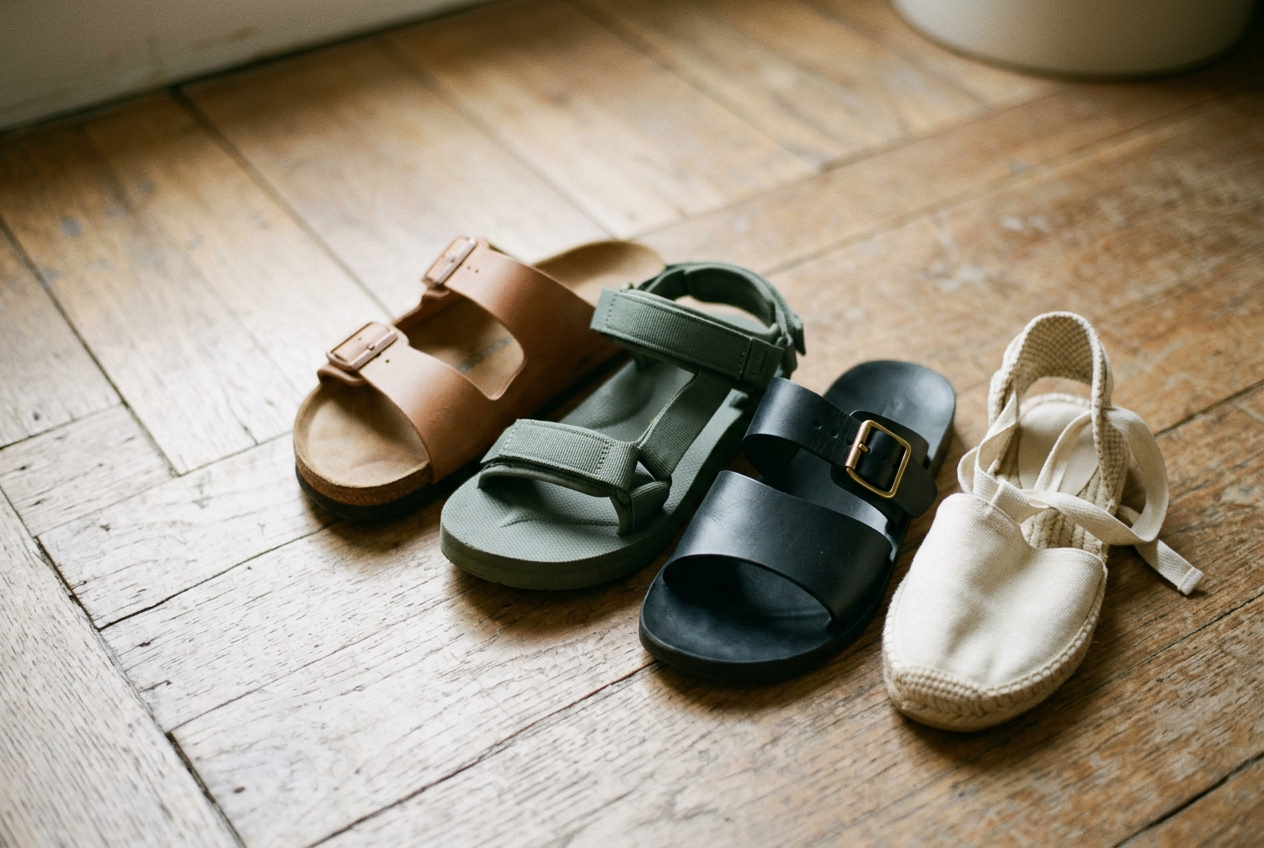
The useful wide-foot sandal is not necessarily the one with the most visible hardware. A buckle can be decorative, a hook-and-loop strap can offer barely an inch of usable adjustment, and an ankle strap can tighten with impressive determination while doing nothing for the part of the foot that is being squeezed.
I used a leather Birkenstock Arizona in the brand’s regular/wide width as the baseline for this comparison, then checked its two-buckle layout against three other common constructions: the independently adjustable webbing on the Teva Original Universal, the continuous strap on the Chaco Z/1 Classic and the three-point hook-and-loop arrangement used on the ECCO Yucatan. These are unisex fit principles, even though color choices, size ranges and retail categorization may split the same mechanics into women’s and men’s departments.
The Arizona kept returning to the center of the test because it demonstrates both the value and the limit of a forefoot buckle. Opening that front strap created measurable-feeling volume over the foot, with no need to loosen the strap closer to the ankle, but it could not make the molded footbed wider or move its raised edge out of the way. Hardware can accommodate a broad foot. It cannot manufacture more sole.
The buckle has to sit in the right place
A forefoot buckle works when its strap crosses the broad area behind the toes and has enough punched holes left after the sandal is fastened. On the Arizona, the front buckle controls the circumference around the forefoot, while the rear buckle changes the fit over the instep, meaning the raised middle section of the foot. Those two zones can therefore be adjusted separately.
That separation matters. A foot may be broad at the ball but shallow through the instep, or broad and high-volume throughout; opening both buckles by the same amount can leave the first wearer sliding backward while the second is still being compressed. On the test pair, moving the front buckle outward by one hole relieved pressure across the leather without making the sandal feel unsecured at the rear. Loosening only the rear buckle did the opposite: the heel moved more, but the forefoot remained exactly where it had been, discussing its grievances with the strap.
Count holes before buying. The final hole is not useful spare capacity if the strap end barely reaches through the buckle, because fastening becomes fiddly and the leather may pull at an awkward angle. A longer strap with several holes beyond the test setting offers a more credible fit range, particularly if feet swell in heat. Also inspect where the buckle frame lands.
Hard metal placed directly over the outer edge of a broad foot can press even when the strap itself is loose.
The Arizona is strongest for a foot that fits inside its regular/wide footbed but needs more room above it. The raised footbed rim makes the boundary unusually obvious: if the little toe sits on that edge, another buckle hole will not help. A broader or straighter footbed is the alternative, even if the upper looks less adjustable.
Hook-and-loop only counts where it overlaps
The Teva Original Universal takes a more forgiving approach. Its polyester webbing straps adjust across the forefoot, around the ankle and behind the heel, and each zone can be set without forcing the others to follow. Hook-and-loop, the fastening system often referred to by the Velcro brand name, adds real volume only while enough of its two mating surfaces remain overlapped to hold securely.
This is the detail product photographs tend to hide. A strap may look long when open, yet the patch of gripping material can be much shorter; on a wide foot, the end then catches only at the edge, leaving a loose tab and a fastening that feels less settled. The useful measurement is not total strap length. It is how much hook still meets loop at the wearer’s comfortable setting.
The Teva layout is effective because its front strap crosses the width problem directly. It can be opened without increasing ankle tension, and the webbing lies flatter than a thick leather buckle strap. A very broad foot may still reach the limit of the patch, while the footbed itself remains non-negotiable, but this construction provides a quick try-on test: fasten the forefoot comfortably, press along the entire overlap and check that the strap end lies flat rather than hovering near the edge.
Hook-and-loop sandals generally sit around the cost of casual sneakers, depending on the sole and upper materials. Their tradeoff is maintenance rather than break-in. Lint and grit collect in the fastening surfaces, wet straps can feel heavier, and a long loose tail looks untidy even when it remains technically attached. None of this is catastrophic.
Sandals seldom fail with cinematic flair; they irritate by millimeters.
Continuous webbing creates room, with homework
The Chaco Z/1 Classic uses a continuous polyester jacquard strap that passes through channels in the midsole. Instead of opening one discrete forefoot strap, the wearer pulls slack through the system to redistribute length across the foot, then secures it with the buckle. This can create meaningful room across several zones, which is useful for a foot that is broad near the toes and substantial through the midfoot.
It is also less intuitive than a buckle with five visible choices. Pull too much webbing into one section and another tightens; leave a twist where the strap enters the sole and the edge may rub. The adjustment needs to be worked through in sequence, then tested while walking, because standing still does not reveal whether the redistributed strap will hold the foot in place on an incline.
Compared with the Arizona, the Chaco system offers a finer range rather than fixed hole increments. Compared with the Teva, it asks for more setup time. That effort can be worthwhile when the foot’s volume does not match standard strap proportions, but the molded sole still has the final vote. Chaco documents width choices for some styles, so the strap setting and the platform width should be treated as separate purchasing decisions.
This is the more technical, often heavier end of the group, generally priced like sturdy walking footwear rather than a basic summer slide. The benefit is a sole and strap arrangement intended for active wear. The penalty is that one does not casually step into a continuous-webbing sandal, tug once and immediately become an expert in tension distribution.
Three adjustable points beat one impressive ankle strap
The ECCO Yucatan uses hook-and-loop adjustment at the forefoot, instep and heel, with a neoprene lining that cushions the contact points. Neoprene is a soft synthetic rubber fabric, and here it reduces the raw-edged feeling that firm webbing can produce against swollen skin. More important for wide feet, the front and middle straps open independently.
This arrangement is useful for high-volume feet because the instep can receive extra room without letting the heel wander. It also demonstrates why a sandal advertised as adjustable should be inspected zone by zone. A rear strap controls heel retention. A middle strap can reduce lift.
Only the strap crossing the front can release pressure where a fixed vamp, the upper section covering the forefoot, would otherwise dictate the fit.
The Yucatan occupies the practical walking-sandal category, with more material and visual bulk than the Arizona or Teva. That is the styling tradeoff. Under wide-leg trousers or with utilitarian shorts, the substantial sole reads deliberate; paired with a narrow, minimal outfit, it will not disappear. The construction earns its presence when a shopper needs several independent fit settings rather than one neat leather line.
Elastic gussets help briefly, then stop
Elastic gussets, small stretch panels inserted beside a strap or upper, can soften pressure and accommodate modest swelling. They do not usually provide the same volume as a strap that opens fully. In the fitting room, press a finger against the elastic and note whether it still has room to extend while the foot is loaded. If it is already stretched flat while standing, its adjustment range has been spent before the walk begins.
This is where many dressier sandals only look accommodating. A buckle may sit at the ankle, an elastic insert may hide beside it, and the polished forefoot band remains fixed from one side of the sole to the other. The sandal can be secured more tightly at the back, but its front circumference never changes. For a broad foot, that design is suitable only when the fixed band fits from the start, with no pinching at its edges and no toe pushed beyond the platform.
Elastic can also disguise a marginal fit during a brief try-on because it yields under pressure. After a longer walk, that pressure still exists; the material is merely pulling back. A full-grain leather band may relax somewhat with wear, while coated synthetic material often changes less, but buying a painful sandal on the promise of future stretching is an expensive way to schedule a blister.
The five-minute fitting check
Start with the sole. Stand normally, then confirm that the broadest part of the foot rests on the platform rather than on a raised rim; the little toe should not be negotiating separate accommodation. Next, open only the front adjustment until the upper stops pressing, leaving the ankle or rear strap at a secure setting. This isolates whether the sandal can add forefoot volume rather than merely loosen everywhere.
Walk for five minutes if the return conditions allow it. Pay attention to strap edges, buckle placement and heel movement, then look at the skin for sharp indentations rather than a temporary, even imprint. With hook-and-loop, inspect the remaining overlap. With buckles, confirm that at least one practical setting remains beyond the chosen hole.
With continuous webbing, sit down and check that no strap has twisted where it enters the sole.
Return to the Arizona test. If opening the front buckle removes pressure while the foot stays inside the regular/wide footbed, the adjustment is doing real work. If the buckle is comfortable but the foot still sits on the rim, stop adjusting. The required feature is a wider platform, not more ankle freedom and certainly not optimism.
Questions people ask
Can an ankle strap make a sandal fit a wide foot?
An ankle strap can improve heel retention, but it does not add room across a fixed forefoot band. For width, look for a buckle, hook-and-loop patch or continuous strap that directly crosses the broad part of the foot, then verify that the sole is wide enough underneath it.
How much hook-and-loop overlap is enough?
The fastening should lie flat with a substantial section of hook and loop fully engaged, not just the edge catching. Press along the overlap after setting the forefoot strap, walk briefly and reject a fit that leaves a long floating tab or begins peeling as the foot bends.
Do leather sandal straps stretch enough for wide feet?
Uncoated leather may soften and relax with wear, but it should not be expected to correct a visibly narrow footbed or a painful fixed band. Buy for a comfortable first fit with usable adjustment remaining; mild firmness can ease, while toe overhang and concentrated edge pressure are construction problems.
Are elastic gussets useful for swollen feet?
They can absorb small changes in volume through the day, provided the elastic is not already fully extended while standing. For substantial swelling or a high-volume forefoot, a strap that opens completely offers more control and can be reset instead of maintaining constant elastic pressure.
One update a day
Today's fashion update, in your inbox
One fashion update each morning — no hype, no filler, just pieces worth wearing.