A High Ankle Strap Can Make a Sandal Less Stable
If an ankle strap sits above the joint, it may follow the leg instead of securing the heel. This walk test shows whether the strap supports anything beyond the outfit.
November 4, 2026 · 7 min read
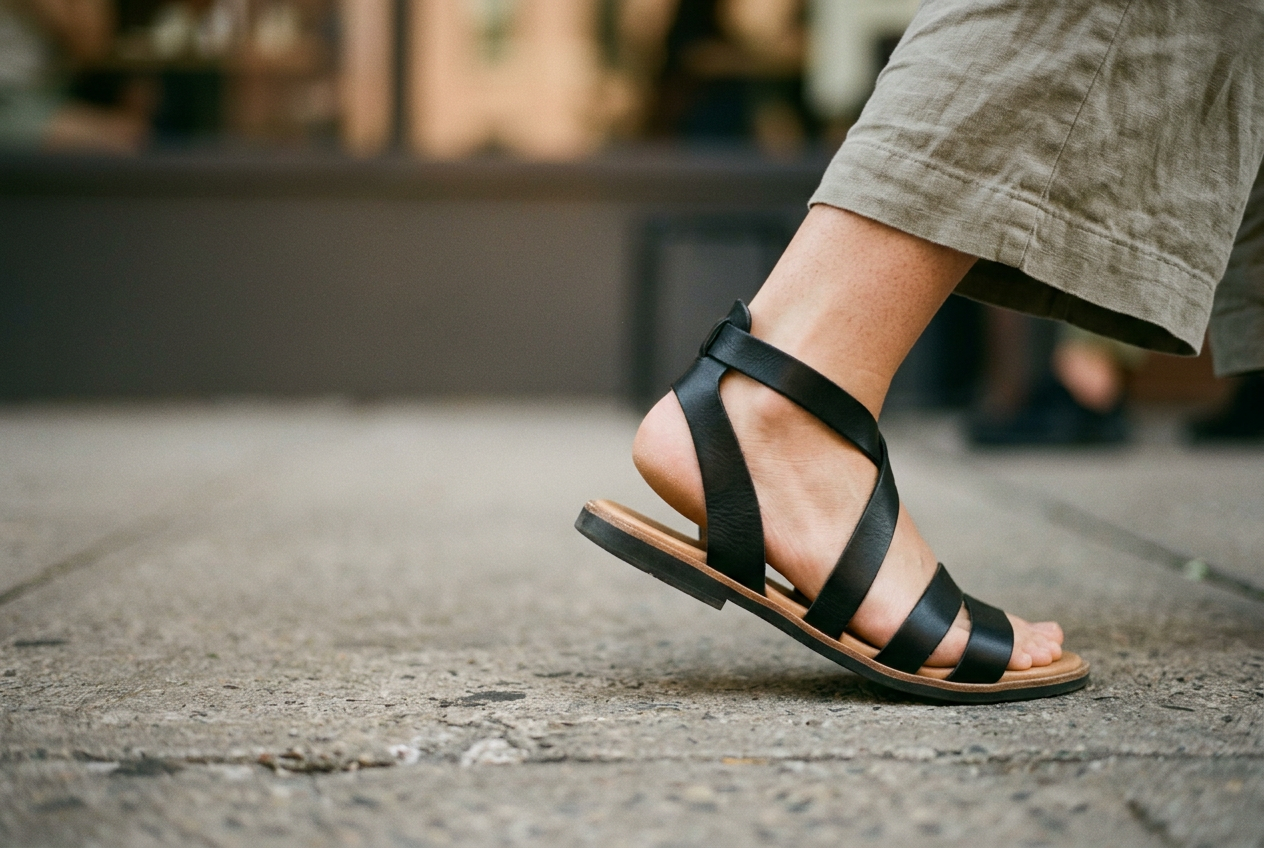
The test case was a black square-toe sandal with a smooth leather upper, leather lining, slim buckled ankle strap and thin rubber outsole. Its strap looked secure in the mirror. It also sat noticeably high, crossing the narrow lower leg above the ankle joint rather than wrapping closer to the top of the heel.
That distinction took about six steps to become irritating.
The sandal stayed attached, technically, but the heel lifted from the footbed on every stride. Tightening the buckle reduced the visible gap while adding pressure above the ankle, and after repeated wear across a week, the strap rubbed in front while the back of the shoe continued to lag behind. The sandal had plenty of strapping. It did not have much control.
This is unisex fit advice. Foot shape, ankle height and gait matter more here than the department in which the sandal is sold, although shoppers crossing between gendered size ranges still need to account for differences in width and length.
Where the strap sits matters more than how much strap you get
An effective ankle strap usually passes close to the ankle joint, meaning the area where the foot bends relative to the lower leg, and connects low enough on the sandal to resist the heel pulling upward. The exact position varies with the pattern, but the useful part of the strap should sit near the rear of the foot rather than climbing onto the lower leg.
On the black test pair, two narrow side pieces rose from the sole and met the ankle strap above the ankle bones. Those pieces are the rear quarters, the sections of an upper that wrap the sides of the heel. Because they were tall and flexible, the strap shifted with my lower leg as I walked instead of drawing the heel back toward the footbed.
That produced heel lift, the momentary separation between the heel and the shoe during a step. Some lift is normal in open footwear, especially when the sole is stiff or there is no back strap. The problem starts when the foot and sole move as separate units: the heel rises, the outsole remains on the ground for a beat, and the strap catches the sandal before it escapes.
A high strap can feel reassuring while standing because it circles a narrower part of the leg and may buckle firmly there. Walking changes the geometry. As the ankle flexes, the strap travels with the leg; if its side attachments do not angle down toward the heel, very little of that tension reaches the rear of the foot.
More tightening will not repair the angle. It merely converts a loose, unstable sandal into a tight, unstable sandal, which is a familiar footwear achievement but not a useful one.
Why the rubbing appears in the wrong place
The first rub on the test pair developed at the front edge of the strap, above the natural bend of the ankle. The leather itself was smooth, and the edge had no obvious roughness, so the material was not the main problem. Each forward step pulled the strap against the lower leg while the foot tried to flex beneath it.
Range of motion means how far a joint can move in its usual directions. A strap crossing too high may limit that movement during stairs, slopes or a brisker pace, particularly when the leather is firm and the buckle has been tightened to compensate for heel lift. Soft suede or padded fabric may disguise the pressure longer, but it cannot change where the force lands.
Strap width alters the sensation rather than the mechanics. A narrow strap concentrates pressure along an edge and can feel sharp; a broad cuff spreads the load but may block more ankle movement. Elastic inserts can reduce the tugging, although they may also let the heel travel farther before the sandal follows.
After a week with the black pair, no useful break-in had occurred. The leather had softened slightly where it bent, yet the heel still rose and the upper still pulled forward. Break-in can ease a stiff edge. It cannot lower the attachment point or redirect a strap that was cut to sit above the joint.
The walk test starts before the first step
Try the sandal on both feet with the footbed flat on the floor. Buckle it at a hole that feels secure without leaving a deep indentation, then place one finger behind the strap. A little clearance is reasonable; a strap should not need tourniquet tension to keep the shoe nearby.
Next, look at the sandal from the side. Trace an imaginary line from the ankle strap down through its side attachment. On a supportive pattern, that line tends to point toward the back half of the heel or the rear edge of the footbed. If it drops nearly straight down from the lower leg, or angles toward the arch, the strap has poor leverage over heel lift.
Press the front of the foot into the footbed and raise the heel slowly. This is not yet a walking verdict, but it shows what the upper does under load. A useful strap becomes gently taut and encourages the rear of the sandal to follow. On the black test pair, the heel rose first, the side pieces bowed, and the sole joined late.
Then walk ten ordinary indoor steps without changing your stride for the shoe. Listen as well as look. A sole that slaps the floor is often arriving after the heel, while toes that grip or curl suggest the forefoot is trying to keep the sandal aboard. Neither response proves the size is wrong, but both justify checking the strap position before reaching for another buckle hole.
Turn, stop and restart. Direction changes expose sideways movement that a straight showroom pass can hide, especially in square-toe sandals whose broad-looking front may still have a narrow usable footbed. The heel should remain reasonably centered rather than sliding toward one edge while the ankle strap stays fixed around the leg.
Finish with stairs or a safe incline if the store permits it. The ankle needs more flex there, so a badly placed strap may dig into the front of the leg, push the heel forward or force a shorter step. Remove the sandals after several minutes and inspect the skin. A developing red line at the strap edge is evidence, not a styling challenge.
Separate a sizing problem from a pattern problem
Sizing up can reduce pressure around the ankle, but it also lengthens the footbed and may increase heel travel. Sizing down can bring the rear edge closer, yet it risks placing toes against the front or outside the usable sole. Neither move changes the vertical position of the strap.
Compare both feet. If one heel lifts because that foot is smaller, an additional buckle hole or a discreet adhesive footbed pad may improve the fit. If both heels lift at the same phase of every step while the straps remain high and tight, the pattern is the stronger suspect.
Also check where the rear quarters attach to the sole. The more direct alternative to the test pair was the same broad category of dress sandal with side straps anchored near the heel and an ankle strap sitting just below or around the ankle bones. That lower arrangement looked less dramatic, but the sole followed sooner and required less gripping from the toes.
A back strap that cups the rear of the heel can provide even clearer control. It needs to sit on the heel rather than above it, and it should not collapse or slide downward during a step. For buyers who dislike ankle pressure, a well-shaped slingback or a sandal with a secure vamp, the section covering the forefoot, may work better than adding more straps higher up.
Price does not correct the pattern
This flaw appears in inexpensive synthetic sandals and polished leather pairs alike. Better leather may soften more agreeably, a lined strap may reduce edge friction, and a firmer outsole may last longer, but none of those upgrades changes the direction in which the upper holds the foot.
The practical cost is time as much as money. A pair that needs several indoor trials, protective patches and constant buckle adjustment has already assigned the owner a small unpaid position in product development. If the heel lifts during the return-window test, keep the outsole clean and stop waiting for the strap to migrate south.
The black pair failed for that reason. Its leather was acceptable, the square toe accommodated the forefoot, and the finish worked with tailored trousers, but the high strap made the shoe less controlled than a simpler lower-set design. Decorative strapping is fine when treated as decoration. It should not command a support surcharge.
Questions people ask
How much heel lift is normal in a sandal?
A slight separation can be normal in open-backed sandals, particularly with a firm sole. The warning sign is repeated, visible lift followed by a delayed slap from the outsole, toe gripping or a strap catching the leg. The foot and sandal should still move mostly as one unit.
Can an extra buckle hole fix a loose ankle strap?
An extra hole can help when the strap sits in the right place and the wearer falls between the existing settings. It will not correct a strap anchored too high. If tightening creates a deep mark above the ankle while the heel keeps lifting, the sandal’s pattern is the problem.
Will a high leather ankle strap improve after break-in?
Leather can soften at an edge and become less abrasive, but break-in does not relocate the strap or its attachments. A high strap that restricts flex or follows the lower leg will retain that basic behavior, even if the rubbing feels less sharp after several wears.
What sandal construction gives the heel better support?
Look for rear quarters anchored close to the heel, an ankle strap crossing near the joint, or a back strap that cups the heel without sliding. During the walk test, the sole should follow soon after the heel rises, without toe gripping, excessive buckle tension or pressure at the front of the ankle.
One update a day
Today's fashion update, in your inbox
One fashion update each morning — no hype, no filler, just pieces worth wearing.