Elastic-Waist Pants Should Still Sit Flat When You Do
A flat front can hide a poorly controlled elastic waistband. Check the back stretch, side-seam anchoring and pocket openings while seated before you commit.
Women's · November 23, 2026 · 8 min read
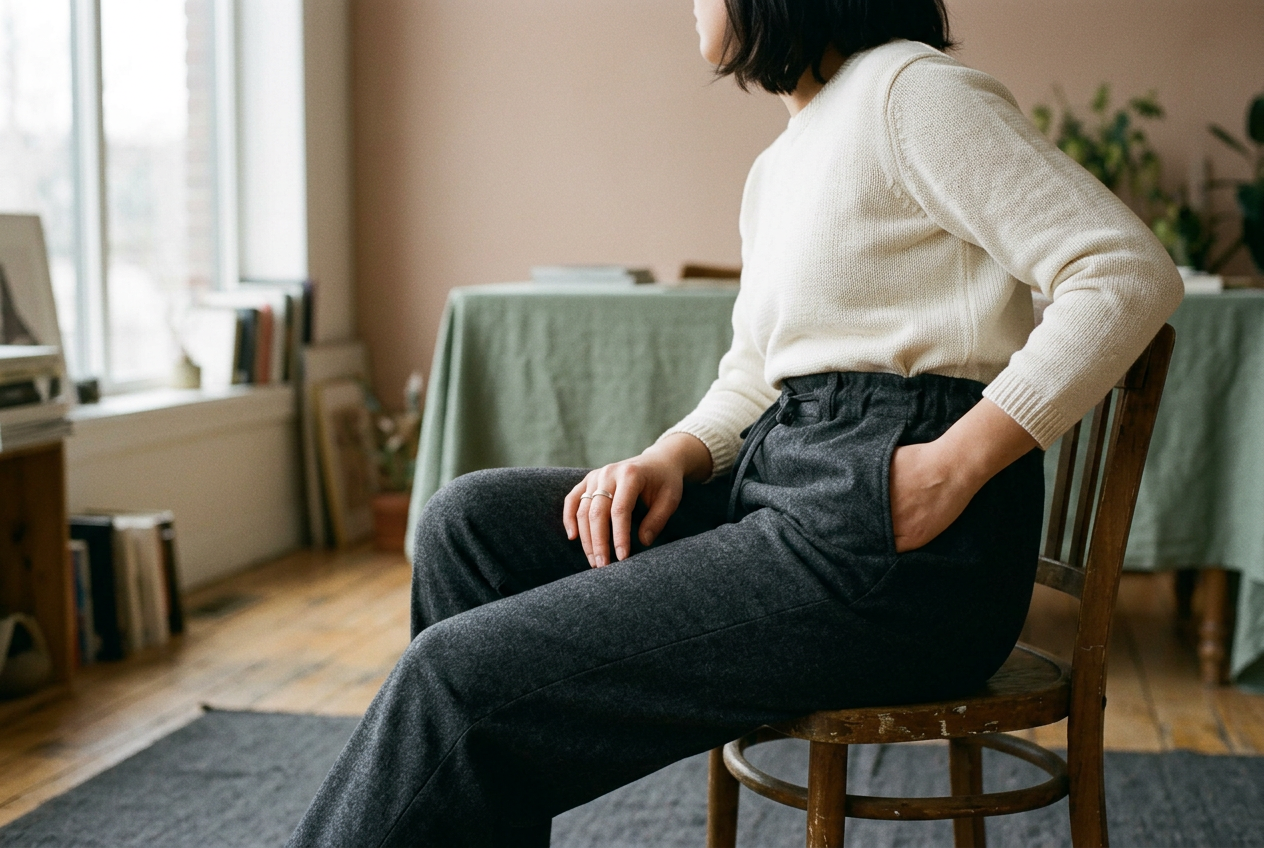
The charcoal pull-on trousers looked convincing on the hanger: medium-weight polyester-viscose stretch twill, a clean front waistband, elastic across the back and slant pockets that lay almost flat. Standing up, they passed as tailored ankle pants. After twenty minutes at a desk, the front rose toward the ribs, the pockets opened and the waistband dipped at the back.
That pair became my test case for a week of ordinary wear. I sat at a desk, ate lunch, walked outside and stood after longer seated stretches, paying attention to whether the trousers settled by themselves or needed to be pulled back into place. They were comfortable in the narrow sense that nothing pinched. The tailoring effect did not survive sitting.
This is women’s coverage, with attention to the higher rises and shaped hip-to-waist proportions common in women’s trousers. The construction checks also apply more broadly, but the fit problem becomes especially visible when a waistband must stretch over the hips and then contract firmly at a smaller waist.
Why the flat front moves
Partial elastic means that only part of the waistband stretches, usually the back or short sections near the side seams. It is a useful compromise. The front can look like a conventional trouser waistband while the elastic gives enough room to pull the pants on, sit down and move through small changes in waist measurement.
Placement decides whether that compromise works. On the charcoal pair, the elastic started slightly behind each side seam and ran across the back. That left the front visually clean, but it also asked a fairly short elastic section to provide most of the expansion. When I sat, the back needed more length than it could release without resistance, so the trousers borrowed room from the front by tipping the waistband and lifting the front rise.
The front rise is the seam length from the crotch to the top of the front waistband. If it feels adequate while standing but suddenly presses upward when seated, the problem may not be rise alone. Watch what the waistband does. A level band that stays in place points toward a rise or hip-shaping issue; a band that climbs in front and drops behind shows that the elastic and waistband are redistributing tension.
Elastic running from side seam to side seam across the full back usually has more room to expand than a narrow center-back insert. Short elastic panels can still work, particularly when the woven front and side sections already match the wearer’s body, but they have less capacity to correct a close waist or a fuller seated hip. More elastic is not automatically better. If it reaches too far forward, it can gather the fabric beside the pockets and make the supposedly tailored front look puckered.
The side seams tell on the waistband
Waistband anchoring means securing elastic or waistband layers at chosen seams so they cannot slide, twist or pull unevenly. On a good flat-front design, the side seams act as firm boundaries: the back elastic expands behind them while the front waistband keeps its length and shape.
The charcoal trousers had visible stitching where the elastic met the side sections, yet the anchoring did not control the lower edge of the waistband well enough. Seated, the top edge stayed close to the body while the lower edge rolled outward slightly. That small rotation was enough to tug the pocket bags forward and send the side seams toward the front of the thighs.
Check this in profile. The side seam should remain close to the center of the body from waistband to hip, even though a little movement is normal. If it swings forward only when seated, the back is likely running out of room. If it swings backward, the front may be too tight across the abdomen or upper thigh.
Neither fault is fixed by congratulating the elastic for stretching.
A stitched-through waistband can offer more control because the elastic is caught at intervals rather than floating freely inside a fabric channel. A channel is the fabric casing that holds elastic. Floating elastic feels soft and can distribute gathers gently, but it may twist or migrate unless it is secured at the side seams and center back. Stitching through every section keeps the band stable, though it can make the waistband firmer and more visibly casual.
Run a finger along the band in the fitting room. A fold, rope-like ridge or abrupt thickness change suggests that the elastic has turned or was joined roughly. Then stretch the waistband with both hands and release it. The front panel should return flat rather than collapsing into diagonal wrinkles that point toward the pocket openings.
Pockets are part of the fit test
Slant pockets are useful evidence because their angled openings sit directly in the path of waist and hip tension. On the test pair, each opening looked closed while I stood. Once seated, the lower corners projected from the body, and the pocket bags pushed against the front twill. A phone made the distortion worse, but the empty pockets already showed it.
Some trousers use a pocket stay, a piece of fabric that connects the pocket bag to the center-front area or waistband, to stabilize the front. It can stop a pocket from drifting toward the side seam and help spread tension across a wider area. The charcoal pair had ordinary free-hanging pocket bags, which were comfortable against the skin but offered the front panel no support.
Pocket flare does not always mean the wearer needs a larger size. A size up may close the openings, but it can also leave excess fabric under the seat and weaken the waistband’s hold. First check whether the horizontal pull lines begin at the pocket, whether the side seam moves and whether the back elastic is already extended near its limit. Those signs point to construction or proportion rather than a universal sizing error.
Do the test with empty pockets, then repeat with what you carry. A trouser that stays composed only when the pockets contain nothing is offering decoration, not useful storage. Deep pocket bags also need enough room to hang downward; if they are caught high in the waistband or cut too narrow, a phone can lever the opening outward every time the hip bends.
A seated test that takes ten minutes
Pull the trousers on without judging them immediately. Walk long enough for the waistband to settle, then note where the top edge sits in front and at the back. Do not reposition it before sitting. The point is to see how the garment manages the transition on its own.
Use a firm chair rather than a deep fitting-room bench. Sit with both feet on the floor for several minutes, lean forward as if working at a table and place one everyday item in a pocket. The waistband may expand, but its front and back edges should remain reasonably level, the front panel should not climb into a new position, and the pockets should not become the widest point of the silhouette.
Stand without pulling at the trousers. The charcoal pair stayed high in front until I hooked my thumbs under the waistband and pushed it down, while the back returned slowly and left fabric caught beneath the band. That need for a reset mattered more than the initial softness. Pants worn for work, travel or dinner should recover after sitting without a private adjustment routine.
Repeat the test after tucking in a thin top if that is how you plan to wear them. A tucked layer uses some waistband capacity and adds friction, which can keep a band from sliding back into place. If the pants only work with an untucked shirt hiding the pockets and waistband, decide whether that limitation matches the role you had in mind.
What is worth buying instead
Look for a front waistband that feels stable rather than rigid, with elastic beginning at or just behind the side seams and enough back length to expand without reaching full tension. The best version for a curvier hip-to-waist difference may have a broad elasticated back plus darts, which are stitched folds that shape fabric around the body, instead of asking the waistband to do all the fitting.
Fabric matters too. The test pair’s elastane helped the twill recover, but stretch in the trouser body could not correct the tipping waistband. A softer woven fabric may disguise pulling by draping over it, while a dense ponte knit can move comfortably and maintain a smooth surface, though neither gives exactly the same crisp effect as woven tailoring. Fiber stretch is support.
It is not a substitute for enough room.
This construction appears from inexpensive pull-on pants through premium workwear, and price alone does not reveal whether the front is properly controlled. At any price, inspect the inside waistband, pocket attachment and side-seam junction. I would pay ordinary midmarket trouser money for a pair that recovers cleanly after sitting; I would skip a more expensive pair if the pockets flare before anything is placed in them.
The alternative may be a conventional zip-front trouser with a small elastic insert at the center back. It takes longer to put on and offers less dramatic expansion, but the closure can anchor the front more securely. For days dominated by sitting, that controlled front may provide more usable comfort than a fully pull-on design that must be adjusted each time you stand.
Questions people ask
Should elastic-waist pants feel tight when standing?
They should feel secure, not fully stretched. If the back elastic is already near its limit while you stand, it has little capacity left for sitting, eating or adding a tucked layer. Check for a level waistband and smooth pockets rather than treating pressure at the waist as proof that the pants will stay up.
Why do trouser pockets stick out when I sit?
The hip and abdomen need more room in a seated position, which can pull an angled pocket opening apart. Flare becomes a construction warning when the side seam shifts, the waistband tips or the empty pocket bag pushes forward. A larger size may help, but only if the rest of the trouser still fits.
Is back elastic better than elastic at the sides?
A full back section usually offers more expansion without disturbing the flat front. Side elastic can make smaller adjustments with fewer gathers, but poorly placed inserts may pull directly on pocket openings. Judge the design by whether its side seams stay centered and its front waistband remains level through the seated test.
Can a tailor fix a tipping elastic waistband?
Minor looseness may be corrected by shortening or replacing accessible elastic. A waistband that tips because the rise, hip shape or back length is wrong requires more extensive alteration and may not be worth the cost. If new trousers already climb in front and dip behind, returning them is usually the cleaner choice.
One update a day
Today's fashion update, in your inbox
One fashion update each morning — no hype, no filler, just pieces worth wearing.