The Arm-Raise Test Catches a Bad Summer-Dress Fit
A dress can look right while you stand still and fail as soon as you reach up. This fitting-room sequence separates fixable fit issues from a bodice cut worth leaving behind.
Women's · November 20, 2026 · 8 min read
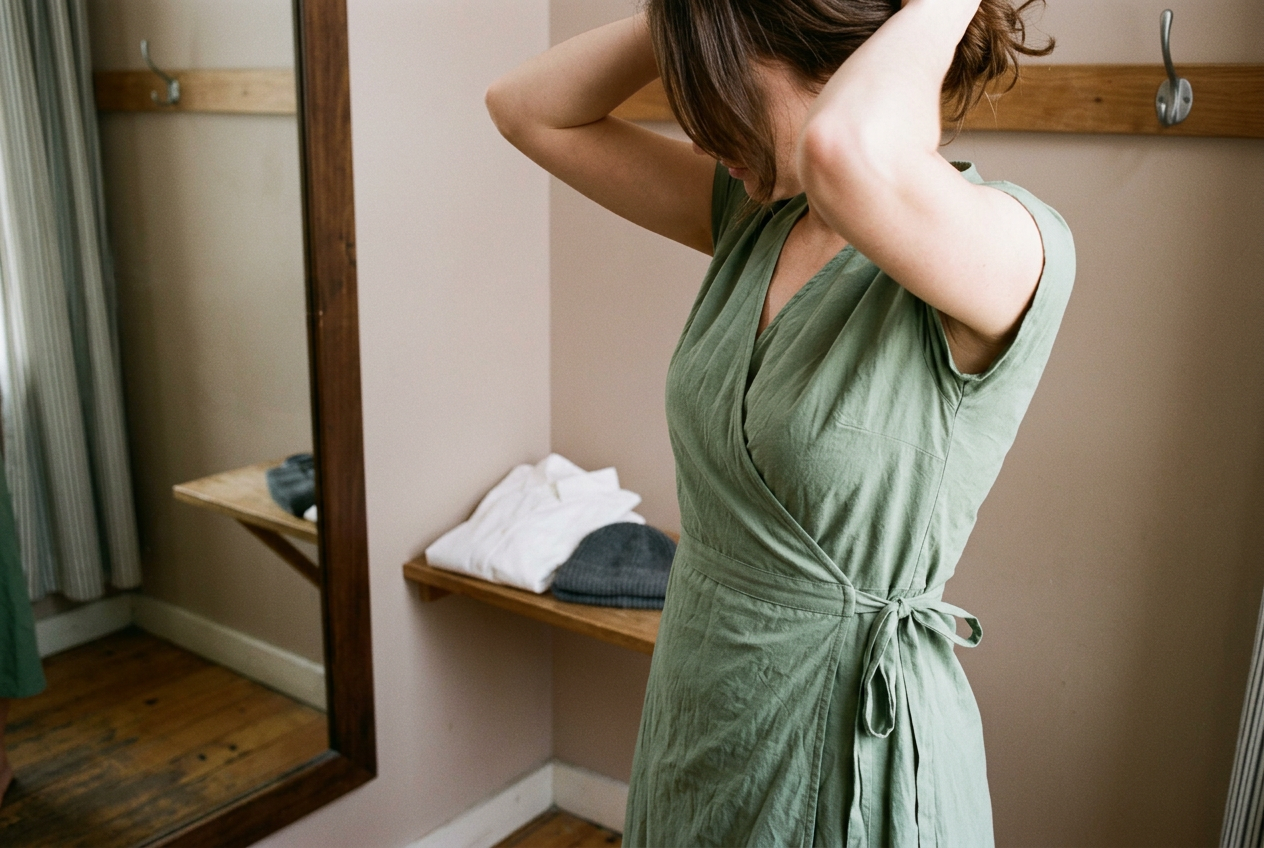
The useful test case is a short-sleeve cotton-poplin wrap midi dress, tried on over the bra and underwear that would normally sit beneath it. Cotton poplin has enough body to show strain clearly, while the wrap closure introduces another common failure point: a front that looks secure at rest but opens or twists once the arms move.
This is women’s fit coverage, focused on dresses shaped through the bust and waist. The same motions can test other garments, but a fitted summer dress has less room to disguise a poor relationship between the sleeve, armhole, bodice, and skirt.
The whole sequence takes about two minutes. Do it after choosing the size that fits best while standing normally, rather than starting with a deliberately tight option and asking movement to settle the argument.
Establish the resting fit first
Stand naturally with your arms down. Check where the shoulder seam lands, whether the waist seam sits at your waist, and how much wrap-front overlap covers the bust. The shoulder seam should meet the outer edge of the shoulder rather than dropping onto the upper arm or pulling toward the neck.
Notice the hem position in front, at the sides, and across the back. It does not need to be perfectly level on every body, especially when the skirt falls over a fuller bust or seat, but this starting point gives you a reference for what happens next.
On the cotton-poplin wrap dress, the waist seam is the clearest marker. If that seam begins at the natural waist and ends under the ribs after one reach, the bodice has moved farther than the wearer did.
Before lifting your arms, slide two fingers around the armhole and sleeve opening. You are checking ease, meaning the extra room built into a garment for movement. Two fingers are not a universal sizing rule, but fabric should not press sharply into the front of the armpit while the arms hang loose.
Raise your arms in stages
Start by lifting both arms straight forward until they are level with the floor. Pause. A well-cut sleeve rotates with the arm, and the bodice may rise a little, but the waist should remain close to its starting position.
Watch the wrap front rather than looking only at the neckline. If the lower layer slides sideways, the V-neck deepens, or the waist tie begins dragging toward one hip, the bodice lacks stable overlap. A hidden snap can control a neckline edge, but it cannot correct a whole front panel that shifts under tension.
Next, open your arms out to the sides. This exposes an armhole that seemed comfortable from the front yet cuts into the back of the arm, where the sleeve joins the bodice. On the poplin test dress, a diagonal crease running from the armpit toward the bust shows that the armhole is borrowing room from the front panel instead of allowing the arm to move within the sleeve.
Now lift both hands overhead as though placing a bag on a high shelf. Do not stretch beyond a normal reach. Look at the waist seam, the back hem, and the amount of fabric covering the bust; if possible, use the fitting-room mirror to check the side and back rather than judging from the front alone.
Lower your arms slowly and count a few seconds. Recovery matters as much as lift. A dress that rises slightly and drops back into place is behaving normally, while one that remains bunched above the waist, caught across the bust, or twisted at the wrap needs manual adjustment after an ordinary movement.
Finish with two uneven motions. Reach one arm forward as though taking a receipt, then lift the other as though holding a subway strap. Real movement is rarely symmetrical, and a wrap dress that survives the overhead pose may still pull open when one side of the bodice carries all the tension.
Read what the dress is telling you
Some hem lift is unavoidable because the sleeve and bodice are connected. The warning appears when the skirt travels several inches, the waist seam leaves the waist, or the back hem stays caught after the arms come down. In a mini dress, even modest lift may create a coverage problem that a midi length conceals without fixing.
A tight armhole usually announces itself through pressure, restricted reach, or a hard fold at the front of the armpit. Check the sleeve cap, the curved upper section of the sleeve that fits into the armhole. If it is too narrow or too shallow, raising the arm pulls the entire dress upward because the sleeve cannot rotate independently.
Underarm gaping behaves differently. With your arm partly raised, look for a triangular opening between the dress and the side of the body, especially if it exposes the bra. Gaping can come from an armhole cut too low, excess width through the upper bodice, or a bust dart that points to the wrong place; a dart is a stitched fold that shapes flat fabric around the body.
A dress can gape and restrict movement at once. The armhole may be low and wide at the side while the sleeve cap remains tight, leaving empty space below the arm but too little usable room above it. Sizing down may close the gap and make the restriction worse.
The wrap front needs its own reading. A small neckline edge that lifts away from the chest can often be secured, but overlap lost across the bust signals a proportion problem, particularly when the waist and shoulders otherwise fit. If the cotton-poplin front slides open every time one arm rises, a camisole will provide coverage without stopping the dress from twisting.
Separate alterations from a wrong cut
A modest neckline gap is alteration-friendly when the shoulder, armhole, waist, and wrap overlap all remain stable. A tailor may shorten a wrap edge, add a discreet snap, or adjust the shoulder seam. These are contained changes, though any visible topstitching or print matching can add labor.
Slight underarm gaping in a sleeveless dress may also be reduced if there is enough seam allowance, meaning the fabric left inside a seam for adjustment. The alteration becomes harder when taking in the side seam would tighten the bust or distort a pocket.
Restricted overhead reach is a stronger reason to leave the dress behind. Enlarging an armhole or rebuilding a sleeve can require reshaping several connected pieces, and there may be no spare fabric to do it. That level of work can cost enough to defeat the value of an everyday summer dress, with no guarantee that the new sleeve will hang cleanly.
Persistent hem lift belongs in the same category. A longer skirt can hide the result, but it does not repair a bodice that is too short, an armhole that is misplaced, or a sleeve that drags the waist upward. Trying one size larger is worthwhile only if the shoulders stay aligned and the neckline does not become loose.
For the poplin wrap midi, the deciding combination is a climbing waist seam and a moving wrap front. Either issue might be manageable alone. Together, they show that the upper body is cut with too little functional room, so a snap or larger size would treat the visible symptom while leaving the movement problem intact.
Let the fabric affect the verdict
Woven cotton poplin has little natural stretch, so the pattern must supply the room needed for reaching. Linen and rayon challis may feel more forgiving because they drape or relax with wear, yet neither can correct a badly placed armhole. Stretch jersey can absorb more movement, although a neckline that turns sheer or a wrap edge that rolls under tension still fails the test.
Repeat the sequence while wearing the underlayer you plan to use. A molded bra, soft bralette, or camisole can change how a fitted bodice sits, and testing in an unusually slippery fitting-room bra may make a wrap front seem less stable than it will be at home.
The final check is practical: lift, lower, and leave the dress alone. If you immediately want to tug the waist down, pull the neckline closed, or free the sleeve from your armpit, expect to repeat that correction every time you reach for something.
Questions people ask
How much should a summer dress rise when I lift my arms?
A little movement is normal, especially in a woven dress with sleeves. The dress should settle when your arms come down, while the waist seam should remain near your waist. A hem that climbs far enough to affect coverage, or stays caught afterward, points to a bodice or sleeve problem.
Can a tailor fix underarm gaping?
Often, if the gap is small and the bust, shoulder, and armhole otherwise fit. A tailor may reshape the side seam or adjust the shoulder. A low armhole combined with a tight sleeve is much less promising because removing width will not create the missing movement room.
Should I size up if the armholes feel tight?
Try the next size, then repeat the full test. Keep it only if the larger size frees the arms without dropping the shoulder seams, loosening the neckline, or reducing wrap coverage. If one area improves while the rest of the bodice collapses, the dress is cut for different proportions.
Does the arm-raise test work on sleeveless dresses?
Yes. A sleeveless dress cannot blame a tight sleeve, so the test reveals whether the armhole is too low, too narrow, or poorly shaped around the bust. Check for underarm gaping at half height, then confirm that the waist and neckline return to place after an overhead reach.
One update a day
Today's fashion update, in your inbox
One fashion update each morning — no hype, no filler, just pieces worth wearing.