White Pants Can Be Opaque and Still Show Every Inner Seam
A substantial white fabric can still reveal pocket bags, seam allowances and overlocking. Inspect the inside before assuming different underwear will fix the problem.
October 29, 2026 · 8 min read
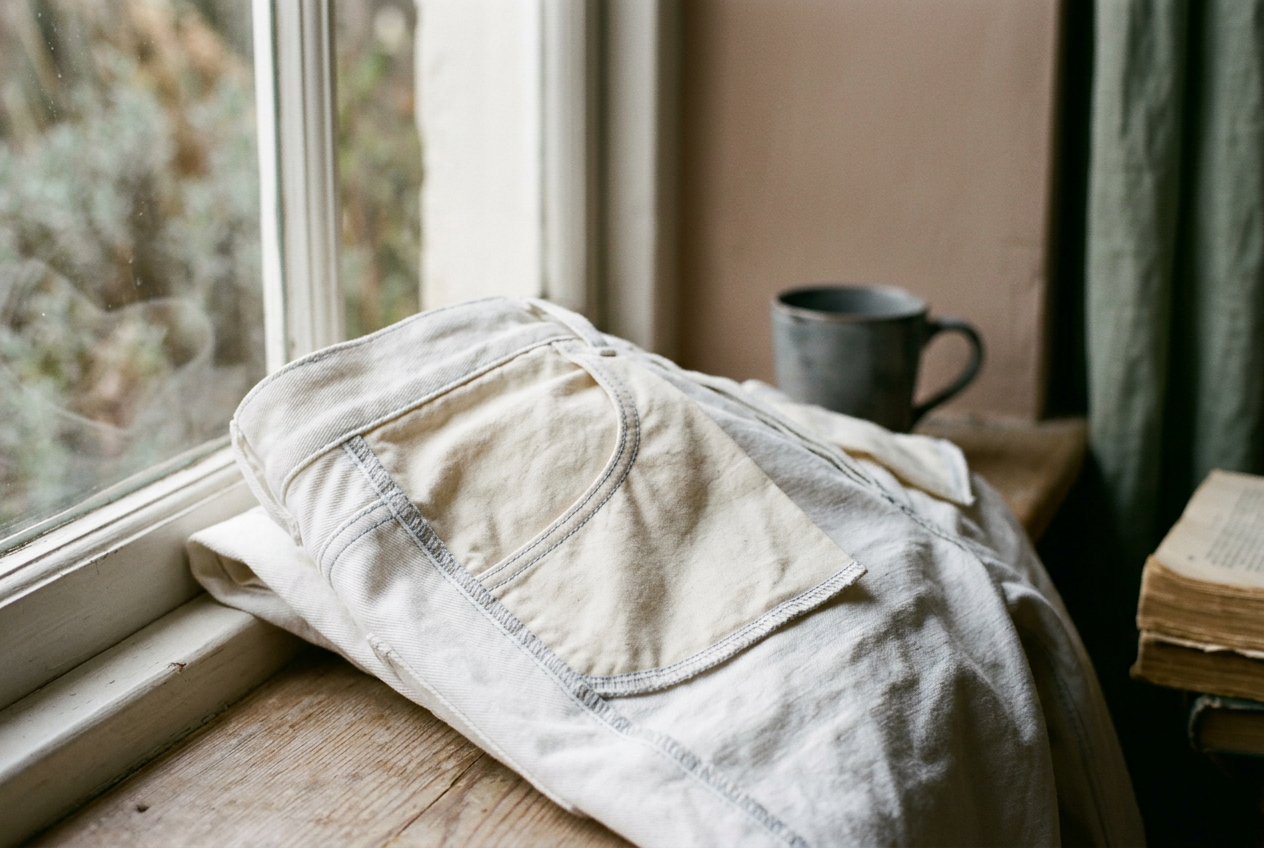
The pair on my table is an unlined, straight-leg white cotton-twill trouser with diagonal front pockets and two back welt pockets. The twill feels substantial between the fingers, the waistband sits cleanly, and dark underwear does not show as a defined shape. At first glance, it passes the usual opacity test.
Then the trousers move into natural light. Each front pocket appears as a pale cream rectangle, the back pocket bags create two horizontal blocks, and the overlocked side seams read as faint blue-gray lines. Overlocking is the looped stitching that wraps a raw fabric edge to stop it from fraying. Nothing is exposed, but the inside of the garment has become part of the outside view.
That distinction matters. Different underwear may solve contrast at the body, yet it cannot conceal a bright pocket bag floating behind white cloth or a bulky seam pressed against it. This guide is unisex because the same construction issues appear in white trousers across women’s, men’s and gender-neutral wardrobes, although the closer the fit through the seat and upper thigh, the more obvious those issues tend to become.
Start inside the trousers
Turn the pants inside out before trying them on. A pocket bag, meaning the fabric pouch that forms the pocket, should ideally sit close in color to the outer cloth without being heavier, brighter or more textured. White is not one fixed shade. A cool optical-white bag can flash through warm ivory trousers, while a cream bag can look dingy beneath a blue-white shell.
On the test pair, the front bags are lighter and yellower than the cotton twill. Their curved lower edges are also finished with dense stitching, so the outline has more visual weight than the center. The result is not general transparency. It is a precise map of the pocket construction.
Hold one layer of trouser fabric over the pocket bag, then move both toward a window. Do the colors merge, or does the bag become a separate block? Repeat the test with the fabric pulled gently across the bag, since trousers stretch over the hips and thighs in a way they do not on a hanger. Avoid yanking hard enough to distort the weave; the goal is to recreate normal tension, not prove that any fabric can become sheer.
Next, inspect the back pockets. Welt pockets, which are openings finished with narrow fabric lips, often hide a larger internal bag than their neat exterior suggests. A back bag that ends halfway down the seat can make a visible horizontal line, especially when the trousers are fitted. If the pocket is stitched shut for display, look from the inside rather than assuming the closure means the pocket is decorative.
Read the seam allowances, not just the seams
A seam allowance is the strip of fabric between the stitching line and the raw cut edge. On white trousers, its width and finish affect what the eye sees from outside. A narrow allowance can produce a sharp line because several layers and rows of thread are concentrated in a small area; a wider allowance may look softer, though it can still show if it flips or bunches.
The side seams on the cotton-twill pair have narrow allowances finished with gray-white overlocking. Under indoor lighting, the thread seems close enough to white. Near a window, its cooler cast becomes clear. Where the allowances turn toward the front of the leg, the overlocking forms a broken vertical stripe.
Pressing the allowance toward the back reduces that stripe, but it does not erase the thread color.
Run a finger down each seam from the inside. You are checking whether the allowance lies flat, twists at the knee or narrows abruptly where the trouser shape changes. Also look at the center-back and crotch seams, where extra rows of stitching may create a dark-looking ridge even when every thread is technically white. Dense white thread can cast a stronger shadow than loosely woven fabric.
Construction quality is not identical to invisibility. A secure overlocked edge may be durable and neatly sewn while remaining visible through the shell, and an expensive pair can still make a poor color match between its internal components. The useful question is whether that finish works for this fabric in daylight.
Use natural light without turning the fitting into a spectacle
Face a window rather than standing with the window behind you. Front lighting reveals pocket outlines and seam shadows without making the whole garment look more transparent than it will in ordinary wear. Turn sideways, sit, and take one normal step. The test pair looked calm while standing square, then showed the curved edge of the front bag when the upper thigh pulled forward.
A phone photo can help because the camera flattens small differences in tone, but exposure settings may brighten white fabric and exaggerate contrast. Use the image as a second view, not a verdict. If a store has no natural light, ask about the return policy and repeat the check at home with tags attached. A bright fitting-room spotlight is good at showing texture and poor at predicting diffuse daylight.
Place your hand behind a single layer only as an initial screen. If fingers are sharply visible, the pants will demand more attention to underwear and fit. If they are not, continue the inspection. The cotton-twill pair passed the hand test, which is exactly why stopping there would have missed the pocket problem.
Fit changes what shows
Try your usual size and the next size that still sits correctly at the waist. When fabric is pulled taut across the seat or upper thigh, tiny gaps in the weave open and internal edges press closer to the surface. A size change can therefore soften a pocket outline even when the fabric itself has not changed.
Watch for horizontal drag lines, pocket mouths that gape, and a side seam that bends toward the front. Those signs indicate tension rather than a purely optical problem. The test pair was not tight at the waistband, yet its front pocket mouth lifted during a step, bringing the bag closer to the outer layer. More room through the upper thigh helped; sizing up everywhere would have made the waist unstable.
That is a fit alteration, not an underwear decision. If the waist fits but the hip or thigh does not, a different trouser cut may be more sensible than buying a larger size and rebuilding the top half. Straight and relaxed shapes generally leave more air between the body, pocket bag and shell, although poor internal color matching can remain visible even in a loose leg.
Underwear helps only with body contrast
For white pants, choose underwear near your skin tone rather than bright white. White underwear can create a high-contrast shape beneath the fabric, while a skin-adjacent shade recedes. Smooth edges also reduce ridges under a close seat. This addresses the underwear line and color, not the construction above it.
Test that separation by removing the pocket bag from the equation as much as possible. Slip a hand between the bag and outer cloth while wearing the trousers. If the visible block disappears when the bag is lifted away, changing underwear will not solve it. If the pocket remains quiet but a brief line shows lower on the seat, underwear is the useful adjustment.
Do not buy uncomfortable undergarments to rescue trousers with conspicuous internal parts. The test pair looked better over low-contrast seamless briefs, but its cream front bags still showed. The improvement was real and incomplete.
Know which alterations are worth discussing
A tailor can replace front pocket bags with fabric closer to the wearer’s skin tone or the trouser shell, depending on which gives the cleaner result. The replacement must remain light enough not to create a new edge, and the work is more involved when the bag is caught into the waistband or side seam. Removing a pocket and closing the opening is another option, though it costs function and may leave the welt or pocket mouth visible.
Pressing twisted seam allowances is a modest fix. Changing cool-toned overlocking thread is harder because the existing stitches must be removed without nicking the fabric, then resewn along an edge that may already be narrow. A tailor cannot make a skimpy seam allowance wider unless spare fabric exists inside the garment. Very narrow allowances also leave little room for future fit changes.
For the cotton-twill pair, replacing four pocket bags would mean paying for substantial internal reconstruction while the cool overlocking would remain. That combination makes the alteration hard to justify. I would return the trousers and look for a pair with better-matched pocketing, wider flat allowances, or a partial lining through the seat.
A lining is an extra inner layer attached to the garment. It can disguise pockets and seams, but it adds warmth, may cling, and does not guarantee opacity if the lining itself is bright against the wearer’s skin. In hot weather, well-chosen pocket fabric and tidy internal finishing may be more comfortable than a full lining.
Spend for construction you can see
Budget and investment pairs deserve the same window test. A lower-priced trouser can succeed with plain construction if its pocket bags match and its seams lie flat; a costly pair can fail when design attention stops at the exterior. Paying more becomes worthwhile when the fabric recovers after sitting, the fit leaves enough ease, and the internal materials stay quiet under changing light.
Inspect before assuming tailoring will bridge the price gap. Replacing pockets, adjusting the waist and correcting the leg fit can turn an inexpensive purchase into a costly project, while narrow seam allowances may prevent the most useful alteration. The better buy is the pair that needs one predictable adjustment, such as hemming, rather than several attempts to hide its construction.
Questions people ask
Can a tailor make visible pocket bags disappear?
A tailor can replace or remove pocket bags, but the result depends on how they attach to the waistband, side seams and pocket opening. Replacement is most promising when the outer fabric is substantial and the bag color is the main problem. It will not hide unrelated overlocking or seam shadows elsewhere.
Should white pants have white pocket bags?
Not always. Bright white pocketing can look stark against many skin tones or show through warmer ivory fabric. The best choice is the one that blends under the outer cloth in natural light, which may be a softer white, a skin-adjacent neutral or a closely matched cream.
Will sizing up make unlined white pants less revealing?
More room through the hips and thighs can reduce tension, soften pocket outlines and stop seam allowances pressing against the surface. Sizing up is less useful when it destabilizes the waist or distorts the rise. In that case, try a cut with more ease in the specific area rather than a larger size throughout.
Is a lining always better in white trousers?
No. A lining can conceal internal construction and smooth the seat, but it also adds warmth and another layer that may cling or show. For summer trousers, matched pocket bags, flat seam allowances and adequate fit ease can produce a cleaner result with less bulk than a full lining.
One update a day
Today's fashion update, in your inbox
One fashion update each morning — no hype, no filler, just pieces worth wearing.