A Fully Lined Summer Dress Can Be the Hotter Choice
Full lining is useful against cling and transparency, but it can turn a light dress into a heat trap. The best choice depends on the lining fiber, coverage, commute, and care label.
Women's · October 18, 2026 · 8 min read
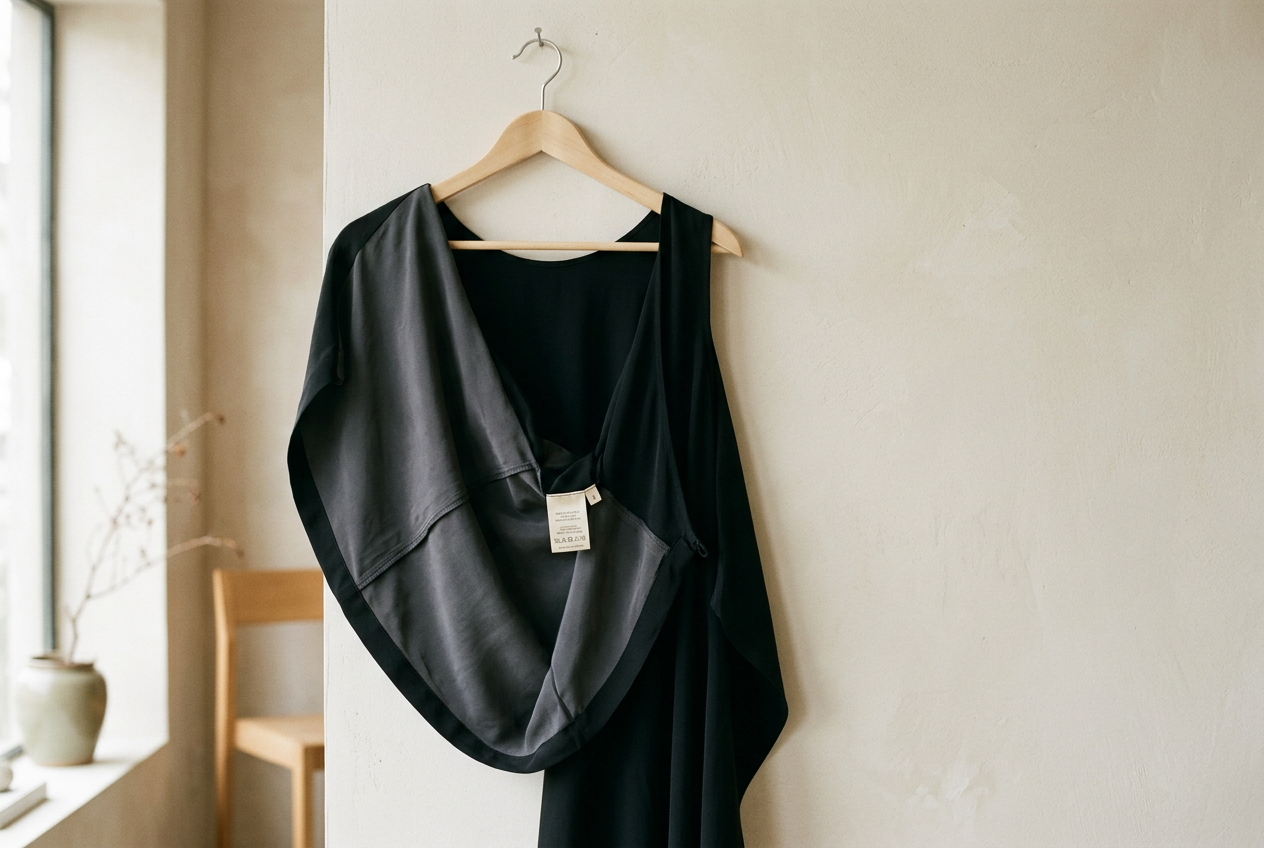
Use a black bias-cut midi dress as the test case: the shell is viscose, the lining is polyester, and the label says dry clean only. Bias cut, meaning the fabric is cut diagonally across its grain, gives the skirt its close, fluid drape. It also makes the dress prone to following every curve, catching between the legs, and showing more under direct light than the same fabric might on a hanger.
The full lining fixes most of that. It also creates the dress’s main summer problem.
A lining is a separate inner layer attached to the garment, and in this case it runs from the neckline almost to the outer hem. The dress looks smooth while standing, stays more opaque in sunlight, and slides over underwear rather than gripping it. Once the wearer walks to a train, sits through a commute, and steps back outside, however, two long layers of fabric hold more warm air than one.
That does not make lining bad. It means coverage, fiber, fit, and cleaning instructions need to be judged together, rather than treating “fully lined” as an automatic sign of quality.
Full lining earns its place when the dress is close to the body
A full lining usually gives the cleanest result on a pale dress, a loose weave, or a skirt that collapses against the legs as soon as the wearer moves. It covers interior seams, reduces show-through, and takes some friction that would otherwise land on the outer fabric. For someone who sits for much of the day, that slick inner surface can stop a skirt from twisting around the hips or developing a sharply creased seat.
Coverage alone does not explain comfort. The black midi dress has a fluid shell, but if its lining is cut too narrowly through the thigh, the inner layer becomes the real fit of the garment. The shell may appear to have room while the lining pulls during a long stride, climbs when the wearer sits, or presses against damp skin. A nonstretch lining under a stretch shell creates the same problem in a less visible form.
Check that fit by sitting for several minutes rather than making one quick bend in the fitting room. Cross and uncross the legs, take a long step, then see whether the lining returns to its original position. If it remains bunched above the knee, more wear will not give it the missing width.
In high heat, a full lining makes the most sense when opacity is nonnegotiable and the garment has enough ease to let air move between the layers. A loose sleeveless dress can tolerate more lining than a fitted dress with a high neckline and narrow armholes, even when both carry identical fiber labels.
Partial lining is often the useful middle
Partial lining, meaning an inner layer that covers only part of the garment, can stop at the waist, mid-thigh, or just above the knee. On the black midi dress, replacing the near-hem lining with a knee-length version would preserve coverage through the seat while leaving the lower skirt lighter and freer to move.
That is a sensible commuter configuration. The lined section protects the area in contact with a chair and limits cling where a crossbody bag or backpack presses the dress against the body, while the uncovered lower skirt releases heat around the calves. It also uses less material, though that saving does not guarantee a lower retail price.
The tradeoff can be visible. A tight lining hem may leave a horizontal ridge beneath a fine shell, and a lining that ends at the widest part of the thigh can catch as the wearer walks. Look for a loose hem with enough circumference to move independently. Under a translucent shell, check the boundary in daylight because fitting-room lighting often disguises it.
Bodice-only lining solves a different problem. It gives coverage at the chest and can support a neckline, but it does nothing for a sheer or clingy skirt. On a dress meant for work, that construction may still require a separate slip, which removes much of the expected heat advantage.
The fiber changes how the second layer feels
Cupro, a regenerated cellulose fiber commonly made from cotton-derived material, is smooth and often used where a lining needs to slide without the distinctly slick feel of standard polyester. It absorbs more moisture than polyester and can feel less clammy against warm skin. Fiber-maker documentation commonly positions cupro as a breathable lining option, but the finished weave and the amount of ease still matter. A tight cupro lining remains another close layer.
Cupro often appears in higher-priced tailoring and dresses. It can be a worthwhile upgrade for a full lining that will spend hours against the body, particularly in a garment worn for work or events, but it is not worth paying for blindly. Inspect the seams and read the care label. A delicate cupro lining paired with a dry-clean-only shell raises the running cost of a dress that may need cleaning frequently in summer.
Acetate is another cellulose-based fiber used for its smooth hand and drape. It can make a polished lining, although care may be less forgiving: heat, aggressive washing, or an unsuitable stain treatment can damage some acetate fabrics. Acetate and triacetate are not interchangeable labels, so follow the instructions on the specific garment rather than assuming all members of the fiber family behave alike.
Polyester absorbs little moisture and dries quickly. It is durable, widely available, and often keeps a garment’s initial price down, which makes it a defensible choice for an occasional dress or a washable design. Against sweaty skin, though, a dense polyester lining can feel sticky and may retain odor between cleanings. The polyester lining in the black midi dress is therefore not a minor label detail.
It is the layer touching the body for most of the day.
A lightweight, loosely cut polyester lining can outperform a dense cellulose lining that fits like a sheath. Construction can outweigh fiber prestige.
Self-fabric lining, meaning the outer material is used again inside, keeps color and movement consistent at necklines or through sheer panels. In a cotton voile dress, it may produce an airy double layer that can be washed with the shell. In the viscose midi, doubling the same drapey fabric could add weight, slow drying, and create friction rather than the easy slide expected from a dedicated lining.
No lining works when the dress can stand on its own
An unlined dress gives heat the easiest exit and usually dries faster after washing. It also exposes seam allowances, offers no barrier against transparency, and lets the shell interact directly with underwear and skin. Linen, substantial cotton poplin, textured seersucker, and some opaque jerseys can work well without lining because their structure already does much of the job.
The flexible alternative is a separate slip. It can be removed on the hottest part of the day, washed more often than the dress, and reused under several garments. Choose a slip that is shorter than the dress slit, roomy enough not to ride up, and compatible with the shell’s care needs. A washable slip beneath a dry-clean-only dress can reduce direct contact with sweat, though it does not make the outer dress immune to marks or odor.
For the black midi, an unlined shell plus a knee-length slip would be more adaptable than the attached full polyester lining. The dress could be worn without the slip for an evening over opaque underlayers, then paired with it for a bright office or a long period of sitting. The compromise is extra dressing time and one more garment to keep aligned.
Read the lining before paying for the dress
Start with the two fiber entries on the care label. Retail product pages sometimes describe only the shell in the main copy, while the composition section reveals a polyester lining or lists lining coverage separately. If the page does not say whether the dress is fully or partially lined, ask or inspect it in person.
Hold the skirt toward a strong light with a hand behind both layers. Then separate the lining and repeat the test with the shell alone. This shows whether the lining is performing necessary opacity work or merely finishing the interior. Pinch both layers at the side seam to judge their combined thickness, and check whether the lining has a vent that corresponds with any slit in the outer skirt.
Cleaning is part of the price calculation. A washable polyester-lined dress may be more practical for frequent commuting than a cupro-lined dress requiring specialist cleaning, even if the latter feels better for six hours at a time. Conversely, paying more for cupro can make sense when the dress will be worn regularly, the fit leaves room for air, and the rest of the construction supports repeated use.
Return to the black bias-cut midi. Its full polyester lining is useful if the priority is a smooth, opaque silhouette and the dress will be worn mainly indoors. For a hot walk, crowded transit, and repeated summer cleaning, a partial lining or separate washable slip is the more capable construction. “Fully lined” describes quantity, not comfort.
Questions people ask
Is a fully lined dress too hot for summer?
It can be, especially when both layers fit close to the body or the lining is a dense polyester. A loose full lining may still be comfortable in air-conditioned settings, and it can prevent cling during long periods of sitting. Judge the lining’s fit and weave alongside its fiber.
Is cupro always better than polyester for a dress lining?
No. Cupro often feels smoother and less clammy, but a narrow cupro lining can restrict movement, and its care requirements may not suit frequent wear. A lightweight polyester lining with enough ease can be the better budget choice when the whole dress is washable and dries quickly.
Can I remove a dress lining?
A tailor may be able to shorten or remove a lining, but the dress could become transparent, cling more, or expose unfinished seams. Shortening a full lining to the knee is often the more useful alteration. Put the dress on before pinning the new length so the lining does not end at a tight point on the thigh.
What should I wear under an unlined summer dress?
Use a separate slip when the shell is sheer or catches between the legs. Pick one that ends above any slit and does not grip the hips when seated. Under a substantial opaque fabric, smooth underwear may be enough, which preserves the airflow gained by skipping an attached lining.
One update a day
Today's fashion update, in your inbox
One fashion update each morning — no hype, no filler, just pieces worth wearing.