Waist and Inseam Aren’t Enough to Buy Trousers Online
A missing rise measurement does not make online trouser shopping impossible, but it does make it riskier. Read the garment’s visible geometry, compare it with trousers you own, and check the return terms first.
Women's · August 24, 2026 · 8 min read
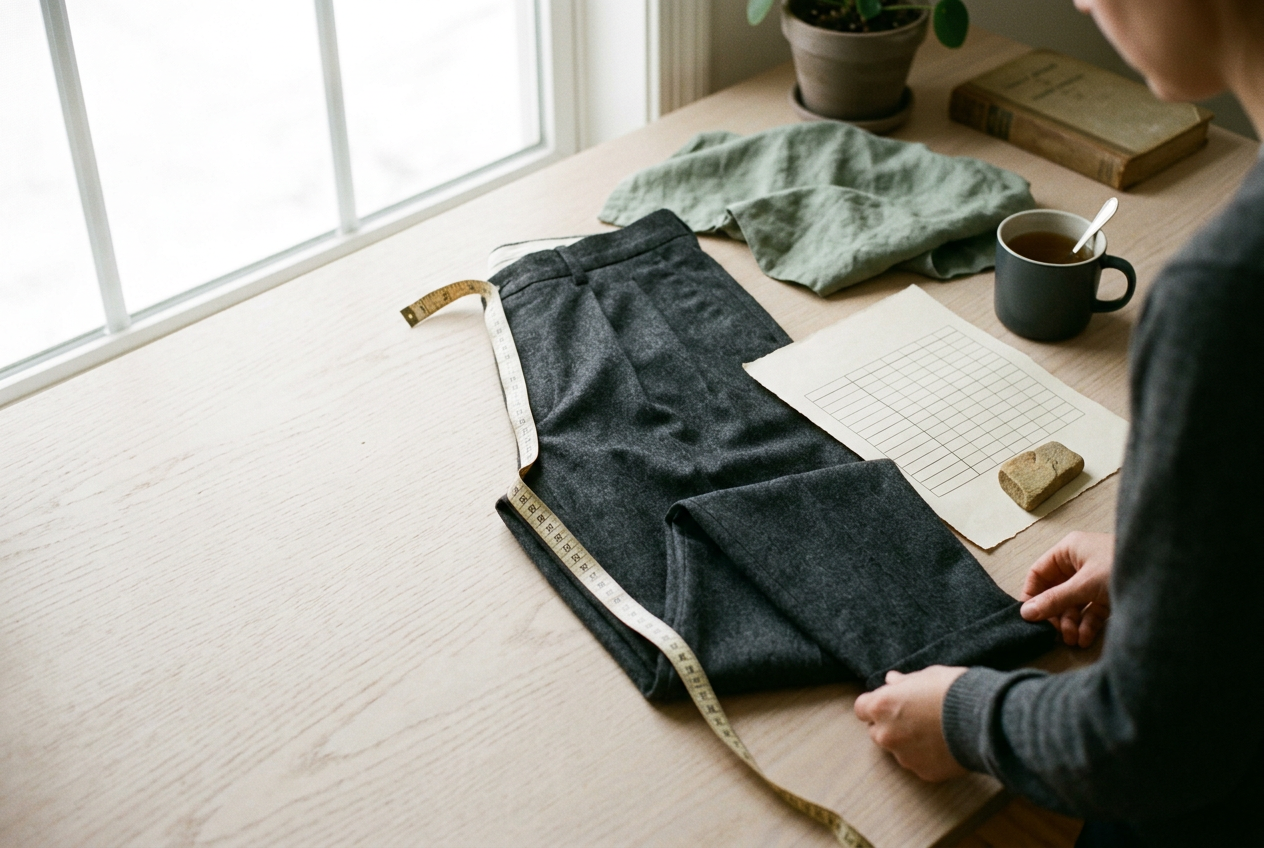
The working case here is a charcoal wool-blend trouser from a typical women’s online listing: a straight waistband, single front pleats, slanted pockets, a zip fly, and wide legs. The page gives garment waist and inseam measurements but leaves out both rises. On the model, the waistband appears to meet the navel, though a tucked knit and slightly angled pose make that less certain than it looks.
This is exactly the kind of listing that invites overconfidence. The stated waist may match your body, and the inseam may suit your preferred shoe, yet the trousers can still pull at the crotch, gape at the back, collapse below the waistband, or sit several inches away from the position shown online.
Front rise is the curved seam distance from the top of the front waistband to the point where the leg seams meet. It helps describe where the waistband sits in relation to the crotch, though it does not settle the fit by itself. Back rise measures the corresponding curved distance up the seat, where more length is usually needed to travel over the body.
Without those numbers, the task changes. You are not identifying an exact rise from a photograph. You are looking for several clues that support the same fit prediction, while recognizing that the back of the trousers may remain an unanswered and expensive question.
Start with the waistband
A contoured waistband, meaning one cut with a visible curve rather than as a straight strip, is shaped to narrow toward the natural waist. It often appears on trousers intended to sit higher and closer to the body, particularly when the difference between waist and hip is pronounced. Look for a curved upper edge in a flat-lay image, angled seams at the sides, or several waistband pieces joined together.
A straight waistband offers less evidence. It may belong to a mid-rise tailored trouser, a genuinely high-waisted style, or a lower-slung cut designed to rest closer to the upper hip. On the charcoal case pair, the straight waistband makes the model’s apparent navel height less persuasive because the garment could be sitting high only on that model’s proportions.
Check the back closure and elastic, too. A center-back notch can give the waistband a little flexibility when seated. Elastic panels may help the waist measurement accommodate movement, but they cannot add enough back-rise length to correct a crotch seam that pulls forward. A drawstring can hold loose trousers at several heights; that versatility also makes the styled position in photographs less predictive.
The useful question is whether the waistband’s construction supports the claimed rise description. A listing labeled high rise but showing a straight, minimally shaped waistband and no rear view deserves more caution than one with a curved band, waist darts, and a side seam that reaches the narrowest part of the torso.
Treat fly length as a clue, not a measurement
The visible fly can provide a rough sense of front-body length. A zip fly that extends well below the pocket opening usually needs more vertical room than a short fly tucked directly beneath the waistband, especially when both garments have similar proportions and are photographed flat.
Still, zipper length is not front rise. The fly may stop early for design reasons, extend into a dropped crotch, or be partly hidden by a placket. Compare it with stable features in the same image, such as the waistband depth and pocket opening, rather than estimating inches from a model whose photograph may have been cropped or resized.
On the charcoal trousers, the fly looks moderately long relative to the waistband, which supports a mid- to high-rise reading. The single pleats begin at the waistband and open toward the hip. That suggests some front volume, useful for a fuller abdomen or a tucked shirt, but pleats cannot compensate for a short seam between waistband and crotch. If they pull open while the model stands still, assume the front is already under tension.
A concealed side zip removes this clue altogether. In that case, waistband shape, darts, side-seam length, and the garment’s position on the model must do more of the work.
Read model photos for strain and position
First locate the top edge of the waistband against the body, not against the shirt. A tucked top may blouse over it, while a belt can pull trousers above the position where they naturally settle. The navel is a useful visual reference only when it is visible and the model is standing close to square.
Then look below the waistband. Horizontal folds across the front can indicate that the trousers are being pulled higher than their cut allows. Diagonal lines running from the crotch toward the hip often point to insufficient length or width in that area. Slanted pockets that gape may reflect a tight hip, a short front rise, or both, so they should be read alongside the pleats and side seam rather than treated as a verdict.
The rear view matters more than retailers often allow. A back waistband dipping downward, horizontal creases beneath it, or fabric drawing into the seat can signal inadequate back rise. The crotch extension, the part of the pattern that projects inward to create room through the seat, also affects comfort and cannot be judged reliably from a front photograph.
Model height and listed size help only at the edges. They do not tell you torso length, hip shape, or where that person prefers to wear trousers. For this women’s fit walkthrough, a model with a straighter waist-to-hip line may make the charcoal pair look relaxed, while the same waistband and seat become restrictive on a curvier body even when the numerical waist matches.
Use garment geometry when the listing gives more numbers
If a page includes the outseam, meaning the length from the top of the waistband down the outer leg, compare it with the inseam. The difference offers a coarse indication of how much garment length sits above the leg, but it is not a substitute for rise because the two measurements follow different paths and may use different endpoints.
This comparison works best within one brand, in the same size, across trousers with similar leg shapes. If a pair you already know fits well has a longer outseam but the same inseam as the charcoal trousers, the missing length is a warning that the new pair may sit lower or offer less vertical room through the body. A deeper waistband can account for part of the difference, which is why product images still matter.
Hip measurements add another layer. Compare the garment waist and hip, not just the size label. A large difference, supported by darts or pleats, points to more shaping between waistband and seat. A smaller difference may suit a straighter figure or a lower wearing position.
Fabric matters here: wool blended with polyester or viscose may resist or recover differently depending on its weave, but without a stated stretch percentage, do not budget for the cloth to rescue a close hip measurement.
The most useful alternative is already in your closet. Lay flat a pair that sits where you want, close its fastening, and measure the front rise along the curved seam from waistband top to crotch junction. Turn it over and measure the back the same way. Record waistband depth and note whether the pair has pleats, stretch, or a shaped band.
Your comparison pair should resemble the new garment; jeans are a poor template for fluid tailored trousers.
Make the return policy part of the fit calculation
The charcoal trousers remain a medium-confidence purchase. Their waistband, fly, and model position point toward a higher fit, but the absent rear view and missing back rise leave seat comfort unresolved. That is acceptable with free returns to the original payment method. It is a poor bet when the item is final sale, return postage is costly, or the retailer issues store credit only.
Before ordering, save the listing images and size chart because pages can change. Confirm whether the chart shows body dimensions or finished garment measurements, since a listed 30-inch waist may describe either your body or the trousers themselves. Read the return window, shipping deductions, restocking terms, and rules for discounted merchandise. Keep enough time to try the trousers while sitting, walking, and tucking in the kind of top you plan to wear.
Do not size up automatically to gain rise. Grading, the way a pattern changes between sizes, usually adds some length and width, but the amount is brand-specific; a larger size may improve the crotch while leaving the waistband and hips too loose. Ordering two sizes can clarify the issue when returns are free, although it ties up more money and creates another parcel to handle.
Alterations have limits. A tailor can often take in a waistband, adjust some back gaping, or shorten the hem. Adding meaningful rise is rarely straightforward because the necessary fabric must already exist in the seam allowances and crotch shape. If the trousers pull into the body or drag downward at the back while seated, return them rather than paying to rebuild a pattern that was wrong for you.
For the charcoal pair, the buy decision rests less on the stated waist than on whether the retailer lets the unknown back geometry be tested without a penalty. If the return is restricted, wait for customer service to provide front and back rise measurements, or choose a listing that publishes them.
Questions people ask
Can
I calculate trouser rise from the outseam and inseam?
Subtracting inseam from outseam gives a rough indication of the garment length above the leg, but it does not produce an exact rise measurement. The seams follow different routes, and waistband depth or a dropped crotch can distort the result. Use the difference to compare similar trousers from the same brand, not as a universal formula.
Does a long zipper mean trousers are high rise?
A long fly supports that reading, particularly when it extends well below the pocket opening and the waistband also looks shaped for the natural waist. It remains a clue rather than proof. Designers can use a long zipper on a lower or dropped-crotch style, while some high-rise trousers close at the side and show no front fly.
Should I size up when the back rise is missing?
Not by default. A larger size may add a little rise, but it also changes the waistband, hip, thigh, and pocket position, sometimes leaving the trousers loose without fixing seat strain. Choose the size supported by finished garment measurements, then order an adjacent size only if the return policy makes comparison practical.
What should I test before removing the tags?
Fasten the trousers at the height where they naturally settle, then sit in a firm chair, walk, raise one knee, and tuck in your intended top. Check for a dipping back waistband, opening pleats, gaping pockets, or fabric pulling into the crotch. Perform the test indoors on a clean floor while every return label remains attached.
One update a day
Today's fashion update, in your inbox
One fashion update each morning — no hype, no filler, just pieces worth wearing.