A Body Size Chart Cannot Tell You How Those Trousers Fit
A waist number may describe the shopper, not the waistband. Here is how to compare both sets of measurements with trousers you already wear and know when to walk away.
August 14, 2026 · 7 min read
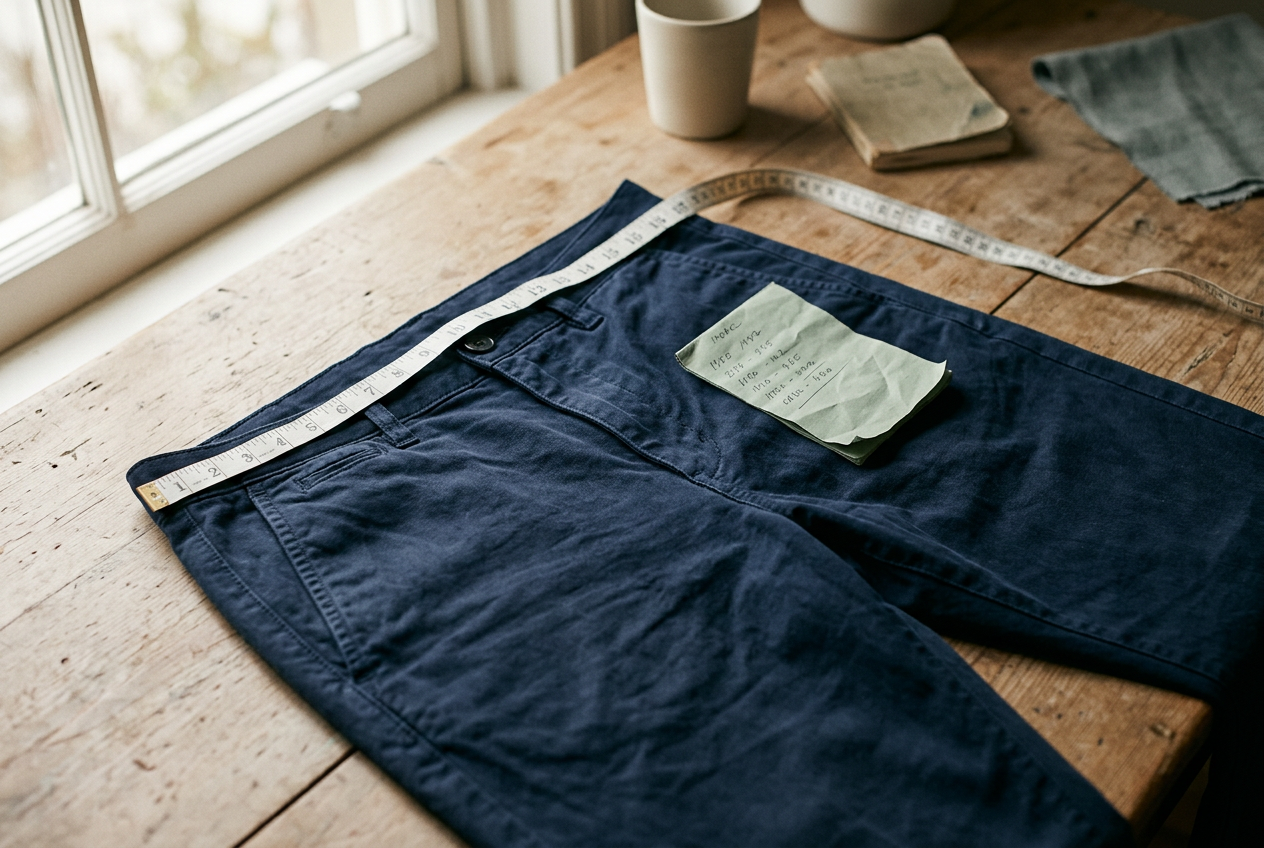
Consider a pair of navy straight-leg trousers in 100% cotton twill, a weave with visible diagonal ribs. They are meant to sit at the natural waist, with enough room for a tucked shirt, and the product page gives a waist measurement for each size but no rise, thigh width, or finished waistband.
That waist column looks useful. It may not describe the trousers at all.
This is the recurring test case here because rigid cotton trousers expose weak size charts quickly. A knit top can stretch over a small mismatch, while a fixed waistband, fitted hip, and set rise leave less room for interpretation. This advice is for unisex wardrobes, though each shopper should compare garments designed for the same intended rise and silhouette.
First identify what the chart measures
A body measurement records the person. A garment measurement records the finished clothing laid flat or measured around its full circumference. Retailers sometimes label the distinction clearly, but headings such as “size guide,” “waist,” and “fits up to” can leave the reader guessing.
Look at the chart beside the product description. If it includes bust, waist, and hip measurements that repeat across dresses, jackets, and trousers, it is probably a body chart. Wording such as “choose the size closest to your measurements” points the same way. Those numbers describe the body the brand intends to fit, not necessarily the dimensions of every finished piece.
A garment chart usually names the product and gives construction-specific information such as waistband, front rise, inseam, or hem opening. It may say that measurements were taken with the garment laid flat. Some brands publish both, which is the useful version: the body chart suggests a starting size, while the product measurements reveal how that design differs from the body.
Return to the navy trousers. If the chart says a size corresponds to a certain body waist, you still do not know whether the actual waistband is close-fitting or cut with extra room. You also cannot tell where that waistband will land. A lower rise meets a wider part of many bodies, so the same circumference can feel tighter even before fabric behavior enters the calculation.
Measure your body, then stop treating it as the answer
Measure the place where the trousers are intended to sit, keeping the tape level and comfortably close rather than pulling it tight. For the natural waist, that is usually the narrower area above the hip bones; for lower-rise trousers, measure at the lower position shown or described by the retailer.
Record the fullest hip measurement as well. Bodies with the same waist can need different trouser shapes because the distance between waist and hip varies, and a waistband that closes is not proof that the seat or upper thigh will fit. Take the measurements over the underwear or thin base layer you would wear with the garment.
These numbers help place you in the chart. They do not predict the finished silhouette, and they are especially weak evidence when the listing uses words such as relaxed, tailored, or oversized without publishing garment dimensions. Fit adjectives describe an intention. Measurements show how the pattern carries it out.
Copy the pair that already works
The most reliable comparison is a similar garment you own. For the navy trousers, choose nonstretch or low-stretch trousers that sit at the same height, rather than comparing them with leggings, jeans worn on the hips, or soft drawstring pants.
Fasten the trousers and lay them on a firm, flat surface without pulling. Measure straight across the inside of the waistband, then double that number for its circumference. Measure the front rise, meaning the distance from the crotch seam to the top of the front waistband, and the inseam, meaning the inner-leg length from crotch seam to hem.
The thigh matters when trousers are fitted through the upper leg. Measure across one leg just below the crotch, following the same point a retailer specifies if it supplies instructions. A hem opening can also settle a silhouette dispute: two products called straight-leg may finish very differently if one narrows toward the ankle.
Write down how the reference pair behaves, not just its dimensions. The useful trousers may fit closely at the waist yet allow a finger inside the band, skim the seat, and crease only slightly when you sit. That description becomes your standard. A larger number is not automatically better if it shifts the trousers lower or changes the intended line.
Your existing pair has also been worn and washed, which can be an advantage and a warning. It represents the fit you live with, but its cotton may have softened, stretched at pressure points, or contracted in laundering. If possible, note whether it fits differently straight from the wash than it does after a day.
Account for ease and fabric before choosing a size
Ease is the difference between the body measurement and the garment measurement. Some ease allows movement; additional design ease creates a loose silhouette. The right amount depends on where the garment sits, how the fabric moves, and how the pattern distributes room across the seat and thighs.
For the test trousers, 100% cotton twill has no fiber-level stretch unless the cloth or construction gives mechanically. It may relax during wear, particularly at the knees and seat, but that does not make a too-small fixed waistband a sound purchase. Cotton can also draw up after washing, depending on how the fabric was finished and how the garment is laundered.
A similar trouser containing elastane may tolerate a closer hip or thigh measurement, though stretch does not fix a rise that is too short or a waistband positioned at the wrong part of the torso. Knits and elastic waists offer more latitude. Tailored waistbands, lined garments, dense denim, and rigid woven fabrics need better documentation because small discrepancies carry more discomfort.
Check whether the retailer says measurements are approximate and whether it explains how they were taken. Manufacturing tolerances mean two garments marked the same size may not be identical, but that is not a reason to accept a chart that omits the basic finished dimensions of a structured piece.
Use a firm decision process
Start with the body chart and select the likely size range. Then compare the garment chart with your reference trousers, paying attention to the waistband, rise, hip or thigh, and leg length that control the fit you care about. If those dimensions and the fabric behavior align, the purchase has a reasonable basis.
If the listing supplies only body measurements, consider how forgiving the item is and how costly a mistake would be. A softly cut, elastic-waist garment with straightforward free returns asks less evidence from the chart. The navy cotton trousers do not. Their fixed waist and fitted upper block make the missing measurements consequential.
Contact customer service before buying when the garment is structured, returns carry a fee, international shipping is involved, your likely size sits between chart entries, or the piece costs enough that you would hesitate to keep an imperfect fit. Ask for facts tied to one size, not a general recommendation.
Please provide the finished waistband circumference, front rise, thigh width, and inseam for this trouser in the size I am considering. Please also confirm whether the garment was measured laid flat and whether the waistband measurement includes any stretch.
Add the product name or code and your intended size. If only one dimension decides the purchase, say so. A shopper who knows the reference trousers need a particular rise should not spend another exchange cycle collecting advice about height or usual size.
A useful reply gives garment dimensions and explains the measuring method. A response that repeats the body chart, recommends a size from height and weight alone, or says the item is true to size has not resolved the problem. “True to size” only means something within a shared standard, and online brands do not share one reliable standard across cuts.
At that point, skip the navy trousers unless the return policy makes experimentation genuinely low-cost and you are willing to spend the time. For a budget item, return postage, repacking, and another order can erase the practical saving. For an investment purchase, weak documentation is a stronger reason to wait because alterations cannot cheaply correct every problem; shortening a hem is routine, while changing the rise or rebuilding a waistband may disturb the whole cut.
Save the measurements of garments that work in a note on your phone, including fabric and rise. The next chart becomes faster to assess, and a seller’s missing information becomes visible before the checkout page rather than in front of a mirror with the tags still attached.
Questions people ask
Is a size chart showing waist and hips always a body chart?
No. Those labels can describe either a body or a finished garment, so check the surrounding instructions. A chart that says to measure yourself usually lists body dimensions; one that mentions laying the item flat, doubling the waistband, or measuring a specific product is giving garment dimensions.
How much larger should trousers be than my body measurement?
There is no universal allowance because rise, fabric, waistband construction, and intended silhouette change the amount of ease needed. Compare the finished measurement with trousers that already fit at the same position, then check whether the new fabric is more rigid, stretchier, heavier, or likely to change after washing.
Can customer service choose my size from height and weight?
It can offer a general suggestion, but height and weight do not show waist-to-hip proportion, thigh room, torso length, or preferred fit. Ask for finished garment measurements instead, then compare them with your body and a similar item you own.
When should I skip an online clothing purchase?
Skip it when a structured garment lacks finished measurements, customer service only repeats the body chart, and returning it would cost meaningful time or money. For the navy cotton trousers, an unexplained waist number is not enough because the fixed waistband, rise, and upper-leg cut control whether the pair can be worn comfortably.
One update a day
Today's fashion update, in your inbox
One fashion update each morning — no hype, no filler, just pieces worth wearing.