A Size Chart Without These Measurements Is a Return Risk
Cross-check your body against the finished garment, then account for stretch and intended ease. One missing measurement can make an otherwise detailed chart useless.
August 10, 2026 · 8 min read
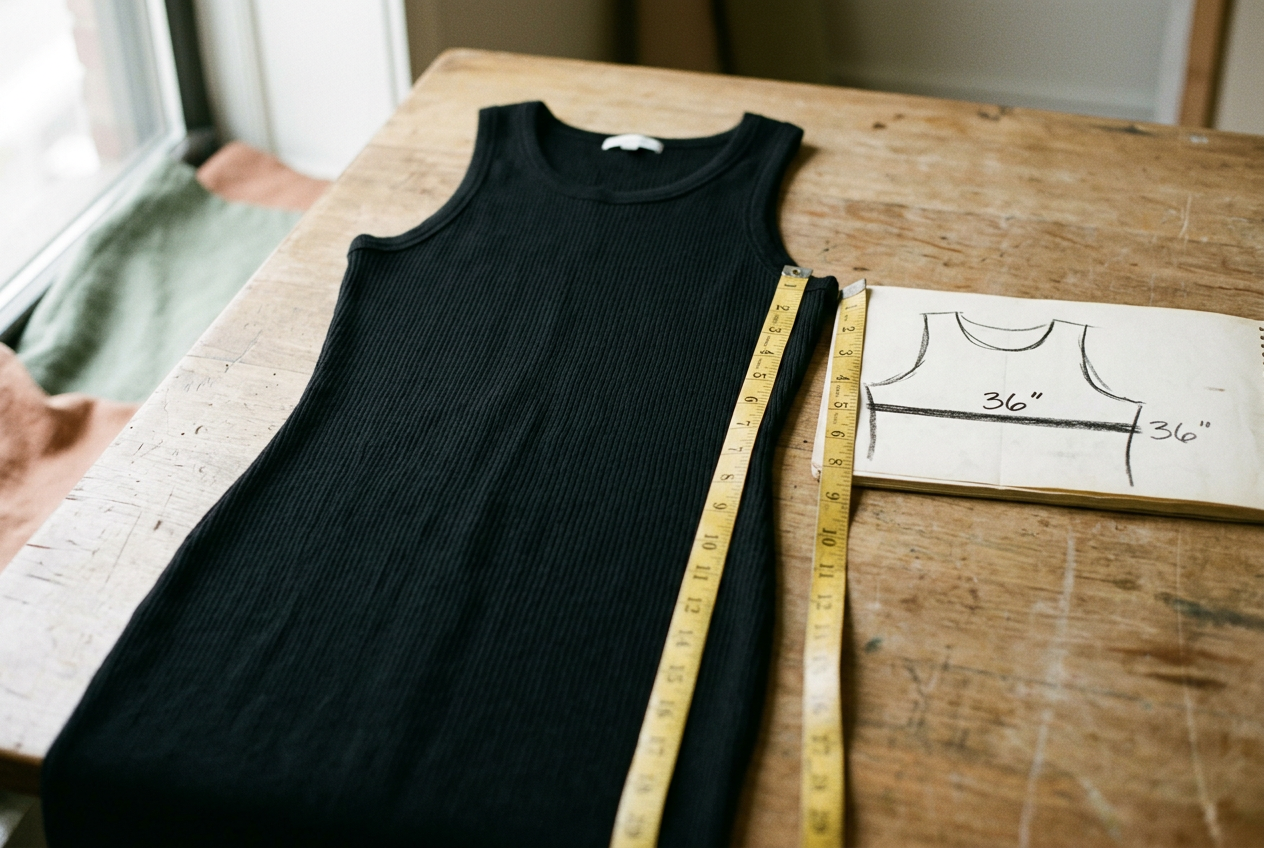
Consider a black rib-knit midi dress described as close-fitting. Its chart gives one line for a medium: “chest 36 inches.” That number looks useful, but it does not say whether 36 inches describes the shopper’s body or the dress itself, and it says nothing about the waist, hip, upper arm, or finished length.
That ambiguity is enough to pause an order. A 36-inch body recommendation and a 36-inch finished bust are different instructions, particularly in a stretch knit designed to sit close to the body.
This cross-check applies across women’s, men’s, and unisex wardrobes. The dimensions change with the garment, but the method stays the same: identify what the chart measures, calculate the room at each relevant point, then decide whether the fabric and cut can support that amount of room.
Start by labeling every number
A body measurement describes the person the size is intended to fit. A finished-garment measurement describes the clothing after it has been cut and sewn, usually measured with the item laid flat or positioned without stretching.
Look for a heading, chart note, measuring diagram, or size-guide tab that identifies which kind you are reading. “Fits bust” usually points to a body measurement. “Garment chest,” “actual waist,” and “measured flat” usually point to the clothing, although the page’s own instructions should settle the matter.
The word “chest” alone does not.
Flat measurements need one more check. If a brand lists 18 inches across the chest from underarm to underarm, that is a half measurement, so doubling it gives a finished circumference of 36 inches. Do not double sleeve length, shoulder width, rise, inseam, or total length; those are linear measurements rather than half circumferences.
Return to the rib-knit dress. If its 36-inch chest is a body measurement, a shopper with a 36-inch bust is being directed toward medium. If it is a finished-garment measurement, that same shopper gets zero ease before stretch enters the calculation. The size label has not changed, but the fit proposition has.
Calculate the room instead of guessing the size
Ease means the extra room built into a garment beyond the wearer’s body measurement. Subtract the body circumference from the finished-garment circumference:
`finished garment measurement - body measurement = ease`
Suppose the dress measures 36 inches around the finished bust and the shopper’s bust is 38 inches. The result is minus 2 inches. Negative ease, meaning the garment is smaller than the body and relies on stretch for a close fit, can be intentional in rib knits, swimwear, leggings, and fitted jersey pieces.
The same result would be a warning in a nonstretch cotton-poplin dress. A woven fabric cannot create missing circumference without pulling at seams, gaping at closures, or restricting movement, so a bust measurement smaller than the body usually points toward the next size or a different cut.
Positive ease does not automatically mean loose. A tailored shirt needs enough room for breathing and arm movement even when the intended look is neat, while an oversized shirt needs considerably more because volume is part of the design. Product wording and photographs help identify that intent, but garment measurements show whether the cut can deliver it on your body.
Do the calculation at every point that controls fit. For the black midi dress, the bust result might be workable because the rib stretches, yet the order remains risky if the chart omits the hip. A dress can stretch comfortably over the chest and still ride upward from the hip, changing both its length and the way the waist sits.
Stretch changes the answer, not the need for measurements
A fiber label can suggest stretch, but it cannot quantify the finished fabric’s behavior. Elastane usually signals mechanical give, while knit construction can stretch even without it, yet yarn, stitch density, lining, seams, and finishing all affect how far the garment moves and whether it returns to shape.
Recovery is the fabric’s ability to return to its original dimensions after stretching. It matters because a soft rib knit may accommodate negative ease for an hour but loosen at the knees, elbows, waist, or seat after wear. A product page that says “high stretch” or provides a stretch scale gives more useful context than a fiber percentage alone, although neither replaces the missing hip or upper-arm measurement.
Treat stretch descriptions as permission to consider negative ease, not as permission to ignore the arithmetic. For the illustrative 38-inch bust in a 36-inch dress, the fabric must expand by roughly two inches around that point. Whether that feels secure or compressed depends on the knit and the intended silhouette, but at least the required work is visible.
Lining deserves its own glance. A stretchy outer fabric over a rigid woven lining fits according to the lining, and a stretch-waist trouser may still be limited by a nonstretch hip and thigh. Closures matter too: a side zip can make a fitted dress easier to put on, but it does not add wearing room once closed.
Match the chart to the garment’s failure point
A long chart can still omit the number most likely to cause a return. Before ordering, identify where this particular garment must clear the body and where its construction offers little forgiveness.
For a fitted dress, compare bust, waist, hip, and finished length; add upper-arm circumference if it has close sleeves. Pants need waist and hip information plus rise, inseam, and enough thigh detail for the cut. A button-up shirt becomes hard to judge without finished chest, shoulder, upper-arm, and length measurements. Jackets also need room over whatever will be worn underneath, so body-only guidance is especially weak when the product description suggests layering.
The useful dimensions change with proportion. Someone who usually fits charts at the bust but needs more room at the hip should not accept a fitted-dress chart that stops at the waist. A person with broad shoulders should be skeptical of a structured woven jacket chart that gives only chest circumference. The omission does not prove the garment will fail; it means the available evidence cannot answer the fit question.
Our black rib-knit dress therefore has a clear information gap. The 36-inch chest may be plausible once identified as a finished measurement, but without a finished hip measurement, a stretch description, and a length measured from a named starting point, the shopper cannot tell whether the dress will skim, cling, or pull upward.
Use one garment you already own as the control
Body measurements are essential, but a well-fitting garment gives better evidence about personal ease preferences. Choose something with a similar fabric and silhouette, fasten it as worn, lay it without stretching, and follow the retailer’s measuring diagram where possible.
For the midi dress, use another close-fitting knit dress rather than a loose woven one. Measure straight across the bust, waist, and hip, then double those flat widths; record total length from the same point used by the product page. High point shoulder, meaning the spot where the shoulder meets the neck, is a common starting point for dress and top length.
This comparison reveals the room you already tolerate. If the owned dress has a 40-inch finished hip and stays in place, a candidate with a 36-inch hip would be asking much more from its stretch. If the retailer withholds the candidate’s hip measurement, there is no honest cross-check to make.
Do not compare garments with unlike construction. A bias-cut skirt, which is cut diagonally across the fabric grain, can narrow and lengthen as it settles on the body. A rigid denim waistband behaves differently from a pull-on rib-knit waist, even when both read the same on a tape. Similarity is what makes the control useful.
Set a stopping rule before checkout
A workable online sizing decision needs four things: a clearly labeled chart, the relevant finished-garment dimensions, enough fabric information to judge stretch, and a stated or visually legible fit intention. Body ranges help choose a starting size, but they do not show how much room the pattern contains.
If one critical garment dimension is absent, check the measuring guide, product details, customer-service information, and any size-specific selector before giving up. This takes a few minutes. Searching reviews for body measurements is less reliable because people measure differently, fit preferences vary, and a review cannot convert an unlabeled chart into a finished-garment chart.
Stop when the missing number controls the fit and the return would cost money, travel, or time. The alternative is not endless research. Choose a retailer that publishes finished measurements, buy a more forgiving cut, or wait until the garment can be tried on.
For the black midi dress, that stopping rule is the hip. A clear bust figure cannot compensate for an omitted hip on a close-fitting silhouette, and the promise of stretch cannot show how much the dress must stretch there.
Questions people ask
How can
I tell whether a size chart uses body or garment measurements?
Read the heading, notes, and measuring diagram rather than relying on labels such as “chest” or “waist.” Body charts often say “fits” or tell you to measure yourself. Garment charts usually say “actual,” “finished,” or “measured flat.” If the page never identifies the type, ask the retailer or treat the number as unusable.
How much ease should a garment have?
There is no single correct amount. A rigid woven garment needs positive ease for movement, while a fitted stretch knit may use negative ease to stay close. Compare the intended silhouette and fabric with a similar garment you own; do not transfer the preferred ease of an oversized shirt to a tailored jacket or rib-knit dress.
Does elastane mean I can size down?
No. Elastane suggests that the fabric may stretch, but the percentage alone does not show stretch direction, firmness, recovery, lining behavior, or seam restriction. Size down only when the finished measurements, fit description, and construction support the amount of negative ease your body would create.
Which missing measurement is a reason to skip an order?
Skip when the omitted dimension controls the fit and the garment offers little room for error. Examples include hip on a fitted dress, shoulder on a structured jacket, thigh on rigid pants, or upper arm on a narrow woven sleeve. A generous return policy can lower the financial risk, but it does not make the chart informative.
One update a day
Today's fashion update, in your inbox
One fashion update each morning — no hype, no filler, just pieces worth wearing.