A Size Chart Means Little Until You Know What It Measures
A waist number may describe your body or the garment laid flat. Use one well-fitting piece from your closet to decode the chart before trusting the size letter.
August 10, 2026 · 8 min read
A line reading “waist: 31 inches” looks precise. It may mean a 31-inch body, a waistband with a 31-inch circumference, or a garment measuring 31 inches at a point the brand considers the waist. Those are different pieces of information, especially in trousers that sit above or below your natural waist.
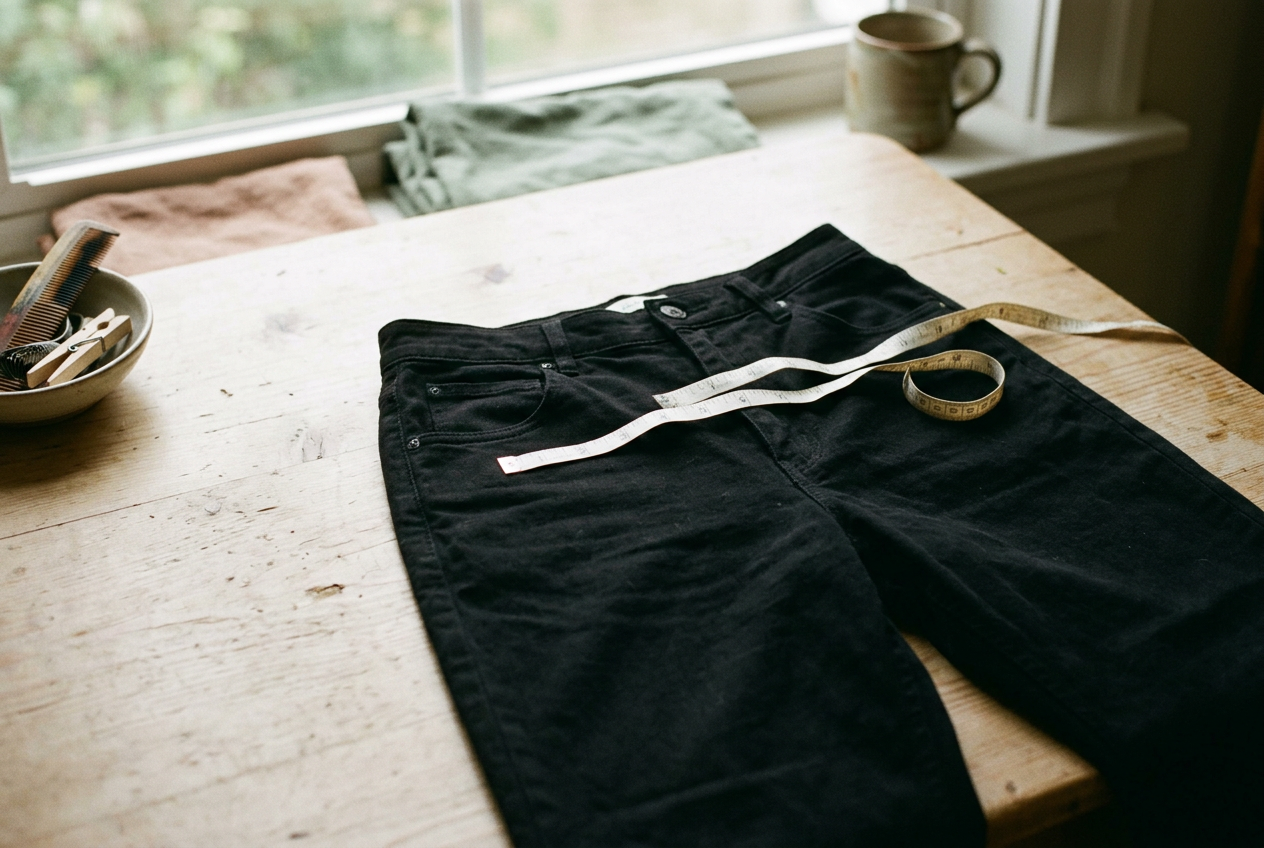
This is unisex advice: the method works across wardrobes, although women’s clothing tends to show more variation between the natural waist, high waist and low waist. The concrete case throughout is a pair of black high-rise cotton-twill trousers with a straight leg, worn comfortably with a tucked shirt. They are useful because woven cotton twill has little give, so its measurements expose fit differences that stretch leggings or an oversized knit can hide.
The trousers also give us a better starting point than the letter on their label. A familiar pair can tell you where a waistband sits, how much room you tolerate through the hip and whether the rise works on your body. The letter cannot.
Read the heading before the numbers
First look for language above or beside the chart. “Body measurements,” “body size” and “to fit” usually mean the numbers refer to the shopper. If the chart says a size is intended for a 31-inch waist, the finished waistband should be larger, smaller or stretchier according to the design.
“Garment measurements,” “finished measurements” and “product measurements” usually refer to the clothing itself. These figures are more useful for comparing the listing with the black trousers, but only if the brand also explains where and how it measured. A waistband circumference and a waist taken lower on the garment are not interchangeable.
Some charts offer no heading. The product page may show a model’s body measurements near a separate table of garment dimensions, which makes it easy to read one as the other. Keep the two panels mentally separate. A statement that someone with a certain waist wears a medium describes the wearer; a line saying the medium has a certain waistband describes the item.
Size letters deserve the least weight. Brands set their own small, medium and large ranges, and numbered sizes can shift too. Treat the label as an index that points to a row, not as evidence that the garment will match another item carrying the same label.
Make a record of the trousers that already fit
Lay the black trousers on a firm surface, fasten the closure and smooth the fabric without pulling it. A flat measurement means the distance across a garment while it lies flat. Measure straight across the top of the waistband, then double that number if you need the full circumference.
Do not stop there. Record the front rise, meaning the distance from the crotch seam to the top of the front waistband, because that tells you where the waist measurement will land. For the hip, measure straight across at the fullest part of the seat rather than choosing an arbitrary distance below the waistband. That fullest point may be easier to identify from the side seam and pocket shape when the trousers are flat.
Measure the upper thigh just below the crotch seam if trousers commonly bind there, and take the inseam from the crotch seam to the hem. The goal is not to create a complete technical specification. It is to capture the places that determine whether this particular straight-leg pair feels right.
Use the same method each time. A soft tape can curve or tilt, and even a modest diagonal changes the result. Measuring twice costs less time than ordering two sizes solely because the chart looked vague.
Keep these figures in your phone with a note that the trousers are high-rise, woven cotton twill and comfortable rather than close-fitting. Fabric and preference matter. The same dimensions in rigid denim may feel firmer, while a knit trouser with elastic recovery may fit at a smaller garment measurement.
Work out whether the chart includes ease
Ease is the room between the body and the garment. A woven trouser normally needs some positive ease through the hip and thigh so the wearer can sit and walk, while a stretch garment may use negative ease, meaning the garment is smaller than the body and expands when worn.
This is where the distinction between body and garment charts becomes practical. If your body waist is 31 inches and a body chart assigns that measurement to a medium, the medium’s finished waistband is not necessarily 31 inches. It may be larger for comfort, shaped with elastic, or smaller at rest because the waistband stretches.
If the chart lists finished garment measurements, compare them directly with the black trousers rather than with your body. Suppose the reference waistband measures 15.5 inches across when flat. Its full circumference is about 31 inches.
A listed “waist: 31” could therefore match closely if the figure describes the finished waistband, but it would mean something else if 31 inches is the body size the brand intends to fit.
The hip usually needs more attention than the waistband on rigid trousers. A drawcord or elastic panel can forgive a waist difference, but cotton twill that is too narrow across the seat will pull at the pockets and restrict sitting. Compare the product’s hip measurement with the reference trousers at the same vertical point, then favor the size that preserves the room you already know you like.
Do not add a universal allowance for ease. A loose pleated trouser and a fitted cigarette trouser should not share the same gap between body and garment, even when both are made from woven fabric. The silhouette sets the room.
Waist placement changes the meaning of waist
The natural waist is the narrower area between the ribs and hips, but a trouser waistband may sit above or below it. A body chart can list the natural waist even when the product sits several inches lower, where the body circumference is often larger. That chart may still guide the brand’s size selection, yet it cannot be compared directly with the finished waistband.
Return to the black trousers. Their front rise tells you that they are high-rise, and their flat waistband measurement belongs at that height on the body. If the product under consideration has a shorter rise, matching its waistband number to the black pair may produce a smaller-feeling fit because the new waistband lands lower on a wider part of the torso.
Product copy helps, but words such as high-rise and mid-rise are relative. The rise measurement is more informative when available. Compare front rise with front rise, then look at the back rise if the brand publishes it; a generous back rise can create more seated comfort even when the front appears unchanged.
Waist placement also explains why taking a tape around your narrowest point can fail for low-rise jeans or skirts. Measure your body where the item is designed to sit, keeping the tape level and comfortably close. That result supplements the brand’s body chart rather than replacing it.
Translate flat listings before comparing them
Retailers sometimes publish only a “flat waist” or “waist width.” That is usually a half measurement across the front of a fastened garment, so double it before comparing it with a circumference. Check the units first. A figure that looks implausibly small may be centimeters, or it may be the undoubled width.
Elastic waists need two figures to be useful: the relaxed width and the comfortably stretched width. A single relaxed number can make an accommodating waistband look too small, while a maximum stretch number says little about all-day pressure. If only one is supplied, compare the construction with your reference garment. A fully elastic knit waistband behaves differently from the fixed cotton waistband on the black trousers.
For tops and jackets, the same method applies at the chest. A flat chest measurement is commonly taken from underarm to underarm and doubled, although the exact point can vary. Compare it with a similar garment, not with bare-body circumference, because shoulder shape, armhole depth and intended layering affect how that width wears.
The useful comparison is always like with like: finished garment against finished garment, body against body, and measurements taken at equivalent positions. Converting the numbers cannot correct a mismatch in where they were taken.
Use the reference pair to choose, not to duplicate
Matching every dimension of the black trousers is unnecessary. Their waistband and hip measurements establish a known fit, while the new cut may be wider through the leg or cropped at the ankle. Decide which differences belong to the design and which would undermine comfort.
For rigid straight-leg trousers, prioritize the hip and rise, then check the waistband. If the hip matches your reference pair but the waistband is modestly larger, tailoring the waist may be possible, though it adds cost and can disturb back-pocket placement. If the waistband matches but the hip is much smaller, sizing up is usually the cleaner option because letting out a garment depends on seam allowance that online photos rarely reveal.
Stretch content changes the call. A small amount of elastane can improve mobility, but the fiber percentage alone does not tell you how far the fabric stretches or how strongly it recovers. Compare a stretch trouser with another stretch trouser when possible. The rigid black cotton-twill pair remains a useful boundary for minimum room, not a perfect twin.
When a chart stays ambiguous, ask customer service to confirm whether each figure is a body measurement, a full garment circumference or a flat width, and request the exact measuring point. Save the reply with the order details. If the retailer cannot clarify and charges for returns, the size letter is not worth betting the return cost on.
Questions people ask
Should
I measure my body or my clothes for online shopping?
Do both, but use each measurement for a different chart. Compare body figures with a body-size chart and a well-fitting garment with finished product measurements. Your clothes are often more useful for judging silhouette and ease because they record how much room you already prefer.
Do
I double every flat measurement on a size chart?
Double a straight-across waist, hip or chest width when you need an approximate circumference. Do not double lengths such as rise, inseam, sleeve or shoulder measurements. Confirm the retailer’s method whenever possible, since some charts use “flat” loosely while already publishing the full circumference.
Why does the listed waist match my trousers but the rise feels wrong?
The waistbands may sit at different heights. A shorter rise places the waistband lower on the torso, where the body can be wider, while a higher rise may reach a narrower point. Compare the front rise with your reference trousers before treating equal waist numbers as equal fits.
What should
I do when a brand gives only size letters?
Check the product copy, fabric content, fit description and model information for clues, then ask for finished garment measurements. If none are available, use the retailer’s return terms to decide whether the uncertainty is acceptable. For rigid trousers, guessing from a medium or large alone carries more risk than it does for a loose knit.
One update a day
Today's fashion update, in your inbox
One fashion update each morning — no hype, no filler, just pieces worth wearing.