One Rise Number Cannot Tell You How Trousers Will Fit
Front rise is only part of trouser fit. Back rise, seat room, and waistband curve explain why the same listed rise can fit a fuller seat or straighter torso very differently.
Women's · August 23, 2026 · 7 min read
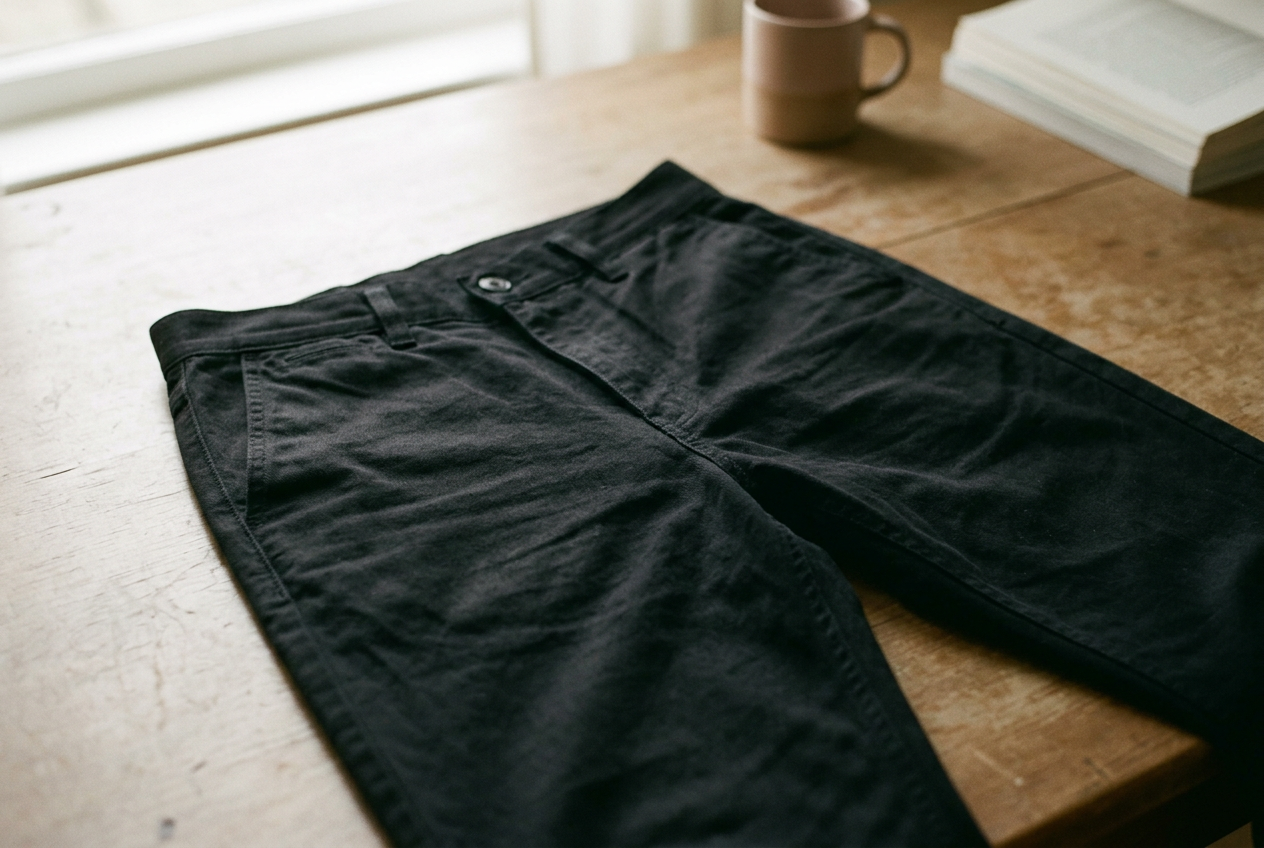
Keep one representative product page in view: women’s high-waisted trousers in rigid black cotton twill, with a zip fly, flat front, fitted waistband, and no stretch listed in the fabric description. The page supplies one rise measurement but does not say whether it is taken at the front or back.
That is enough information to suggest where the waistband may sit. It is not enough to show how the trousers will travel from the front waist, through the crotch, and around the seat, which is where two pairs with an identical published rise can behave very differently.
This is women’s sizing coverage, particularly useful for shoppers with a fuller seat, a straighter waist-to-hip line, or both. The construction principles also apply more broadly, but women’s trouser patterns usually make the waist and hip relationship especially important.
Start by finding out which rise was measured
Front rise means the seam distance from the crotch junction to the top of the front waistband. On many product pages, “rise” means front rise, yet brands do not always say so, and their measuring methods can differ at the waistband and along the curve of the seam.
Back rise is the corresponding seam distance from the crotch junction to the top of the back waistband. It is usually longer because it has to pass over the seat, but the amount of added length varies with the pattern. A fuller-seat cut may place considerably more of the total rise at the back without looking unusually high from the front.
Return to the black cotton-twill trousers. If their sole number is a front rise, it tells you something about the distance between the front crotch and waist. It says nothing firm about whether the back waistband will stay level while sitting, whether the rear seam has enough length to follow a fuller seat, or whether the waistband will pull downward at center back.
Comparing that number with another brand can also mislead. The second brand may include the full waistband in its measurement, use a different sample size, or measure along a slightly different path. Treat rise figures as comparable only when the size and method match.
Rise has depth as well as length
The seam measurement is one line on a three-dimensional garment. Crotch extension, meaning the part of the pattern that projects inward from the leg to create body depth, also determines whether there is enough room from front to back.
A longer back rise with a short extension can still pull into the seat. A roomier extension may accommodate projection without sending the waistband much higher. Product pages rarely publish this dimension, which is why a rise number should be read beside the cut, fabric, and rear photographs rather than treated as a complete fit specification.
Rigid cotton twill makes the distinction easier to feel. It will soften with wear, but it cannot create missing pattern depth in the way a fabric with elastane can temporarily yield around the body. If the black trousers show taut diagonal lines running from the seat toward the side seams, or the center-back waistband is being pulled down in the rear photograph, more back length or depth may be needed. A close fit alone does not prove a problem, but visible strain is useful evidence.
Stretch can hide a marginal cut during a brief try-on. It may also turn missing room into steady pressure at the stomach or crotch after several hours, so the presence of elastane is not a substitute for a well-shaped rise.
The waistband curve decides where that room ends
A contoured waistband is cut with a smaller top edge than bottom edge so it follows a narrower waist above the upper hip. When the difference suits the wearer, the band settles against the body without a rear gap and without needing to be cinched by a belt.
That shape often helps someone with a fuller seat and a marked difference between waist and hip, especially when the pattern also supplies enough back rise and crotch extension. The pieces work together. Extra seat room without enough waistband shaping can leave a gap, while a sharply curved band on a shallow back rise may grip the waist as the seat pulls the entire garment downward.
A straighter torso may have the opposite experience. If the waistband narrows more than the body does, its top edge can dig in or roll while the trouser body remains loose just below it. A straighter waistband, with less difference between its upper and lower edges, may sit more cleanly even when its listed rise matches the curved version.
This is why “size up” is often an incomplete answer. Sizing up may release the waistband, but it also adds fabric through the hip and leg without changing the underlying relationship among front rise, back rise, and waistband shape. For the black cotton-twill pair, that could trade pressure at the top edge for excess cloth at the upper hip.
Read the rest of the page as pattern evidence
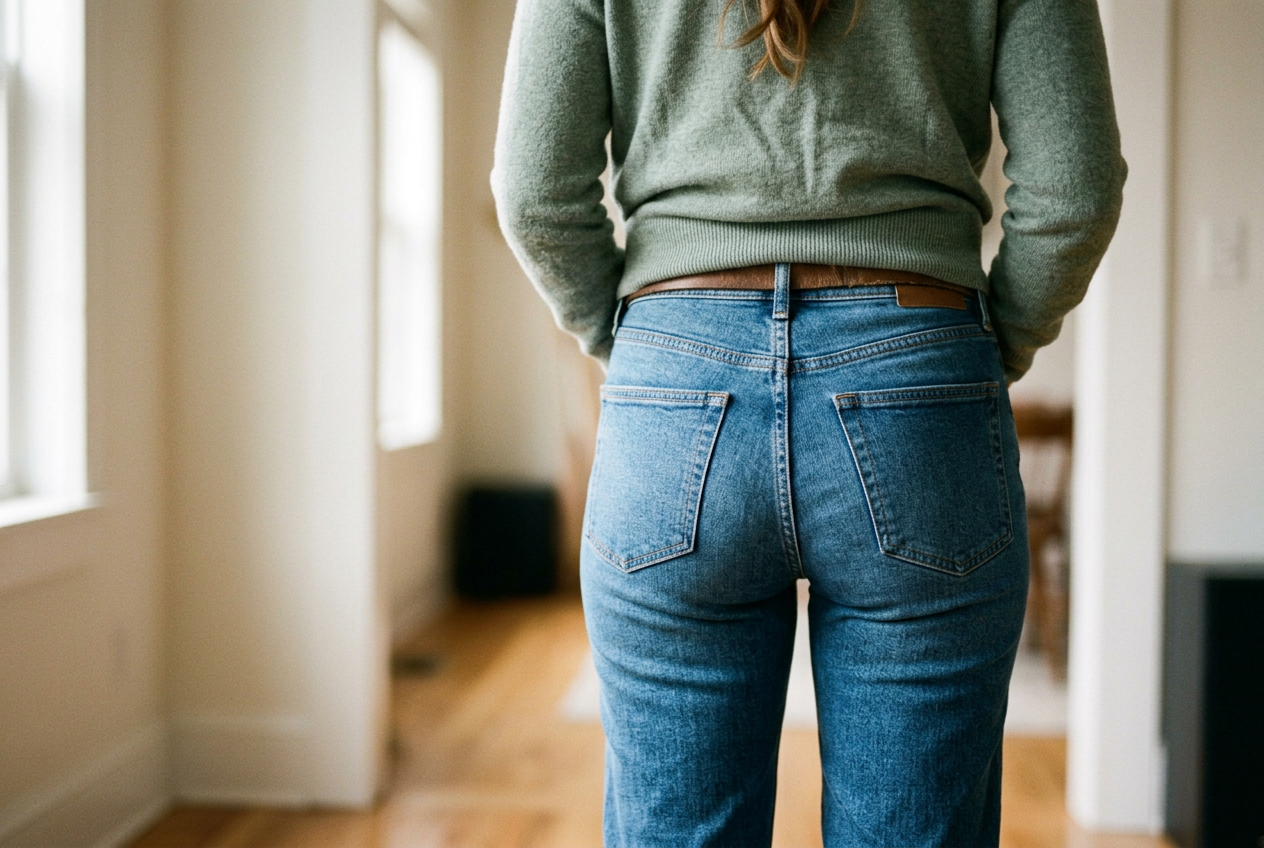
Start with the rear and side views. A waistband that sits higher at center back than at center front suggests the pattern has allocated more vertical length to the rear, although photography and styling can exaggerate the effect. Darts extending down from the back waist can shape the fabric over the upper seat, while a curved back yoke can perform some of the same work in jeans.
Then inspect the waistband itself. Product copy may use “contoured,” “curved,” or “shaped,” but a clean product photograph can be more useful than a vague fit description. On a garment shown flat, a contoured band forms an arc rather than lying as a straight strip. If the trousers are only shown on a model, look for a smooth upper edge and check whether a belt, jacket, or hand placement conceals the back waist.
Fabric matters here. The representative trousers are rigid twill, so the cut must supply most of the room. A bias-cut woven garment can move differently, and a stretch trouser may tolerate a closer waistband, but neither tells you whether the back rise suits your proportions. “High rise” is a position label, not a promise about rear coverage.
Customer service can sometimes fill the gap. Ask, “Is the published rise measured at the front or back, and does it include the waistband?” Follow with, “What is the back rise in the size I plan to order?” For the band, ask whether it is straight or contoured.
If the photographs are unclear, ask whether the back waist is drafted higher than the front. Those answers are more useful than another general assurance that the style fits true to size.
Decide what can be altered and what should be returned
Once the trousers arrive, assess the waistband before judging the leg. Sit in a firm chair, stand, and bend enough to pick something up. The band should remain secure without cutting at the front or dropping sharply at the back, and the crotch should not pull harder as your body changes position.
A rear waist gap with comfortable room through the seat often points to waistband shaping rather than a need for a smaller overall size. A tailor may be able to reduce the waist, though pockets, belt loops, and center-back construction affect the work and cost. Missing rise or crotch depth is harder to correct because the necessary fabric is not present inside the garment.
Pressure at the front waistband paired with loose fabric below it can indicate that the band is too curved for a straighter torso. Deep horizontal folds near the fly may mean excess front length, while diagonal pulling across the rear usually deserves more attention than a little loose cloth under the seat.
For the black cotton-twill trousers, the buying decision is straightforward if the retailer cannot identify the published measurement and offers limited returns: skip them unless you already know that brand’s cut. A familiar pattern is worth more than a nominally perfect rise number. If returns are easy, order according to the hip or seat area that is hardest to alter, then reject the pair if the back rise pulls or the waistband shape fights your torso.
Questions people ask
Is a higher front rise better for a fuller seat?
Not necessarily. A fuller seat usually needs adequate back rise and crotch depth; adding front rise alone can create folds around the fly without improving rear coverage. Look for a rear view, a back-rise measurement, and evidence that the waistband is shaped to meet the waist after the fabric passes over the seat.
Why do high-rise trousers still gap at the back waist?
“High rise” describes where the garment is intended to sit, not how closely the waistband follows the body. Gaping can occur when the seat fits but the waistband is too straight or too large at the top edge. Insufficient back depth may also pull the trousers out of position and make the gap more noticeable.
What trouser rise works for a straighter torso?
There is no single best length. A straighter torso often gets a cleaner fit from a waistband with modest contour and a less dramatic difference between front and back shaping. Check for pressure along the waistband’s top edge; if the upper hip is loose at the same time, changing rise length alone is unlikely to fix it.
Can a tailor fix the wrong rise?
A tailor can sometimes reduce a gaping waist or adjust the waistband, depending on the pockets, belt loops, and available seam allowance. Adding meaningful rise length or crotch depth is rarely practical because there is usually no spare fabric where it is needed. Return trousers that pull through the crotch even when the waistband is open.
One update a day
Today's fashion update, in your inbox
One fashion update each morning — no hype, no filler, just pieces worth wearing.