A Body-Only Size Chart Cannot Tell You If Trousers Fit
Your waist and hip measurements identify a starting size, not the finished fit. Garment dimensions, ease, stretch and model details reveal whether the waistband will close and the leg will hang properly.
August 11, 2026 · 8 min read
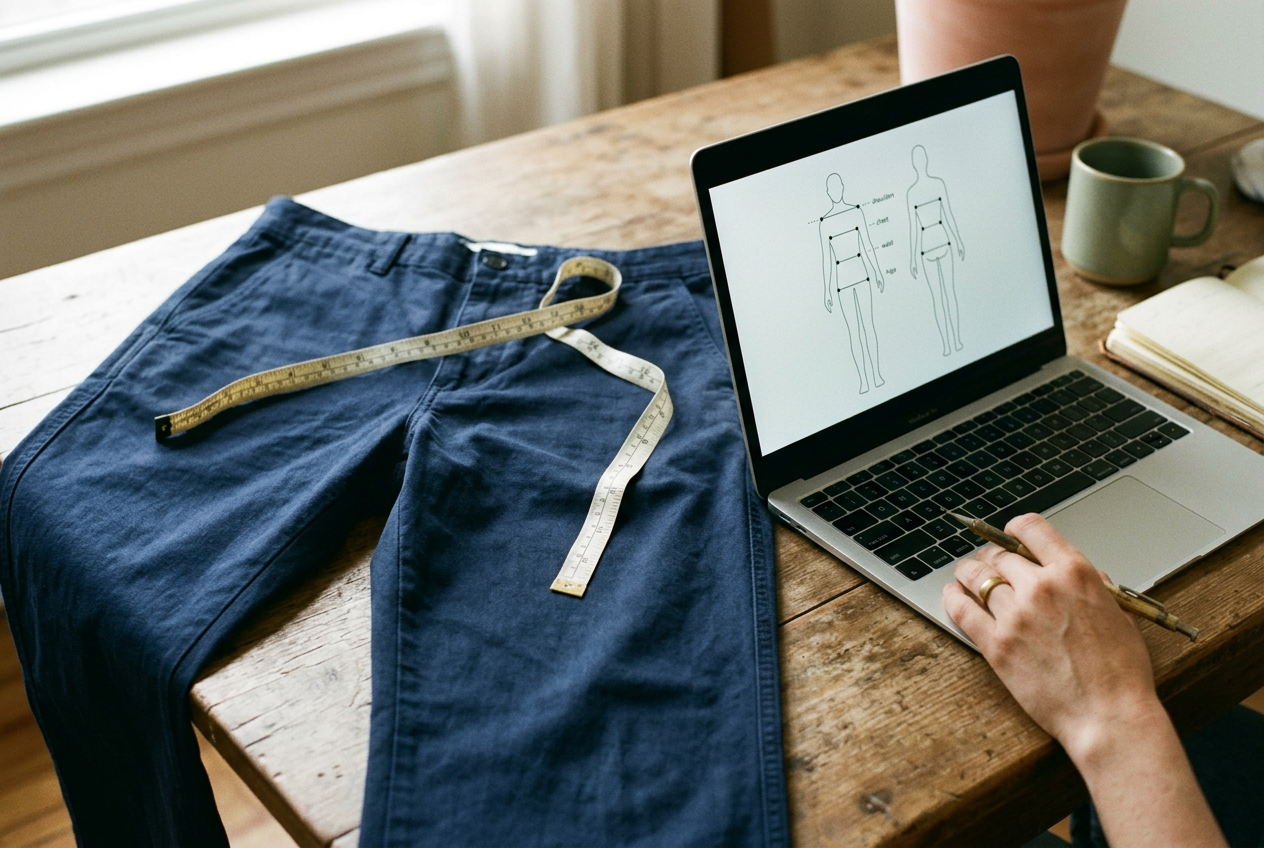
Take a navy straight-leg trouser in cotton twill with a small amount of elastane, designed to sit just below the natural waist and work with a tucked shirt and loafers. Its product page gives body waist and hip ranges, while the photographs show a clean waistband, smooth hips and a leg that falls without gripping the thigh.
That information still cannot tell you whether the trousers will fit.
A body chart tells you which customer the brand associates with each size. It does not reveal the dimensions of the trousers, how much room the pattern includes, whether the waistband stretches, or how the rise positions the garment on your torso. Those missing facts decide whether the navy trousers look straight and easy or pull across the hips before collapsing into a loose waist.
This is unisex sizing advice. The same method works for trousers sold in women’s, men’s and gender-neutral departments, although the useful measurement points and the brand’s assumptions about waist-to-hip proportion may differ.
Body measurements are only the starting point
Body measurements describe you. Garment measurements describe the finished piece, measured at specific points while it is laid flat or placed on a form. A chart that says a size fits a particular waist range is therefore making a recommendation, not reporting the waistband’s physical circumference.
The difference is ease, meaning the space between the body and the garment. Straight-leg cotton trousers need enough ease through the seat and thigh for sitting, pocket use and an unstrained crease, but a close waistband may have little ease because it is supposed to hold the trousers in place. A relaxed trouser needs more. Stretch leggings use negative ease, meaning the garment is smaller than the body and expands when worn.
For the navy trousers, a body-waist number cannot show whether the waistband itself matches that number, exceeds it slightly or measures smaller and relies on elastic or fabric stretch. A hip range also conceals where the garment reaches its fullest width. If your fullest point sits lower than the pattern’s, the nominally correct size may catch at the upper thigh while leaving room elsewhere.
Sizing labels add another layer. Brands grade patterns, meaning they increase or decrease a base pattern to create adjacent sizes, but each label chooses its own increments and proportions. Going up one size may add useful hip room while also lengthening the rise and widening the leg opening. It is not a neutral enlargement.
Ask for the trousers, not another recommendation
Customer service may repeat the body chart or suggest taking your usual size. Ask for measurements that can be checked against trousers you already own instead. For this straight-leg pair, the useful figures are the waistband measured along its top edge, the hip width at the brand’s stated measurement point, the front and back rise, the thigh width just below the crotch, the inseam and the leg opening.
Rise is the distance from the crotch seam to the waistband. It matters because a waistband that measures correctly can still feel tight when the rise forces it onto a wider part of your torso, while a longer rise may place the same waistband higher and change how much fabric sits through the seat.
Send a compact request and specify whether you want flat or full-circumference measurements:
Could you provide the finished garment measurements for this size: waistband along the top edge, hip width with the distance below the waistband noted, front and back rise, thigh width one inch below the crotch, inseam and leg opening? Are these measured before or after any garment washing? Does the waistband stretch, and if so, what is its relaxed and comfortably stretched measurement? Please also confirm the size worn by the model and whether the garment was pinned or altered for the photograph.
That wording avoids a common problem: one retailer may report a flat waistband width, while another gives the doubled circumference. The hip point also needs a location. A number measured seven inches below the waistband cannot be compared cleanly with one taken nine inches below it, especially on a body or pattern with a pronounced curve.
If customer service cannot supply every figure, prioritize the measurement linked to the likely failure. For trousers that usually gap, get the garment waist and hip. If thighs are the sticking point, request thigh width and rise. For hemming decisions, inseam alone is not enough because the rise changes where the crotch and hem land.
Stretch does not erase a pattern mismatch
A fiber label containing elastane signals potential stretch, but it does not state how far the finished fabric moves or how well it returns. Recovery means the fabric’s ability to regain its original dimensions after stretching. Loose recovery can turn a comfortable waistband into one that bags after several hours, while strong recovery may make a close trouser feel firmer than expected.
Construction matters as much as fiber content. Woven cotton twill generally behaves differently from a rib knit, and stretch may run mainly across the body rather than vertically. A rigid waistband facing, fused interfacing or nonstretch pocket bag can restrict an area even when the outer cloth gives. For the navy trousers, a flexible leg does not guarantee that the top edge will expand through a seated waist.
Ask where the stretch is. A useful answer identifies whether it runs across the garment, lengthwise or both, and whether the waistband itself moves. If no one can confirm, treat elastane as a comfort detail rather than permission to buy a visibly smaller garment.
There is a tradeoff. Sizing down may sharpen the waist and reduce extra cloth at the seat, but it can strain the zipper, pull the side pockets open and flatten the intended straight line through the thigh. Sizing up may solve movement while creating tailoring work at the waist. A waistband alteration is often more involved when it disrupts belt loops, back pockets, lining or a center-back seam, so the larger size is not automatically the economical choice.
Read model sizing as evidence, not proof
A model photograph helps when the page states the model’s body measurements, height and worn size. Height alone says little about fit. Two people of the same height can have different rises, thigh proportions and waist-to-hip relationships, which changes where the navy trousers sit and where the knee break appears.
Look first at tension. Horizontal drag lines near the fly or upper thigh suggest the garment is being pulled sideways, while pockets that flare can indicate insufficient room or a pocket construction that refuses to lie flat. Extra folds under the seat may come from too much length in the back rise, too little room elsewhere, posture, or the model’s stance. One image cannot settle the cause.
Styling can hide relevant information. A long untucked layer covers the waistband; a hand in the pocket changes the hip line; a wide stance gives the leg more apparent room. Product samples may also be pinned or altered, which is why asking directly is worthwhile. If the retailer cannot confirm, compare several images and give more weight to the garment measurements than to the polished silhouette.
The model’s stated size becomes most useful as a proportion check. If the model’s waist points toward one chart size and the hips toward another, yet the smaller size is shown, the photograph may demonstrate a close hip fit rather than establish that other shoppers should size down.
Measure the pair that already works
Body measurements can shift with posture, tape position and the time of day. A well-fitting trouser offers a more practical comparison because it already contains your preferred ease.
Choose a pair with a similar rise, fabric and intended silhouette. Fasten it, smooth it without stretching, and measure the waistband along the top edge. Note the front and back rise, the hip width at a recorded distance below the waistband, the thigh just below the crotch, the inseam and the leg opening. Double flat widths where a seller reports circumference.
Do not compare the navy cotton-twill trousers with soft sweatpants or a highly elastic knit. Their measurements may look alike on paper while their resistance, drape and recovery produce different fits. A rigid trouser you tolerate only while standing is also a poor benchmark. Use the pair you can sit in and wear for several hours without readjusting.
Small differences can matter at the waistband and thigh, while a wider leg may absorb a larger difference without discomfort. The product’s intended line sets the acceptable range. If customer service reports a much narrower thigh than your working pair and the fabric stretches only across the grain, another label size or a different cut is a safer choice than hoping wear will reshape it.
Check before starting the return
Keep the tags attached and measure the delivered garment before deciding that its label is wrong. Compare it with the retailer’s finished dimensions if those are available, using the same measurement points and no tension on the fabric. Manufacturing tolerance, meaning the small allowed variation between production pieces, may explain why your pair differs from the published figure.
Then ask whether another unit in the same size is likely to measure differently, whether the next size changes the rise and thigh as well as the waist, and whether washing or pressing affects the stated dimensions. For the navy trousers, exchanging up makes sense only if the added hip or thigh room outweighs the wider waistband and altered leg shape. Reordering the same size makes sense only when the received pair falls outside the retailer’s expected tolerance or appears distorted.
Photograph the tape at the waistband, hip point and problem area before contacting support. This costs a few minutes, but it replaces “these run small” with evidence that can distinguish a mislabeled item, a production variation and a pattern that does not suit your proportions.
Questions people ask
Should
I choose a size from my waist or hip measurement?
Use the measurement tied to the garment’s hardest area to alter or accommodate. For straight trousers, that is often the hip or thigh, provided the rise is suitable; then check whether the waistband can be adjusted without disrupting pockets, belt loops or closures. A garment chart is still needed to confirm the available ease.
How much ease should trousers have?
There is no universal amount because a close cigarette trouser, straight cotton-twill pair and loose pleated style need different room. Compare the finished waist, hip and thigh measurements with a similar pair that already fits, then check that you can sit without pocket flare, drag lines or pressure at the waistband.
Does elastane mean I can size down?
No. Elastane may improve movement, but the weave, waistband construction and recovery determine how that stretch feels and whether it lasts through a day. Size down only when the finished garment measurements still preserve the intended ease through the seat and thigh, rather than relying on the cloth to remain under constant strain.
Is it worth exchanging for the same size?
It can be if your garment measures outside the retailer’s stated tolerance, has twisted seams or appears mislabeled. If its measurements match the specification and the rise or thigh still fails, another identical size is unlikely to fix the pattern mismatch; compare the next size’s finished measurements before putting a second parcel in motion.
One update a day
Today's fashion update, in your inbox
One fashion update each morning — no hype, no filler, just pieces worth wearing.