Closed-Toe Office Shoes Need a Better Summer Outfit Formula
The workable formula starts with linen or lightweight wool, adds an unlined top, and finishes with closed shoes that move some air. Socks and hem length decide whether it looks polished.
Women's · October 4, 2026 · 8 min read
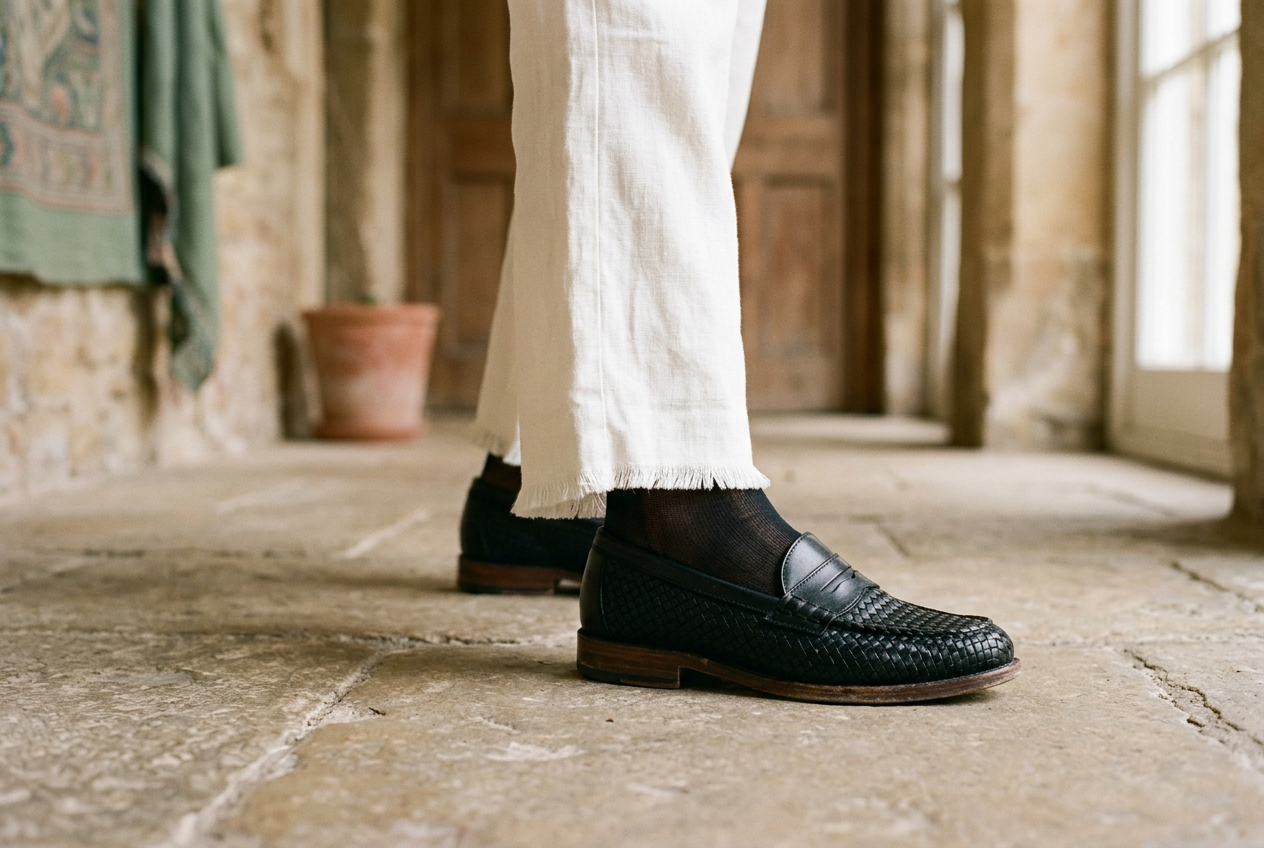
The outfit behind this formula is specific: ivory linen trousers, a loose cotton voile shirt and black woven-leather penny loafers. Voile is a lightweight plain-weave fabric that lets air pass through more readily than standard shirting. The loafers have an interlaced leather vamp, a low stacked heel and a solid leather footbed.
This is women’s coverage, though much of the fabric and footwear logic crosses departments. The useful point is not that one outfit looks summery. It is that each piece manages a different source of heat while still meeting an office rule that excludes sandals, mules and other open-toe shoes.
During a weeklong wear check, the loafers proved to be the limiting piece. Their woven uppers admitted some air across the toes, but the solid footbed still trapped heat underfoot, and wearing them without socks created friction at the heel by late afternoon. The outfit worked once thin socks and the trouser hem were treated as functional parts of the formula rather than last-minute styling choices.
Start with the piece that covers the most skin
The bottom half does most of the cooling work. Choose full-length trousers in linen, a linen-viscose blend or tropical wool, meaning lightweight suiting woven with enough openness to release heat. A knee-length or midi skirt in the same materials also works, provided its lining does not cancel out the benefit of the outer fabric.
The ivory trousers in the test outfit are 100 percent linen with a relaxed thigh and a straight leg. That shape matters. Linen worn close through the seat and upper thigh can feel clammy once it absorbs moisture, while a little clearance allows the fabric to move away from the body. The tradeoff is creasing: pure linen develops folds quickly at the lap and behind the knees, which a formal workplace may read as too casual.
A linen-viscose blend wrinkles less and often hangs with a cleaner vertical line, though it may feel heavier. Tropical wool is the better substitution for conservative offices because it keeps a tailored surface and resists deep creasing, but check the garment against a bright window before buying. Some lightweight cloth becomes more transparent than it looked under fitting-room lighting.
For skirts, inspect the lining first. Polyester lining can turn an airy linen shell into a heat trap. An unlined skirt, a partial lining that ends above the knee, or a breathable cotton lining is more useful. Opacity still matters, so test the skirt while sitting as well as standing; fabric stretched across the hips can reveal more than loose fabric on a hanger.
Keep the top unlined and away from the underarm
The top should be light without looking like beach cover-up fabric. Cotton voile, cotton lawn and silk crepe can all work, while a dense poplin shirt may feel warmer than its crisp appearance suggests. Lawn is a smooth, finely woven cotton that usually has more body than voile, making it easier to wear in an office without a camisole.
The test shirt has dropped shoulders, a loose armhole and no synthetic lining. Those details reduced contact around the upper back and underarm, where a fitted shirt tends to hold damp fabric against the skin. Its weakness was opacity. A skin-toned bra worked under the pale cloth, but adding a full polyester camisole defeated much of the cooling benefit.
If an underlayer is required, use the smallest one that solves the problem. A lightweight cotton bralette, a cropped camisole or a breathable slip confined to the necessary area adds less warmth than a long, close-fitting synthetic tank. For stricter dress codes, substitute a loosely fitted silk crepe blouse or an unlined shell with a high neckline and enough ease across the bust to prevent pulling.
A jacket should be optional rather than built into the outfit. Keep one at work in unlined linen, cotton seersucker or lightweight wool for meetings, then remove it at the desk. An unlined jacket lacks the full interior fabric layer found in conventional tailoring, although the sleeves may still contain lining to help them slide over a shirt.
Choose closed shoes by construction, not by label
A loafer, ballet flat or oxford is not automatically suitable for heat. Airflow depends on the upper, lining and footbed. Patent leather and thick synthetic uppers hold warmth; perforated leather, woven leather and some engineered mesh allow more exchange, though no closed shoe will feel like a sandal.
The black woven loafers worked because the openings sit across the vamp, the section covering the top of the forefoot. They still look structured from normal standing distance, and the penny-loafer shape fits an office wardrobe better than a loosely woven resort shoe. Up close, the weave exposes the sock underneath, so sock color becomes visible through the upper.
Fit needs extra attention. Woven leather can flex, but the seams around the toe and heel remain fixed, and the interlaced strips may press across a high instep. The test pair felt generous at the toes yet firm over the center of the foot. Sizing up would have loosened the heel, so a wider last, meaning the foot-shaped form around which a shoe is built, would be the better alternative for a broad forefoot.
After several office days, the main failure was underfoot rather than above it. The solid leather footbed grew warm during the commute, even while the woven vamp felt less enclosed than a standard loafer. A removable perforated insole would improve drying, but many dress loafers lack the depth to accept one without crowding the toes.
Mesh flats are cooler, provided the mesh is backed only where support is needed. Very soft versions can reveal every toe joint and may collapse at the heel, which reads less polished and can create rubbing. Perforated leather flats offer a middle ground. They move less air than open weaving but hide socks more effectively and usually retain a cleaner shape.
Woven leather commonly costs around the price of a decent pair of sneakers and rises sharply with finer leather or hand-finishing. Cheap synthetic weaving is not an equivalent bargain if the backing is solid plastic, since the visible holes may not pass through to the foot. Hold the shoe to a light and inspect the inside before paying for the appearance of ventilation.
Let the socks and hem solve the awkward part
Going sockless made the loafers feel cooler for the first hour and worse later. Moisture collected at the heel, where repeated contact created friction. A thin no-show sock fixed that problem, but only when its opening sat below the woven sections and its heel grip held through a full commute.
Look for a low-cut sock made from fine cotton, merino or a moisture-moving synthetic blend. Merino can manage moisture without much bulk, though loosely knitted versions may slide inside smooth leather shoes. Cotton feels familiar but stays damp longer. A synthetic performance sock dries faster, yet thick cushioning can tighten a dress shoe that already fits closely.
The trouser hem determines whether a no-show sock remains invisible. With the ivory trousers, the cleanest length touched the top of the loafer and broke only slightly at the front. A cropped hem exposed the ankle and looked lighter, but it also revealed the sock whenever the wearer sat down. Going without socks was not worth the friction.
If visible socks suit the office, make the choice deliberate. A fine-gauge sock, meaning one knitted with small stitches for a smooth surface, looks sharper than an athletic ankle sock. Match it closely to the trouser for a continuous line, or choose a controlled contrast that relates to another color in the outfit. Through woven black leather, charcoal or black is quieter than pale beige.
Skirts change the balance. A midi hem leaves more leg exposed, so a black loafer can look visually heavy even when the shoe itself breathes. A dark brown, oxblood or muted taupe shoe softens that boundary, while a pointed or almond toe extends the line more than a short round toe. Sheer knee-highs can reduce rubbing without adding a visible ankle band, although their synthetic fibers may feel warm in humid weather.
Make one substitution at a time
The formula holds when each change preserves the same function. Replace linen trousers with tropical wool, but keep the relaxed cut. Swap the voile shirt for an unlined silk shell, but retain space at the underarm. Exchange the woven loafers for perforated flats, then reassess the sock because the opening and heel fit will differ.
Do not buy an entire summer office capsule before testing the shoes for one full day. Foot swelling, commute length and indoor air conditioning can reverse an outfit’s priorities by afternoon. The black woven loafers earned a place in the rotation, but only with thin socks and a nearly full-length hem; they were not comfortable enough to rescue a fitted synthetic outfit.
Questions people ask
What are the coolest closed-toe shoes for an office?
Woven or perforated leather loafers and structured mesh flats tend to move more air than patent leather or fully backed synthetic shoes. Check whether openings pass through the upper, then inspect the lining and footbed. A breathable-looking upper cannot compensate for a solid plastic backing or thick foam underfoot.
Can I wear loafers without socks in summer?
You can, but a full workday may bring heel friction and trapped moisture even in woven loafers. A thin no-show sock is the practical first choice. Make sure it sits below the shoe opening, stays attached at the heel and does not add enough bulk to crowd the toes.
Where should summer trousers end over loafers?
For a conventional office, let the hem touch the top of the loafer with little or no pooling at the ankle. A cropped hem feels lighter but exposes socks whenever you sit. If the sock needs to disappear, test the hem while seated before committing to alterations.
Are linen trousers polished enough for a formal workplace?
Pure linen may crease too sharply for the most conservative offices. A linen-viscose blend or tropical wool keeps a smoother line while remaining lighter than dense year-round suiting. Choose a relaxed thigh, verify opacity in strong light and avoid a heavy polyester lining that traps heat.
One update a day
Today's fashion update, in your inbox
One fashion update each morning — no hype, no filler, just pieces worth wearing.