A Crisp Cotton Poplin Shirt Can Still Be See-Through
The word poplin does not guarantee coverage. A quick check of the yarns, color, finish, and fit will tell you more than weight or crispness alone.
October 3, 2026 · 8 min read
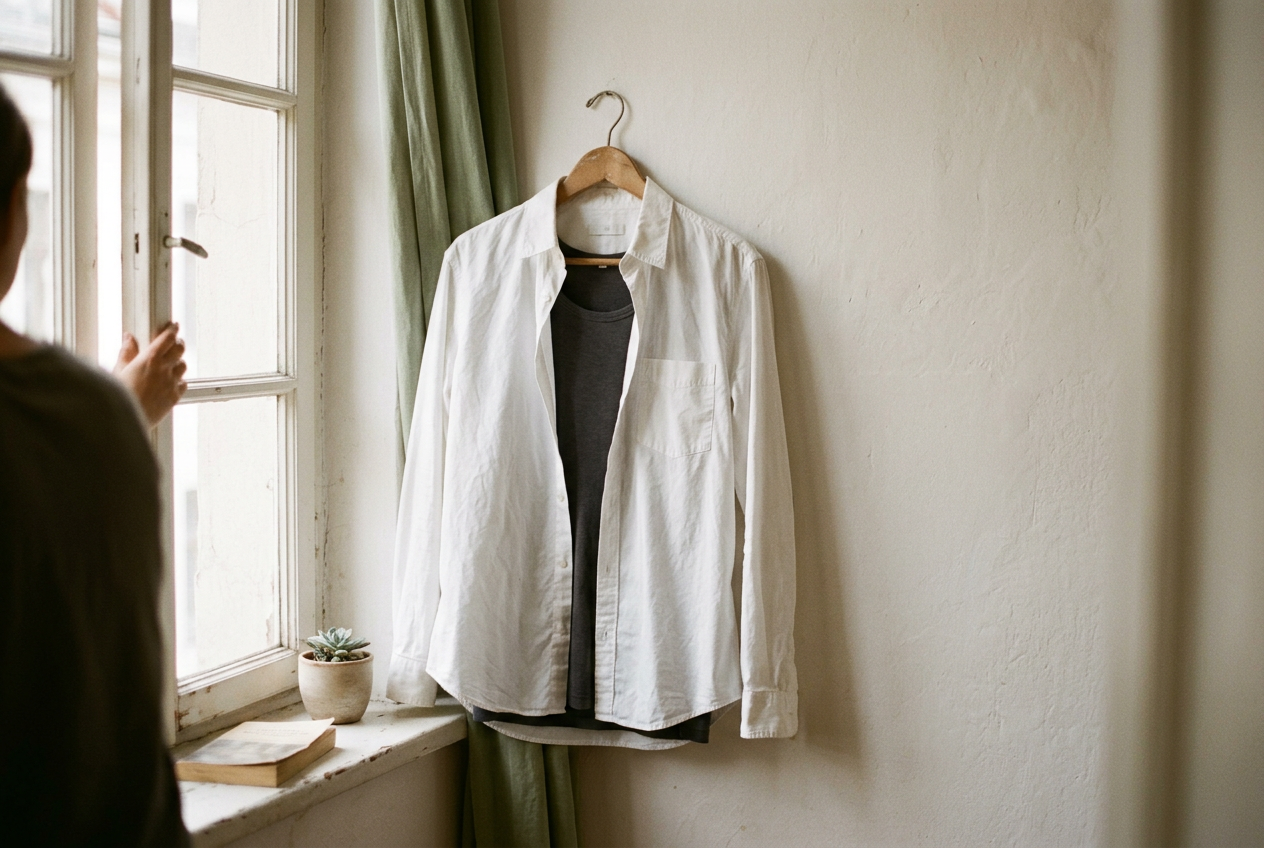
The white cotton poplin shirt on my desk looked dependable in the fitting room. It was 100 percent cotton, cut with a dropped shoulder and a loose body, and crisp enough to hold the collar away from the neck. Under overhead store lighting, the front appeared solid.
Daylight changed the verdict. With a charcoal tank underneath, the tank's neckline and armholes showed through the body, while the chest pocket and button placket stayed white because those areas had extra layers. The contrast was strong enough that the shirt worked as a deliberate overshirt, but not as the clean, standalone white button-up I had been evaluating.
That failure is easy to miss because poplin describes a structure, not a promise of coverage. Poplin is a plain weave, meaning each crosswise yarn passes over and under alternating lengthwise yarns. It can be dense and opaque, fine and translucent, or somewhere between, while retaining the smooth surface and restrained crosswise rib that shoppers recognize.
This is unisex advice. Bodies create tension in different places, but the same fabric mechanics apply across women's and men's wardrobes: a shirt that looks opaque on a hanger may reveal an undershirt, bra edge, waistband, or skin once the cloth stretches or catches light.
Crispness and opacity measure different things
The white shirt felt dry, smooth, and almost papery. That crispness suggested structure, yet it did not tell me how much light could pass between or through its yarns. Fabric weight is similarly incomplete; grams per square meter, often shortened to GSM, measures weight over an area, but it does not explain how that material has been distributed.
A heavier cloth can use thicker yarns with visible spaces between them. A lighter cloth made from finer yarns may pack those yarns closely enough to block more light, even though it feels less substantial in the hand. Fiber fuzz, yarn twist, and surface treatments complicate the comparison further, which is why weighing two shirts mentally by pinching their hems is a poor opacity test.
Yarn thickness matters most in relation to weave density, the amount of yarn packed into a given area. Fine yarns can sit close together and create a smooth, tightly covered surface. Thick yarns may provide coverage themselves, but if the loom has left larger openings around them, a backlit shirt can still become transparent.
On the desk shirt, the crosswise ribs were distinct when I held the hem near a window. Between them, I could see fine channels of light. The fabric was not loosely woven in the way of gauze, and it did not feel flimsy, but its single-layer body let enough light through to outline the dark tank clearly.
White makes a marginal weave easier to expose
Color changes how a shirt handles light. Dark dyes absorb more of it, so the same construction in navy may appear more opaque than in white. Pale blue, cream, and pink can also perform differently from bright white, although color cannot rescue a notably open weave.
White has another disadvantage: contrast. A white undershirt may look like the obvious companion, yet its edges can show sharply where two white layers meet bare skin. A close-to-skin shade usually disappears better, provided the tone is chosen for the wearer rather than treated as one universal version of beige.
A dark underlayer makes transparency intentional. The charcoal tank under my white shirt produced a clear graphic outline, which was useful with loose trousers and the shirt open at the neck. It failed only when I wanted the button-up to read as an uninterrupted white surface. Opacity is not always the goal, but it should be a choice rather than a fitting-room surprise.
Print can disguise outlines without blocking light. A stripe or check breaks up the visible edge of an underlayer, while a white ground between motifs may remain translucent. Judge the palest area of a print, not the overall visual busyness.
Finish can create convincing crispness
Finish means a treatment applied to fabric after weaving, and it can change the first impression of a shirt without changing its underlying construction. Starch or resin can add stiffness. Calendering, which presses cloth between rollers, can flatten fibers and create a smoother, denser-looking surface.
Those treatments are not inherently bad. They help collars sit neatly and can make a budget shirt feel polished straight from the rack. The problem comes when surface crispness is used as evidence that the cloth is substantial or opaque. Some finishes soften with laundering, so a shirt bought for its board-like hand may relax while the basic weave remains just as light-transmitting.
The white shirt's collar, cuffs, placket, and pocket all looked more opaque than its body, partly because interfacing or folded cloth added layers in those zones. Inspecting only the cuff would have given the wrong answer. The broad single layer below the pocket was the revealing part.
If a shirt is expensive enough to feel like an investment purchase, the finish deserves more scrutiny, not less. A higher price may reflect finer yarn, cleaner seams, better pattern work, or a more refined surface, but it does not guarantee the coverage needed from a white work shirt. Premium sheer poplin can be beautifully made and still be wrong for that job.
Run the test on one layer
In a store, start at the lower back or the body beside the chest pocket, where there is one layer of fabric. Slip the black care label, a dark wallet, or another high-contrast object behind that section without pressing it directly against the cloth. Leave a little space. If the object's edges remain obvious under ordinary light, the shirt is likely to reveal a dark underlayer in daylight.
Next, hold that same area toward a bright ceiling fixture. Backlighting exaggerates transparency, so this is a comparison test rather than a pass-or-fail verdict. Use it to compare two shirts in the same position. The one that shows a sharper outline and more visible points of light will usually be less forgiving outside.
The hand test is less useful than it appears. Fingers pressed against fabric block light differently from a torso sitting behind a loose shirt, and skin contact can make almost any pale cloth seem more opaque. Keep the test object slightly behind the material and look at the clarity of its boundary.
Fit must be tested separately. Button the shirt, reach forward, and sit down if the fitting room allows it. Horizontal pull lines across the chest or upper back show that the cloth is under tension, which can open tiny spaces in the weave and increase visibility. Gaping between buttons is a fit problem even when the fabric itself passes the opacity test.
Sizing up can help when the shirt is tight, but it did nothing meaningful for the loose white shirt because its body was already hanging away from mine. If the shoulders fit and the chest pulls, seek a fuller cut rather than accepting sleeves and a collar that have become too large. If the untensioned back panel is sheer, more ease will not repair the weave.
Daylight gets the final vote
At home, keep the tags attached and check the return policy before washing. Wear the underlayer you expect to use, stand facing a bright window, then turn sideways and step farther into the room. Indirect daylight shows everyday transparency; direct sun is a harsher stress test that can expose seams, pockets, and body outlines more strongly.
Look with your eyes before using a phone camera. Automatic exposure can brighten shadows and make a shirt look sheerer than it does in person, or darken the scene and hide the problem. A photo is useful for comparing front, side, and back views under the same conditions, but it should not overrule what is visible in the mirror.
Repeat the test over both a close-to-skin layer and a dark one. This takes a few minutes and answers two different shopping questions: whether the shirt can stand alone with discreet underwear, and whether it can function as an overshirt with visible contrast underneath.
For the shirt on my desk, the answer split cleanly. The close-to-skin layer was acceptable for casual wear, though its straps still appeared in strong window light. The charcoal tank turned the transparency into part of the outfit. Neither result supported paying a premium for a supposedly opaque white staple.
A shopper who needs reliable coverage has better alternatives. Compare another poplin with a denser single-layer body, try the same shirt in a darker color, or move to cotton twill, a weave identified by diagonal lines, which often feels less airy and may read more casual. The tradeoff is real: greater opacity can mean less breathability, a heavier drape, or a shirt that loses poplin's clean snap.
Questions people ask
Is every white cotton poplin shirt see-through?
No. Poplin can be woven from fine, closely packed yarns that give strong coverage without feeling heavy. White does reveal weaknesses more readily, so inspect a single-layer body panel rather than the cuff, pocket, yoke, or placket, where folded fabric can make the shirt look more opaque than it is.
Does a higher GSM guarantee better opacity?
No. GSM records fabric weight, not the size of the openings between yarns or the way light moves through the cloth. It can help when comparing closely related fabrics, but a lighter, densely woven poplin may provide better coverage than a heavier shirt made with thicker yarns and more space around them.
Will washing make a sheer poplin shirt more opaque?
Do not rely on it. Cotton may tighten or shrink a little, yet laundering can also remove starch or another finish that made the new shirt look denser and crisper. If opacity matters, buy a shirt that passes the daylight test before washing, then follow its care label to limit unwanted shrinkage.
Should
I size up if my poplin shirt turns transparent?
Size up only when tension is causing the problem, shown by pulling across the chest, back, or buttons. A fuller cut may be better if the collar and shoulders already fit. When a loose, hanging panel remains sheer in daylight, changing size adds fabric around the body but does not change the weave.
One update a day
Today's fashion update, in your inbox
One fashion update each morning — no hype, no filler, just pieces worth wearing.