Your Summer Dress May Need a Lining, but Not a Full One
A lining can stop sheerness and cling, but it also adds warmth, labor, and alteration costs. The right answer depends on the outer fabric and where the dress fits closely.
Women's · September 24, 2026 · 7 min read
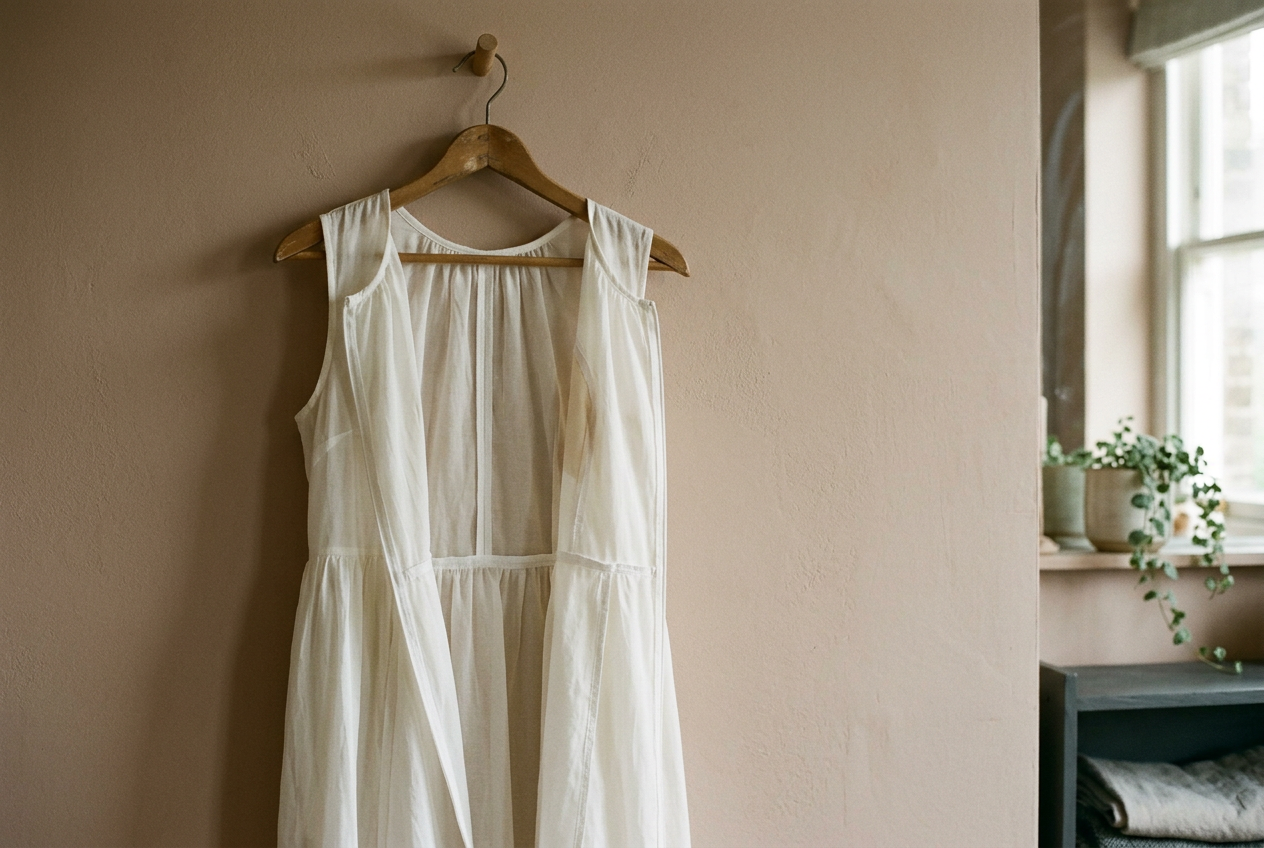
The dress that settles this argument is an ivory cotton voile midi with a darted bodice, gathered skirt, side-seam pockets, and an invisible zipper at the center back. Voile is a lightweight woven fabric with a slightly open structure, so it can feel cool while revealing far more in direct sun than it does under fitting-room lights.
This is women’s coverage, and fit matters here. The bodice sits close enough to put the fabric under tension across the bust, while the skirt hangs away from the body until sitting, walking, or a breeze presses it against the legs. Those two sections need different things from a lining.
In hands-on checks, the unlined voile felt airy and did not irritate bare skin because its French seams, meaning the raw edges are enclosed inside a second seam, kept the allowances smooth. Opacity was the failure. Nude underwear reduced contrast but did not stop the outline of the legs from appearing in backlight, and damp fabric clung at the lower back.
That dress does not need lining because its seams are poor. It needs coverage because the material is pale, fine, and used in a silhouette that alternates between loose and close contact with the body.
What each construction changes
A full lining, meaning an attached inner layer that follows most of the dress, gives the ivory voile consistent color and opacity from neckline to hem. It also keeps the outer skirt from catching on underwear or sticking to damp skin. The finish looks deliberate because there is no visible line where the inner layer stops.
The cost is heat and labor. Even a light lining reduces airflow when it sits close to the outer fabric, particularly through the fitted bodice and waistband, and the dressmaker must cut, sew, attach, and hem a second garment-shaped layer. At the budget end, that extra work may be replaced by a tightly woven polyester lining that feels slick in the fitting room but holds warmth during a long outdoor afternoon.
A partial lining covers only the area that needs reinforcement or opacity. On this dress, a bodice lining would conceal darts and stabilize the neckline, but it would leave the sheer skirt unresolved. A skirt lining would address coverage while preserving some airflow above the waist, though its upper edge must be cleanly secured so it does not roll or show through the voile.
Length matters. A lining that ends around mid-thigh can create a visible horizontal cutoff under pale fabric, especially when the wearer stands near a window. Extending it to just above the outer hem looks better, but that construction is close to a full lining in fabric use and sewing time. The remaining difference is mainly at the bodice.
No lining gives the best airflow and the lowest weight. It also makes laundering and alterations easier because there is only one layer to handle. For the ivory voile dress, however, no lining works only if it is sold and worn as a beach cover-up, or paired with a separate slip that supplies the missing opacity.
Opacity and cling are separate tests
A fabric can pass one test and fail the other. Medium-weight linen may look opaque while standing, then become more revealing where it stretches across the seat. Viscose crepe can block light yet cling sharply after perspiration reaches it. Cotton poplin may need no opacity help at all, though a very fitted cut can still catch on underwear.
Check both conditions before buying. Place a hand behind one layer of the dress near a window, then pinch the fabric so it forms two layers. If the doubled section changes color dramatically, a single layer is unlikely to stay discreet in strong daylight. Next, let the skirt fall over the clothes being worn beneath it and sit down.
Cling becomes clearer when the fabric is under pressure.
With the voile midi, the hand remained visible through one layer and mostly disappeared through two. That points toward a lining made from another light, matte fabric rather than a slick, heavy one. A shiny lining can reflect through a pale shell, while a contrasting lining may alter the dress’s color.
Cling also depends on surface texture. Smooth rayon or cupro lining, a regenerated cellulose fabric often used for its fluid hand, lets a skirt move over the legs more freely than cotton lawn. Lawn breathes well and suits a casual cotton dress, but its slightly dry surface can grip tights, textured underwear, or another cotton layer.
Airflow depends on weave as much as fiber
“Natural fiber” does not guarantee a cool lined dress. Two dense cotton layers can feel warmer than an open linen shell paired with a light, loosely woven lining, and a full skirt can remain comfortable because the layers hang apart while the same materials feel close in a fitted sheath.
For the ivory voile dress, a fine cotton lawn lining would keep the hand and care routine coherent, but it would add body to the gathers and make the skirt stand farther from the hips. Lightweight rayon would hang more fluidly and reduce cling, although the care label must suit the outer cotton because attached layers cannot be washed separately.
Polyester lining is durable and usually less prone to wrinkling, yet a dense version can trap heat and retain odor around the bodice. The fiber name alone is not enough. Hold the lining up to light, feel its weight, and notice whether air moves through it when gently blown against the back of the hand.
A separate slip remains the flexible alternative. It adds the same extra layer while worn, but it can be removed for beach use, washed more often than the dress, and replaced if the fit is wrong. It may also twist, show at the neckline, or sit awkwardly under a low back, which is why an attached lining earns its higher cost in a close, occasion-oriented dress.
Seam protection can justify a small lining
Lining protects more than modesty. It covers scratchy zipper tape, shields delicate seam allowances from repeated friction, and reduces strain where the wearer pulls the dress on and off. Fine silk chiffon, loose rayon gauze, and open eyelet are vulnerable enough that this protection can extend useful wear.
The voile midi already has enclosed seams, so a skirt lining does little additional work there. Its bodice is different. Repeated friction from a bra band and the movement of the invisible zipper can wear a fine outer cloth, making a bodice lining worthwhile even if a slip handles skirt opacity.
An opaque linen shift with flat, smooth seams may need no lining. A linen dress with a structured, closely fitted bodice can benefit from partial lining around the torso, particularly when the neckline would otherwise stretch. Stretch jersey usually needs a different answer: if the lining does not recover at the same rate as the outer knit, it can sag, restrict movement, or pull the hem upward.
Alterations get harder with every attached layer
An unlined dress is the easiest version to change. A tailor can reach the side seams, darts, and hem directly, which matters for a garment likely to need waist or bust adjustments. French seams take more time to open than overlocked edges, but the work remains visible and accessible.
Partial lining adds a step only where it is attached. Taking in the bodice of the ivory voile dress would require opening the lining, adjusting both layers, and closing the interior again; shortening an unlined skirt below that bodice would remain straightforward.
With full lining, a side-seam alteration usually means changing two sets of seams while keeping their ease balanced, and shortening the dress may require two hems at different finished lengths. Invisible zippers complicate the job further because both outer fabric and lining meet around the tape. The alteration is possible, but the labor can erase the value of a cheap purchase that almost fits.
That makes lining construction part of the fitting-room decision. If the bust fits but the waist needs substantial reshaping, an unlined or bodice-only construction leaves a cleaner path. If the dress already fits and the fabric is delicate, full lining has more value.
The material decides the answer
For pale voile, chiffon, georgette, open lace, and fine eyelet, full lining usually earns its place when the dress is intended for ordinary street wear rather than layering over swimwear. A partial lining can work when the pattern itself provides coverage, or when the sheer area is deliberate and placed away from underwear.
Light linen, chambray, seersucker, and cotton poplin often perform better unlined in loose silhouettes. Their appeal is airflow and visible texture, both of which can be dulled by an attached inner shell. Check pale colors in sunlight and inspect the seams before accepting that tradeoff.
For the ivory voile midi, the strongest ready-to-wear construction is a lined bodice plus a skirt lining that reaches close to the outer hem, using a light matte material rather than dense polyester. In practical terms, that is nearly a full lining, and it deserves a middle or investment-level price because the extra cutting and finishing are doing visible work.
At a low price, I would rather buy the same dress unlined with good French seams and budget for a well-fitting slip than pay for a short, static-prone lining that creates a line across the thighs. The extra layer is justified only when its material and length solve the original problem.
Questions people ask
How can
I tell if a summer dress is too sheer before buying it?
Check it near natural light with your hand behind one layer, then sit and look at areas where the fabric stretches across the body. Pale voile, fine linen, and loose gauze can appear opaque under overhead store lighting but reveal outlines in direct sun.
Is a cotton lining always cooler than polyester?
No. A dense cotton lining can block more airflow than a very light polyester weave, although cotton often feels less slick against damp skin. Compare weight, weave, and fit rather than relying on the fiber label, and remember that a fitted bodice holds heat more readily than a loose skirt.
Can a tailor add lining to an unlined dress?
Often, but the job is easier when the dress has a defined waist seam and enough interior structure for attachment. Adding a full lining around an invisible zipper, fitted neckline, and pockets takes substantial labor, so a separate slip may make more sense for a lower-cost dress.
Does a lined dress need a slip too?
Usually not if the lining reaches close to the hem, stays opaque in daylight, and moves smoothly over the body. A short lining that clings or creates a visible cutoff may still need a slip, but doubling both layers can defeat the airflow that made the summer dress appealing.
One update a day
Today's fashion update, in your inbox
One fashion update each morning — no hype, no filler, just pieces worth wearing.