A White T-Shirt Can Pass the Mirror and Still Turn Sheer
Color labels tell you almost nothing about opacity. Use the fabric, phone-flash, and movement checks to find the white T-shirt that stays covered outside the fitting room.
September 16, 2026 · 7 min read
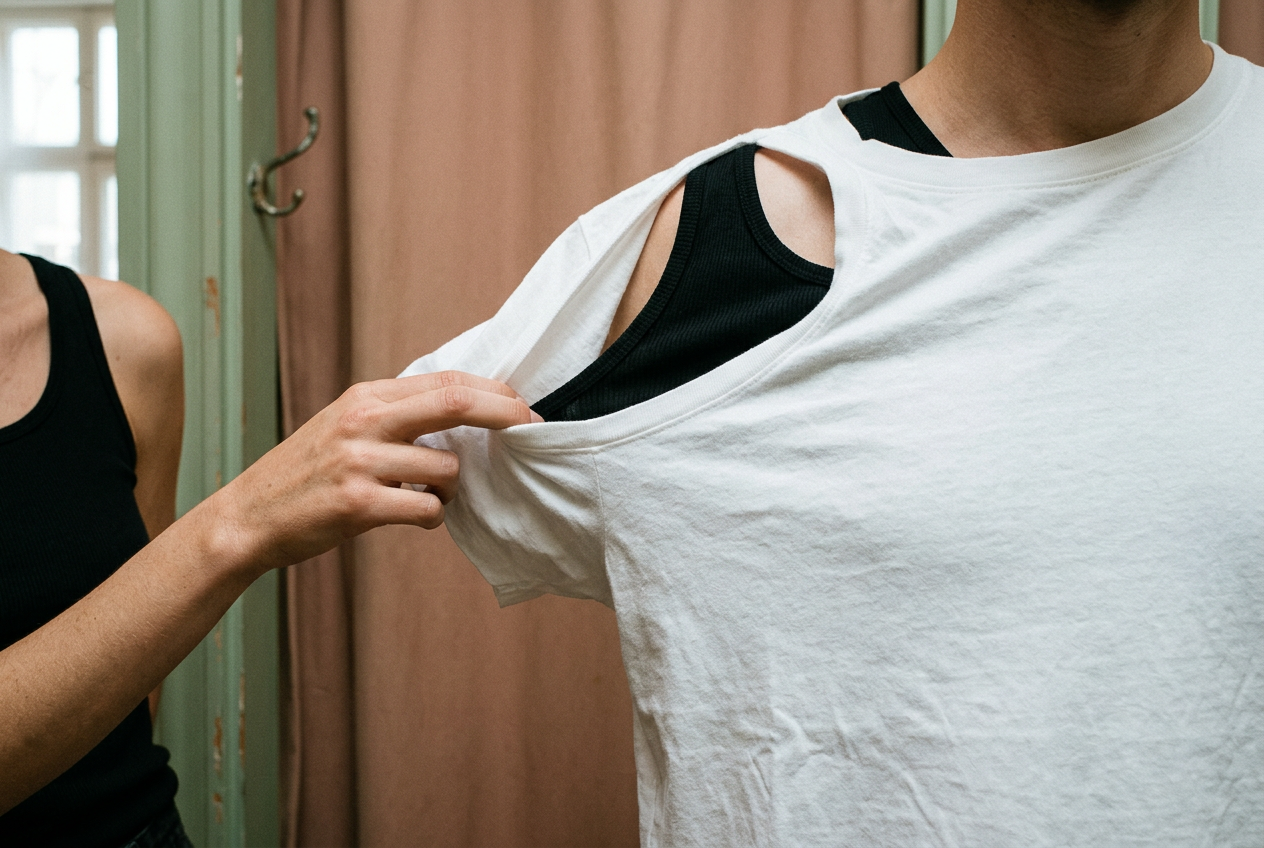
The white crewneck used for this walkthrough looked fine at first glance: 100% cotton on the care label, a regular fit, a doubled ribbed neck, and a smooth single-layer body. Under the fitting-room ceiling lights, worn over a black ribbed tank, it seemed covered enough to buy.
Then the hem was pulled gently across the stomach. The black ribbing appeared. Raising both arms made the upper back lighter, while a side view showed the tank’s neckline through the T-shirt. The mirror had not lied, but the still, front-facing check had tested the garment under its easiest conditions.
This is unisex advice. Bodies create tension in different places, yet the mechanics stay the same across wardrobes: a T-shirt becomes more transparent where the knit opens, where the fabric presses against skin or an underlayer, and where bright light finds a direct path through it.
Start with the fabric rather than the shade name
White, optic white, ivory, and chalk describe color, not coverage. An ivory T-shirt can be sheer, while a brighter white can stay opaque, because the amount of visible light passing through the body depends more on how the fabric was built and how far it stretches on the wearer.
Fabric weight is useful, though shoppers rarely get the number. GSM, meaning grams per square meter, measures how heavy a fabric is for its area. A higher GSM often gives more coverage because there is more material between the body and the light, but weight alone cannot settle the question. A heavy, loosely knitted jersey may reveal more than a lighter fabric with compact loops.
Knit density, meaning how closely the yarn loops sit together, is the stronger clue you can inspect without specifications. Hold the T-shirt by one layer and look across its surface rather than straight through it. A dense jersey reads as an even field. A loose one shows tiny gaps or distinct rows, especially when it is pulled sideways.
The walkthrough crewneck had a smooth surface and enough body to hang away from the black tank at the waist. Across the upper back, however, the same fabric opened under tension. That failure matters more than how substantial the folded shirt felt on the display table.
Texture can complicate the reading. Slub jersey, a knit made with yarn that varies in thickness, has deliberate thin and thick areas; those irregularities may look appealing on the hanger but create scattered points of transparency. Ribbed fabric also stretches farther than plain jersey and can expose the layer underneath as its raised columns separate.
Read the fiber label, then test the construction
A 100% cotton label does not promise opacity. Cotton can be knitted into a compact, firm jersey or a fine, airy one, and two shirts with the same fiber content may behave differently under identical light.
Cotton-polyester blends can hold a smooth surface and recover their shape well, but the result depends on yarn size and construction rather than the presence of polyester alone. Modal, viscose, and lyocell often give a T-shirt softer drape, which means the fabric may settle closer to the body instead of standing away from it. That closeness can make an underlayer more legible even when the material does not look especially thin in the hand.
Elastane, meaning a stretch fiber often listed as spandex, improves recovery and can help a fitted T-shirt keep its shape. It also lets the garment expand farther. Once the body fabric is stretched across the chest, stomach, shoulders, or upper arms, the loops spread and coverage can drop sharply.
The percentage on the label cannot show how much strain the chosen size creates. A close-cut cotton T-shirt with no elastane may still turn sheer because it is being pulled beyond its resting width, while a slightly roomier stretch blend may remain covered. Fit is part of fabric performance, not a separate concern to solve later.
Make the hand check do real work
Put one hand inside the T-shirt so there is only one layer of fabric between your hand and the fitting-room light. Keep the fabric relaxed first. Look for the outline of the fingers, the contrast between palm and fingernails, and any visible creases in the skin.
Next, spread the fabric lightly across the knuckles. Do not yank it. The aim is to reproduce the modest tension created by a shoulder blade, chest, or bent elbow, not to make every white fabric fail. If the fingers become much clearer with that small amount of stretch, expect the shirt to lose coverage wherever it fits closely.
Repeat the check near the side seam and upper back rather than relying on the front hem. Manufacturers sometimes use the same fabric throughout, but garment shape changes how that fabric is loaded. The walkthrough crewneck passed over a flat palm and failed over the knuckles, which matched what happened when the shoulders moved.
Feel the fabric between finger and thumb, too. A firm surface that springs back after a gentle pull is usually more promising than one that stays widened or feels gauzy, although softness should not be confused with weakness. The visual result under tension remains the deciding evidence.
Use phone flash as a stress test
Fitting-room LEDs are often bright overhead and dim around the body. That arrangement can conceal transparency on the front of a shirt because the strongest light is not traveling toward the mirror through the fabric.
With the retailer’s rules and other shoppers’ privacy in mind, take a mirror photo from about an arm’s length with the phone flash on. Use the same black tank or another high-contrast underlayer for every T-shirt being compared. Check the front, then turn sideways. A flash photo that reveals seams, straps, or the tank neckline shows where direct light may expose the layers outdoors or in photographs.
Phone processing varies, so flash is not a pass-or-fail laboratory measurement. Some cameras brighten shadows or increase contrast. Treat the image as a comparison tool: keep the phone position, underlayer, fitting-room spot, and pose consistent, then compare candidates under the same unfavorable light.
The white crewneck looked acceptable in its first no-flash photo. With flash, the black tank was visible at the shoulders and through the stretched upper body, while the looser lower half remained covered. That distinction pointed to a fit problem as much as a fabric problem.
Move before changing sizes
Raise both arms, bring them forward as if reaching for a shelf, and rotate your torso. Sit if the fitting room permits it. Watch the upper back, chest, stomach, and underarms as the fabric moves, since these zones can shift from relaxed to taut without the shirt feeling obviously tight.
A size up may fix transparency if it allows the same fabric to hang rather than stretch. Check the shoulder seam and neckline before deciding, because extra width can also drop the shoulder too far or make the collar stand away from the body. If sizing up solves coverage but ruins the intended silhouette, the better alternative is a denser fabric in the original size.
Also inspect recovery after movement. A shirt that stays widened at the elbows, chest, or hem may become more revealing during wear even if it began the day covered. The walkthrough crewneck recovered at the waist but remained lightly pulled across the upper back, confirming that its regular-fit label did not describe how it fit this particular body.
Spend for evidence, not promises
Budget multipacks sometimes contain excellent dense jersey, and a premium single T-shirt priced closer to a decent woven shirt can still be thin by design. Cost may buy smoother yarn, stronger seams, or a more refined collar, yet none of those guarantees opacity.
At the budget end, inspect every color separately. Brands may use different dye processes or fabric batches, and the white version can behave differently from black or navy. For an investment purchase, look for useful specifications such as fabric weight, fiber percentages, garment measurements, and return terms, then perform the same physical checks. A disclosed GSM figure narrows the search; it does not replace trying the shirt under tension.
The worthwhile upgrade is the shirt that passes the hand check, stays covered through movement, and keeps the silhouette you wanted without requiring a camisole or undershirt. If the expensive option still needs an extra layer for ordinary wear, the price is paying for something other than dependable coverage.
Questions people ask
How can
I tell if a white T-shirt is see-through before buying it?
Place one hand inside a single layer, inspect the relaxed fabric, then stretch it lightly across your knuckles. Wear a high-contrast underlayer for the fitting and check the shirt with phone flash and normal movement. A front-facing mirror check alone misses transparency caused by tension.
Does a heavier white T-shirt always stay more opaque?
No. Greater fabric weight often helps, but a heavy jersey can still have a loose knit that opens when stretched. Look for closely spaced loops and even coverage, then test the fabric across the shoulders or chest. Density and fit can matter more than a substantial feel on the hanger.
Should
I size up if a white T-shirt turns sheer?
Size up when the fabric becomes transparent only where it is pulled tight, provided the larger size still sits properly at the neckline and shoulders. If more room makes the shirt shapeless or exposes the collar, keep the intended size and choose a denser jersey instead.
Is 100% cotton better for white T-shirt opacity?
Not by itself. Cotton can be knitted into dense, firm fabric or fine, open fabric, so the fiber label cannot predict coverage. Blends with modal or stretch fibers may drape or expand differently, but construction and the amount of tension on the body remain the useful tests.
One update a day
Today's fashion update, in your inbox
One fashion update each morning — no hype, no filler, just pieces worth wearing.