A White Skirt Can Pass the Mirror and Fail in Daylight
White fabric is only half the opacity question. This fitting-room method catches contrast from linings, pockets and seams before a skirt leaves the store.
Women's · August 28, 2026 · 8 min read
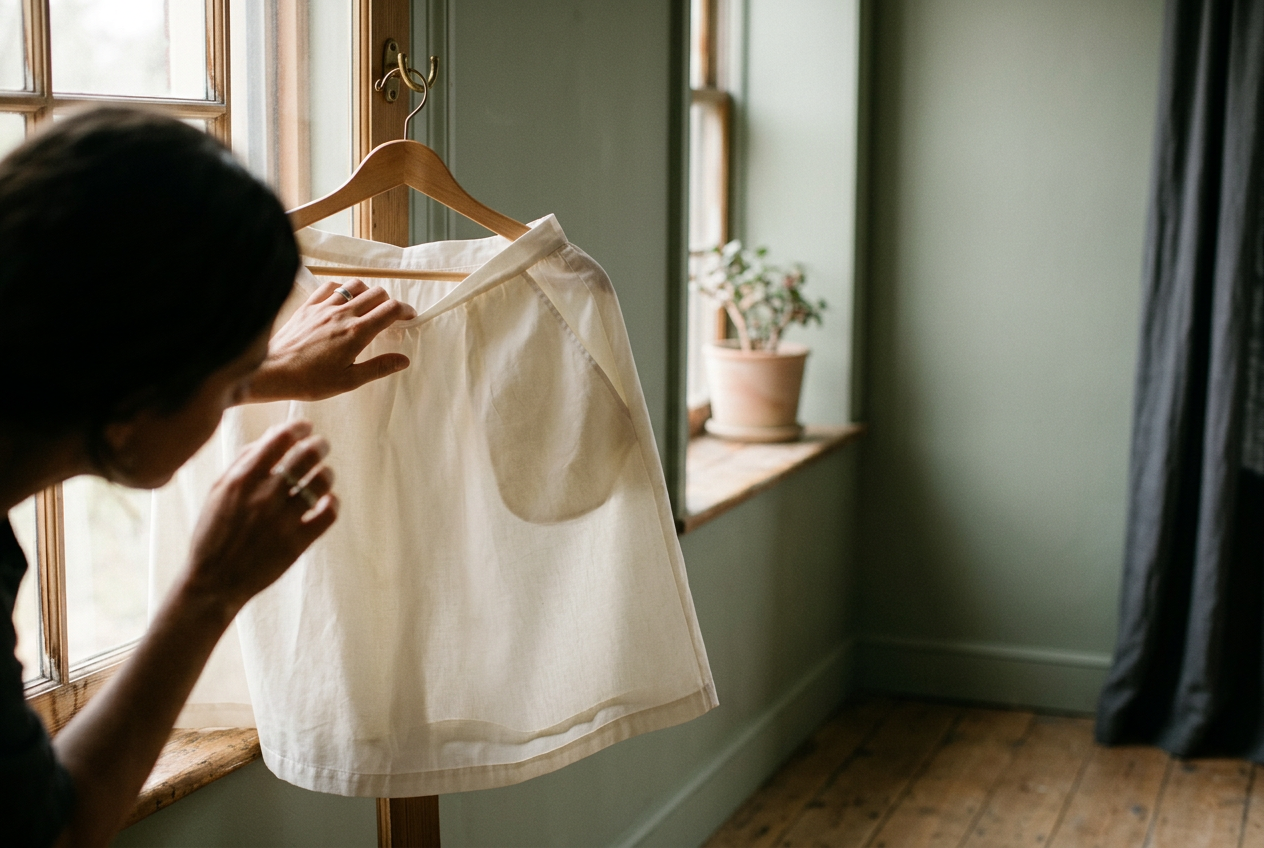
The skirt that prompted this guide was an ankle-length white cotton-poplin style with a gathered waist, side-seam pockets and an attached white polyester lining that stopped above the knee. In the fitting-room mirror, the body looked solid enough over taupe briefs. Beside the store window, two pale pocket shapes appeared at the hips, followed by a sharp horizontal line where the lining ended.
Outside, the problem became clearer. The white lining did not disappear under the white cotton. It made the lined section look brighter and denser than the unlined lower skirt, while the pocket fabric created another layer of white at each hip. Nothing was fully exposed, but the construction was visible before the silhouette was.
That distinction matters. A white skirt can cover the body while still showing every internal layer, and the effect often reads less like intentional sheerness than an unfinished opacity check. This is women's coverage, although the testing method applies to any pale garment built with lining or pockets.
Start with the care label and the inside
Before holding a skirt to the light, turn part of it inside out and read the fiber label. Cotton poplin often looks crisp and substantial on a hanger, yet a fine weave can transmit more light than its hand suggests. Linen has visible variation by nature. Polyester may be thin but less airy, while viscose can drape close enough to outline what sits underneath.
Fiber content does not deliver a verdict. It tells you what behavior to investigate.
On the cotton-poplin test skirt, the outer layer felt firm between two fingers, which made it seem safer than a floaty fabric. The lining was slick, lightweight polyester. That combination reduced direct underwear show-through above the knee, but the difference in texture and density created the bright lined block that became obvious outside.
Look next at where the lining begins and ends. A lining attached at the waistband may stop high on the thigh, at the knee or close to the hem; the higher and straighter its edge, the more likely it is to produce a visible horizontal cutoff under a translucent shell. A curved or loose lining edge can still show, but it tends to look less severe than a taut band crossing the leg.
Use the window before the fitting-room mirror
Fitting-room lighting usually falls from above, and a skirt hanging in soft folds can look more opaque because those folds overlap. Natural light travels through the fabric differently, especially when the wearer stands between a window and the viewer.
Put on the skirt with the underwear you would realistically wear. For the first pass, choose a smooth, skin-adjacent shade rather than bright white; skin-adjacent means close enough to your own coloring that it does not create a hard boundary beneath the garment. The shade need not be an exact match. Low contrast matters more than a perfect color name.
Stand several feet from a window, first facing it and then turning so the window is behind you. Keep a little distance from the glass. Direct sun can exaggerate every fabric weakness, but even broad, indirect daylight will reveal a lining edge or pocket outline that overhead bulbs suppress.
Now move. Take a normal stride, sit briefly if the fitting area allows it and smooth the skirt only once. Fabric becomes more revealing when it stretches across the seat or separates around the legs, so a still front-facing pose gives the garment its easiest possible test rather than the conditions in which it will be worn.
The cotton-poplin skirt passed while facing the window. With the light behind it, the lower unlined section became visibly lighter around the legs, and the white lining formed an opaque panel above. That was useful information, not an automatic rejection: the skirt could work with a longer slip, but it was not a dependable pull-on-and-go purchase in its original construction.
White lining can increase the contrast
It seems logical that a white skirt should have white lining. Under certain fabrics, that choice creates more contrast than a muted beige, brown or other skin-adjacent tone would.
White lining reflects light through the outer layer, making the lined area appear brighter. Where the lining stops, the skirt returns to the color influenced by skin and shadow beneath it. The eye catches the border between those zones, particularly on a straight skirt where the fabric lies close to the body.
A skin-adjacent lining works differently. It reduces the color break between the covered body and the surrounding fabric, which can help the outer white read as one continuous surface. It will not rescue a gauzy skirt or conceal strongly colored underwear, and a lining much lighter or darker than the wearer may introduce its own contrast.
If a store carries the skirt in more than one light color, compare the interiors. Otherwise, bring a thin camisole or scarf in a skin-adjacent shade and place a single layer behind the outer fabric near the hem, then compare that patch with the white-lined area. Do not bunch the test fabric, since multiple layers produce an unrealistically opaque result.
A separate half-slip offers the most practical alternative when the skirt itself fits well. Choose one long enough to extend beyond the attached lining but short enough to remain hidden during a stride. A slip adds cost, warmth and another waistband, so it is a reasonable fix for a skirt with excellent cut or fabric, not a duty every inexpensive white skirt deserves.
Inspect the pockets as their own opacity test
Pocket bags, meaning the fabric pieces that form the pocket inside a garment, commonly show through white skirts as rounded or rectangular patches. They may be cut from the main fabric, a lighter lining material or a sturdier cotton that becomes the most opaque area on the garment.
Place one hand inside the pocket and the other behind the skirt body. If the pocket area looks brighter before either hand is visible, the pocket bag is already affecting the color. Then let the skirt hang naturally and view it from several feet away, because a shape that seems minor at arm's length can dominate the hip line from conversational distance.
On the test skirt, the pocket bags were white and doubled back near the side seams. That created four layers in small areas where the folded pocket met the outer shell, so the hips showed pale angular marks even though the center front looked even. Removing the pockets would have reduced the contrast, but paying for an alteration to correct a new garment's basic construction did not feel worthwhile.
Pocket placement also changes fit. A gathered or elasticized waist can push the bags forward, while a close hip may pull them open and make their outlines more pronounced. Try the size you expect to buy, then one size up if the waistband permits it; if the pockets become less visible in the larger size, tension is contributing to the problem rather than fabric alone.
Do not size up automatically. Excess fabric can add folds without solving the white-on-white contrast, and a loose waist may require alteration. The useful result is knowing whether the failure belongs to fit or construction.
Read the seams before they read through
A seam allowance is the strip of fabric inside a garment between the stitched seam and its cut edge. Because it adds another layer, it can appear as a bright vertical stripe under white cloth even when the seam itself lies flat.
Check the center back, side seams and any tier joins from the outside while light passes through the skirt. Wide allowances create broader stripes. Allowances that are unevenly trimmed can leave wavering lines, and overlocked edges may cast a narrow textured shadow if the outer fabric is fine.
The test skirt's side seams became more noticeable below the lining, where there was no second full layer to balance them. This is why judging only the front panel misses part of the decision: the main cloth may be adequate while its layered construction creates a map of every join.
Minor seam visibility is normal in very light colors. The decision point is whether your eye lands on the skirt's line or on the internal construction first. If the seam allowances and pockets announce themselves in ordinary indirect daylight, styling will not make them disappear.
Make the final test with a phone camera
A phone camera can sharpen contrast, but it should confirm what the eye sees rather than act as the only judge. Ask a companion to take an unfiltered photo from the front and back near a window, or use a timer where store policy allows. Keep the exposure at its default setting and avoid portrait mode, which can blur garment edges.
Review the image at normal size. Zooming in until individual threads appear turns a practical clothing decision into a forensic exercise. Look for the lining cutoff, bright pocket shapes and dark underwear edges during movement. A short video of one turn is often more revealing than a posed photograph because the skirt shifts away from the body and lets light through.
For the cotton-poplin skirt, the video settled the choice. The lower panel flashed translucent with each step while the pocket bags remained fixed, making the internal shapes more obvious in motion. A full-length skin-adjacent slip corrected most of the contrast during a second test, but it also removed some airflow and added a waistband under the gathered waist.
That tradeoff was the answer: workable with an extra layer, unreliable without one.
A dependable buying threshold
A white skirt does not need to behave like denim. Some light transmission can look deliberate, especially with lace, voile or loosely woven linen. The useful threshold is whether the garment works with the underwear and layering effort you are willing to repeat.
For a daily cotton skirt, I would require even color across the pocket area, no hard lining cutoff and enough coverage for an ordinary outdoor walk in indirect daylight. A vacation cover-up can pass with much less. An evening skirt may earn a separate slip if its cut is difficult to replace.
If the store has no useful window, confirm the return policy and repeat the test at home before removing tags. Stand near an open doorway or shaded window, then walk past it while recording from several feet away. The check takes minutes. Altering pockets or buying a better slip takes more money and attention, which should be part of the purchase decision rather than a surprise after the first sunny wear.
Questions people ask
What color underwear works best under a white skirt?
Choose smooth underwear in a shade close to your skin rather than bright white, which can create a visible high-contrast shape. Red sometimes disappears under white on particular skin tones and fabrics, but it is not a universal rule. Test the exact pairing in daylight because fabric thickness and undertone change the result.
Does a lined white skirt still need a slip?
It may if the attached lining ends high, contrasts with your skin or leaves visible pocket shapes below it. A longer skin-adjacent slip can even out the appearance, though it adds warmth and another waistband. Test the slip during a stride so its hem does not appear through the outer skirt.
Can a tailor fix visible pockets in a white skirt?
A tailor may remove the pocket bags, replace them with a less contrasting fabric or reshape them, depending on how the side seams and waistband are built. Ask whether the pocket opening will remain stable afterward. The alteration makes most sense when the skirt's fit and fabric justify spending beyond the purchase price.
How much sheerness is acceptable in daylight?
The practical limit depends on the skirt's job. For everyday wear, the lining edge, underwear boundaries and pocket shapes should not become the first visible details during a normal outdoor walk. For an intentionally sheer skirt, judge whether the underlayer looks deliberate and stays in position rather than demanding constant adjustment.
One update a day
Today's fashion update, in your inbox
One fashion update each morning — no hype, no filler, just pieces worth wearing.